Uchiyama Eikyū-ji: A Buddhist Temple and Former Monastic Complex in Japan


Site at a Glance
- Rating
- 3.7
- Popularity
- Low
- Country
- Japan
- Primary era
- Medieval
- Eras represented
- Medieval
- Civilizations
- Unclassified
- Site type
- Religious
- Remains
- Monastery
On this page11 sections
History
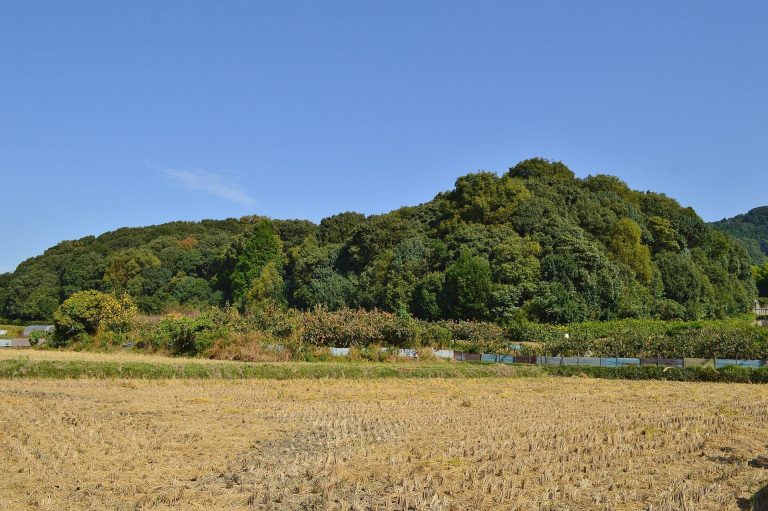
Uchiyama Eikyū-ji was a Buddhist temple in Tenri, Japan, traditionally established between 1113 and 1118 under the patronage of Emperor Toba. Known as Uchiyama because mountains surrounded it on three sides, the temple was also called Kongojo-in and had Amida Buddha as its principal image. Its foundation marked the beginning of a long institutional connection with Kofuku-ji’s Daijo-in, one of the powerful aristocratic monastic complexes associated with the major Buddhist temple Kofuku-ji in Nara.
Foundation and development
Temple foundation documents attribute the establishment of Uchiyama Eikyū-ji to Raijitsu, the second head of Daijo-in. Construction and institutional development continued under Jinpan, the third head of Daijo-in and a son of the former Grand Chancellor Fujiwara no Morozane. Another record treats Raijitsu and Jinpan together as the founders and indicates that Jinpan inherited Raijitsu’s mountain retreat. These traditions place the temple’s origins within the religious and aristocratic networks of the late Heian period.
A Shingon hall was built in 1136, followed by an octagonal tahoto pagoda in 1137. Shingon Buddhism is an esoteric tradition centered on ritual, mandalas, sacred texts, and devotional images. As the institution expanded, it acquired numerous halls, monastic residences, and supporting facilities. Its religious complex included a Kichijo hall, Kannon hall, Jozon-in, Mieido, a sutra repository, belfry, bathhouse, and shrines dedicated to four tutelary deities and to Tamagaki.
Institutional power in the medieval period
From its beginning, Uchiyama Eikyū-ji functioned as a subordinate temple of Daijo-in. It also became the shrine-temple of Isonokami Shrine as Buddhist-Shinto syncretism developed. This was the historical combining of Buddhist institutions and practices with the worship of Shinto deities. With the authority of Daijo-in behind it, the temple possessed considerable power during the Muromachi period.
The Taiheiki records that Emperor Go-Daigo took temporary refuge at Uchiyama Eikyū-ji in 1336. Go-Daigo was associated with the Kenmu Restoration, an attempt to restore direct imperial rule in fourteenth-century Japan. A place known as the Kayano Gosho site was later commemorated within the temple precinct, preserving the memory of the emperor’s stay.
Expansion and early-modern transformation
By 1585, Uchiyama Eikyū-ji had 56 associated monastic complexes and subtemples. In 1595 Toyotomi Hideyoshi granted it an estate producing 971 koku of rice, and this landed income continued through the early-modern period. The estate provided an enduring economic foundation for the extensive institution.
During the early-modern period, Uenoin, one of the temple’s monastic complexes, became the seat of the temple head. It separated from Kofuku-ji’s direct control while adopting the Shingon affiliation. Uchiyama Eikyū-ji was ranked after Todaiji, Kofuku-ji, and Horyu-ji among the great temples of Yamato Province. Its scale and magnificence gave rise to the nickname “the Nikko of the West.” The late-Edo Yamato-e painter Reizei Tamechika was staying at the temple shortly before his assassination.
Destruction after the Meiji separation
The temple’s institutional foundation collapsed after the 1868 separation of Buddhism and Shinto. This early Meiji anti-Buddhist movement, often called Haibutsu-kishaku, involved the separation, confiscation, destruction, and dispersal of Buddhist institutions and objects. The twenty-eighth abbot, Uenoin Ryōchin, returned to secular life, took the name Fujiwara Ryōchin, and became a priest of Furu Shrine.
Ryōchin applied to convert the temple grounds into shrine land, explaining that he wished to prevent confusion between Buddhist and Shinto institutions. He also sought to relocate and preserve the temple, but the request was rejected. The temple estate was confiscated, removing its economic foundation. Uchiyama Eikyū-ji was abolished, while its remaining monks entered secular or Shinto service, with many becoming priests of Isonokami Shrine.
The ownerless buildings were offered at auction but found no buyers, and they were largely dismantled. The destruction was unusually thorough for a monastery of this scale. One interpretation holds that the institution collapsed internally as well as under external pressure, because Ryōchin, who headed the economically powerful Uenoin and may have sympathized with the cause of imperial restoration, appears to have controlled temple affairs to an exceptional degree. Another account states that the monks themselves announced their return to secular life and that the principal image was destroyed before officials.
Local residents later destroyed or looted buildings and treasures. Acting on official orders, the Nakayama family temporarily took custody of Buddhist images and paintings, but by 1876 most of the temple’s treasures, including images, paintings, and scriptures, had been lost. Some objects went abroad. The Eight Patriarchs of Shingon painting attributed to Shinzen, acquired by the Museum of Ethnology in Berlin, was destroyed during the battle for Berlin at the end of the Second World War. Many surviving objects in Japan later received National Treasure or Important Cultural Property status, designations for cultural objects and structures judged to possess especially high historical, artistic, or cultural value.
Later history and commemoration
The former temple was not rebuilt after the anti-Buddhist destruction. Its dependence on Kofuku-ji may have protected it institutionally in earlier centuries while weakening its ties with the surrounding community, reducing local support for reconstruction. The surviving buildings were allowed to decay, and the main sanctuary of the former Sumiyoshi Shrine, which had served as the temple’s guardian shrine, burned in an arson attack in 1890.
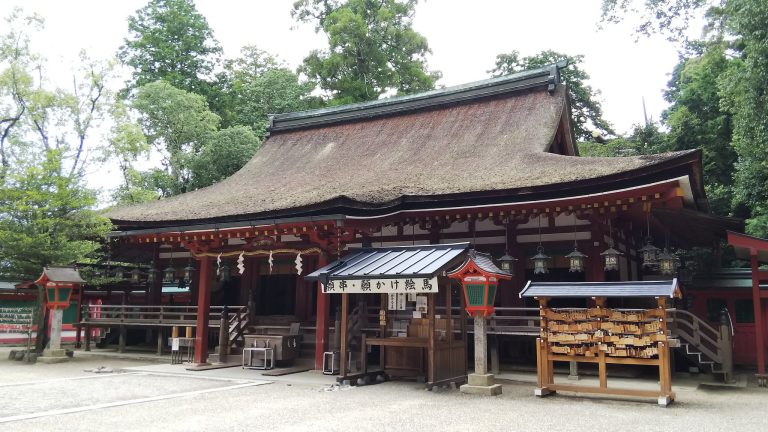
In 1914, the remaining worship hall of the former shrine was transferred to Isonokami Shrine. It became the worship hall of Izumo Takeo Shrine, a subsidiary shrine venerating the spirit of the Kusanagi sword. In the same year, wataka fish from the temple pond were moved to the Mirror Pond at Isonokami Shrine and to the Mirror Pond in front of Todaiji’s central gate. These populations are now natural monuments of Nara Prefecture.
The former temple site lies south of Isonokami Shrine along the Yamanobe-no-Michi. In 2013, the Tenri University Historical Society produced a reconstruction diorama of the complex. It was displayed at Tenri City Hall for one year and is now held by the university. The temple reached its nine-hundredth anniversary in 2014.
Remains
Pond garden and former precinct
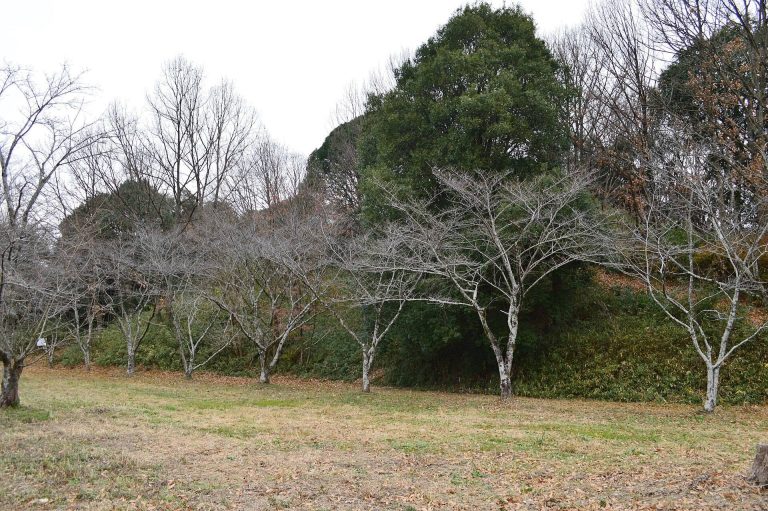
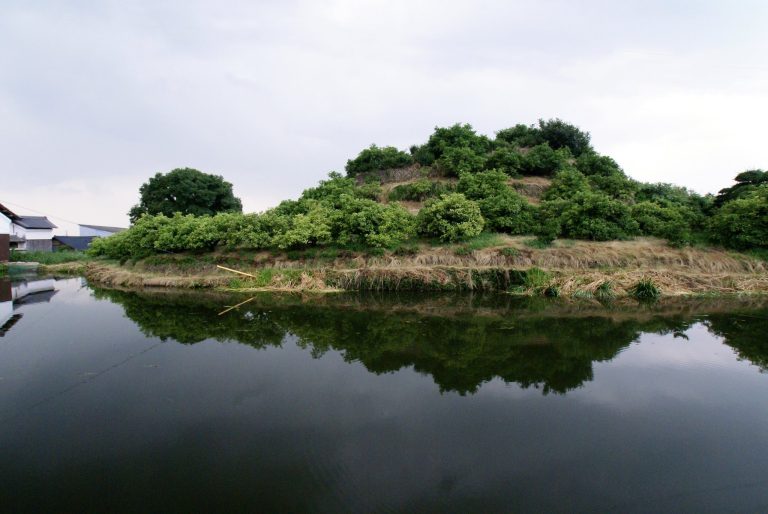
Uchiyama Eikyū-ji was organized around a pond in a Jodo-style strolling garden. A Jodo-style garden is a Buddhist paradise garden centered on a pond, while a strolling garden is arranged for movement along paths through changing views. The pond, known as the Main Hall Pond, is the principal surviving remnant of this landscape. The medieval and early-modern precinct placed the main hall, Kannon hall, octagonal tahoto pagoda, Dainichi hall, abbot’s quarters, guardian shrine, and numerous monastic complexes and subtemples around the pond. Earlier records also identify the Shingon hall, Mieido, sutra repository, belfry, bathhouse, Kichijo hall, Jozon-in, and several shrines as parts of the wider complex.
Relocated shrine architecture
The former Sumiyoshi Shrine worship hall was built in the fourteenth century. After the shrine’s main sanctuary burned in 1890, the surviving worship hall deteriorated before its transfer in 1914 to Isonokami Shrine. There it became the worship hall of Izumo Takeo Shrine and survives as a divided worship hall. Its relocation preserves a building that once occupied the guardian-shrine position within the former temple complex.
Paintings and ritual images
Several important works formerly belonged to the temple’s halls. The Illustrated Narrative of the Two Great Esoteric Sutras was associated with the fittings of the altar in the Shingon hall and is now held by the Fujita Museum in Osaka. It presents legends about the transmission of the Mahavairocana Sutra and Vajrasekhara Sutra, the canonical sources for the Womb Realm and Diamond Realm mandalas. Its monumental landscapes, soft outlines, and balanced colors reflect the characteristics of Heian-period Yamato-e.
The Illustrated Lives of the Eight Patriarchs of Shingon was formerly a sliding-door painting in the Shingon hall and is now held by the Idemitsu Museum of Arts. Wooden standing figures of Jikokuten and Tamonten are held by Todaiji in Nara. The wooden figures of the attendants of the Four Heavenly Kings are divided among the Tokyo National Museum, the Seikado Bunko Art Museum, and the MOA Museum of Art. They were made by Kōen, a grandson of the sculptor Unkei, and are rare examples of this subject.
Wooden images of Fudo Myoo and the Eight Great Youth Attendants are held by Setagaya Kannon-ji in Tokyo. Kōen made these figures as well, and they passed through the collection of Nakano Chutaro, a collector from Niigata, before reaching their present institution. The seated image of Aizen Myoo is held by the Tokyo National Museum. This wooden polychrome image retains its original decoration, including glass beads, while its shrine cabinet contains polychrome paintings of other deities. Both survive in good condition from their creation in the late Kamakura period.
Markers and memorials
The former site retains a stone marker identifying the Kayano Gosho remains, a monument inscribed with a verse attributed to Matsuo Basho, and memorial towers commemorating successive abbots. Basho was a major seventeenth-century Japanese haiku poet. These surviving markers and memorial structures, together with the Main Hall Pond, preserve the location and selected associations of a temple whose buildings and treasures were dispersed after its abolition.