Higashinorikura Kofun: A Sixth-Century Keyhole Burial Mound in Japan
Site at a Glance
- Rating
- 4
- Popularity
- Very Low
- Country
- Japan
- Primary era
- Medieval
- External website
- Open
- Eras represented
- Medieval
- Civilizations
- Yamato
- Site type
- Burial
- Remains
- Burial Mound
On this page6 sections
History
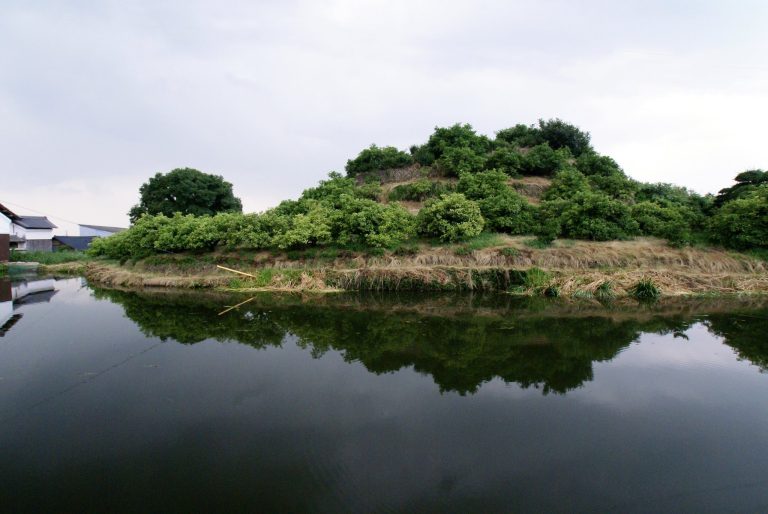
Higashinorikura Kofun is a burial mound in Tenri, Nara Prefecture, Japan, built during the first half of the sixth century in the early part of the late Kofun period. The Kofun period was Japan’s prehistoric era of large burial mounds, conventionally dated from about the third to the seventh century. The mound occupies the Higashinorikura area of Somanouchi Town and the Kitayama area of Otogi Town, where it forms part of the Somanouchi Kofun Group.
The Somanouchi Kofun Group
Higashinorikura Kofun stands among Nishinorikura Kofun, Obaka Kofun, and other burial mounds in the surrounding area. These mounds date from the end of the middle Kofun period through the early late Kofun period. Some scholars have interpreted Nishinorikura, Obaka, and Higashinorikura as burial places associated with chiefs of the Mononobe clan. The Mononobe were a powerful ancient Japanese clan traditionally linked with military authority and, in later accounts, with the defense of indigenous religious practices.
Early records and archaeological investigation
The mound was illustrated in the 1893 Survey of Ancient Tombs and Burials in Yamato, which included abbreviated drawings of its stone chamber and stone coffins. Sato Kokichi investigated the site in 1913. The Nara Prefectural Archaeological Institute of Kashihara examined the western side of the mound in fiscal year 1981. Tenri University and the Tenri Municipal Board of Education have continued surveying and excavating the site from 2018 onward. This work revised the recorded mound length from 75 metres to 83 metres.
Remains
Mound and moat
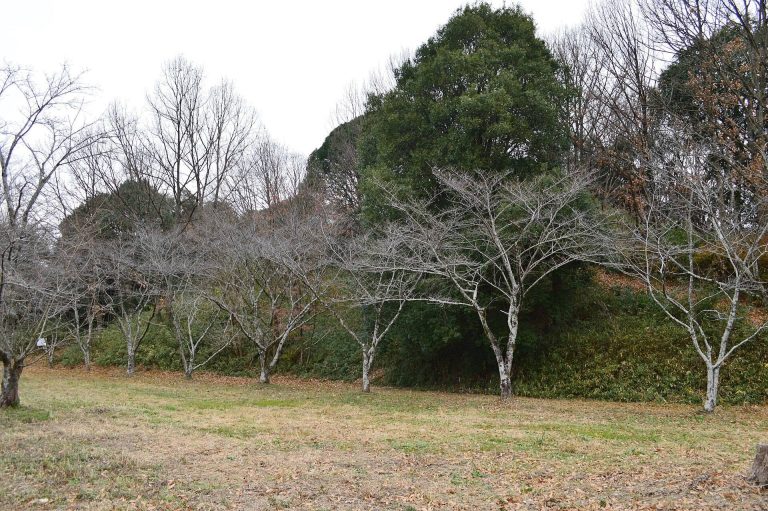
Higashinorikura Kofun is a two-tiered, keyhole-shaped mound built on a ridge extending westward from the eastern edge of the Nara Basin. A keyhole-shaped mound combines a circular rear section with a projecting square front. At Higashinorikura, the square-front section is strongly enlarged and faces west-northwest. The mound is approximately 83 metres long. Along the western side of the front section, an identified moat measures about 10 metres across and 2 metres deep. Fragments of cylindrical haniwa, fired clay objects placed on or around burial mounds, were found on the mound’s outer surface.
Horizontal stone chamber
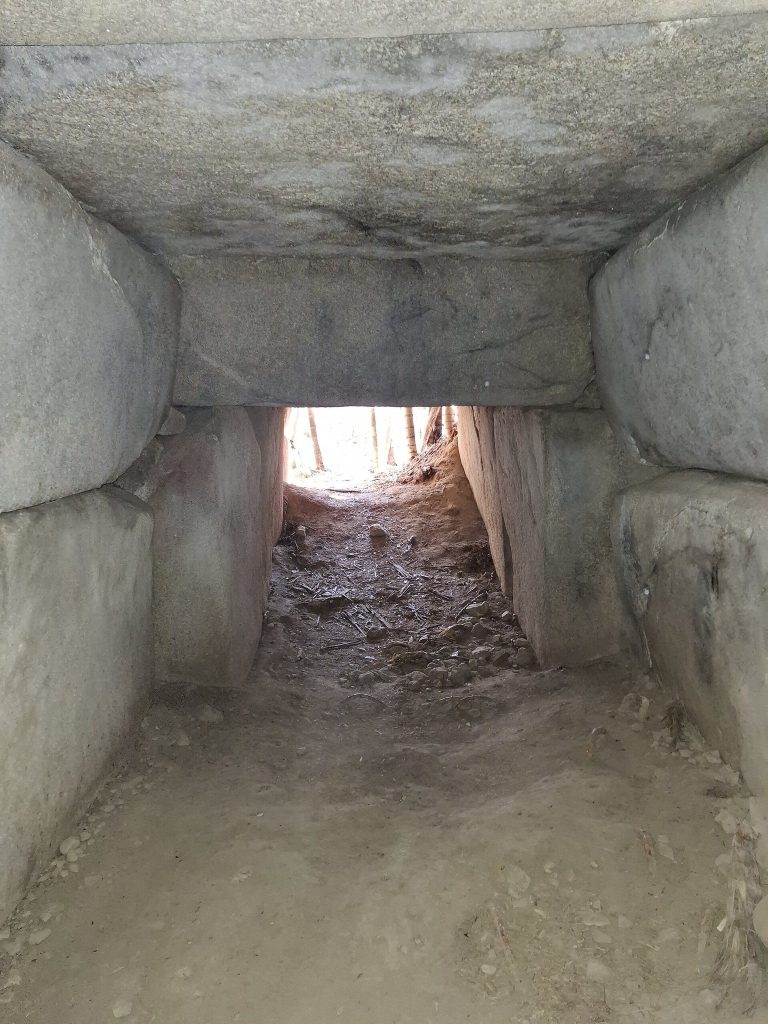
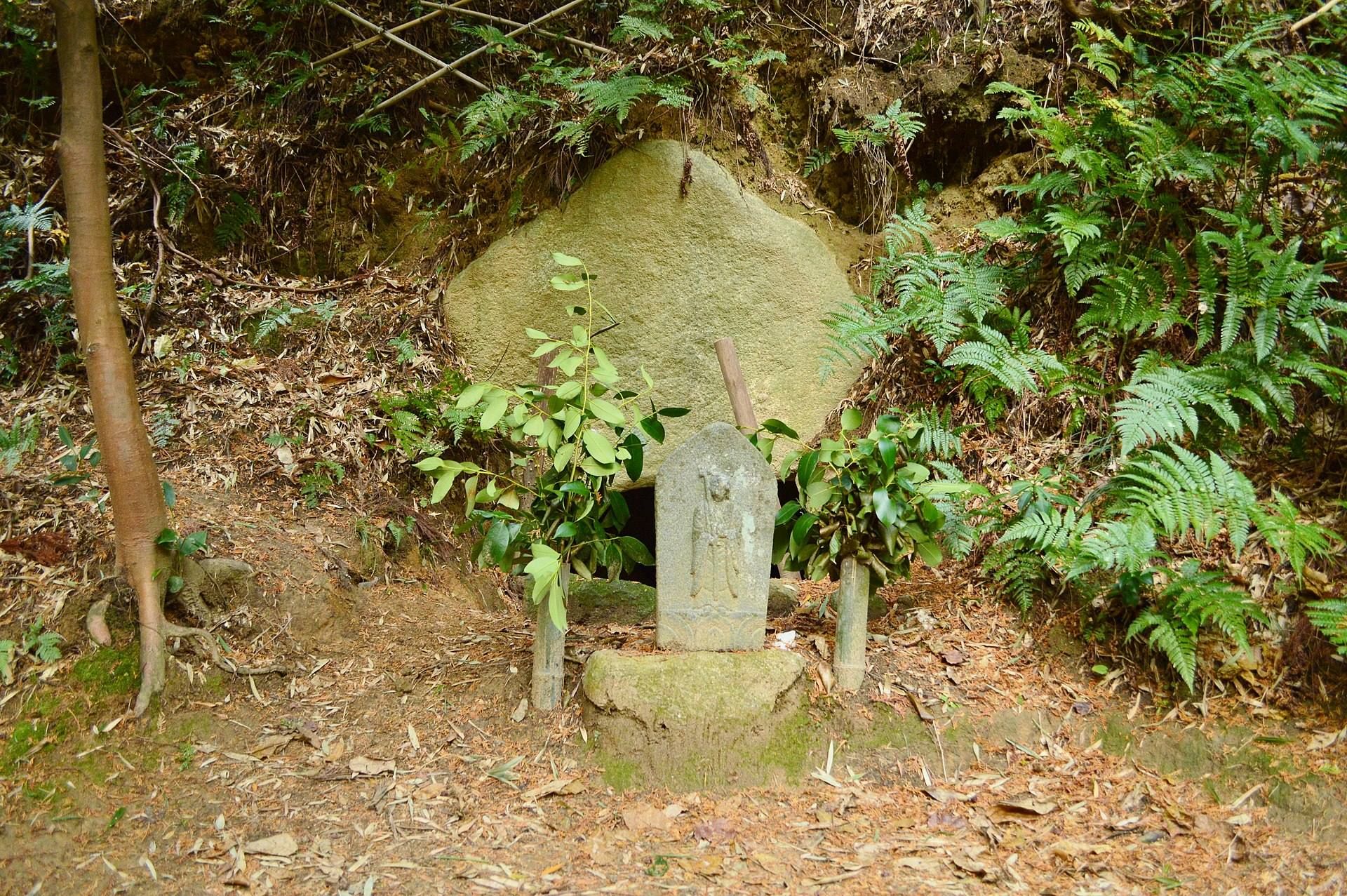
The rear circular section contains a large horizontal stone chamber, a burial room entered through a side passage rather than through a vertical shaft. It is a single-shouldered design, meaning that the passage joins the main chamber asymmetrically, with a projecting shoulder on one side. The chamber opens to the south and measures 14.6 metres overall. The main chamber is about 7.6 metres long, 2.4 metres wide, and currently 3.3 metres high, while the passage is approximately 7 metres long, 1.7 metres wide, and currently 1.5 metres high. Enormous natural granite stones form the structure, and its rear wall has three courses of masonry.
One carved-out, house-shaped stone coffin stands near the rear wall. It is made from Aso welded tuff, a volcanic stone also known as Aso pink stone or Mamon stone. Its lid has a relatively narrow, flat upper surface, an early characteristic, and includes carved projections for hanging ropes. A second assembled, house-shaped coffin made from white tuff from Mount Nijo lies near the passage, although only its base stone remains. The chamber was robbed. Small plates from lamellar armor and ornaments from horse harnesses were recovered as burial goods, but their present whereabouts are unknown.