Kotohiki Hachimangū: A Hachiman Shrine in Kan’onji, Japan


Site at a Glance
- Rating
- 4.2
- Popularity
- Low
- Country
- Japan
- Primary era
- Early Modern
- External website
- Open
- Eras represented
- Medieval, Early Modern
- Civilizations
- Ashikaga shogunate, Kamakura shogunate, Tokugawa, Yamato
- Site type
- Religious
- Remains
- Sanctuary
On this page17 sections
History
Kotohiki Hachimangū is a Hachiman shrine in Kan’onji, Japan, founded in 703 on Mount Kotohiki. Hachiman, a Japanese war-associated deity whose worship became closely connected with the imperial house and warrior families, is enshrined here with Emperor Ōjin, Empress Jingū, and Tamayori-bime. The shrine developed as part of a combined Shinto and Buddhist religious complex and became an imperial prayer site supported by rulers, military leaders, and local authorities.
Foundation traditions
The shrine’s best-known foundation legend tells of three days of darkness, followed by the arrival of a mysterious boat on the shore below Mount Kotohiki. Music from a koto, a Japanese zither, came from the vessel. The monk Nisshō approached and heard Hachiman identify himself as a deity who had come from Usa to protect the imperial house. Local residents then carried the sacred boat and its instrument to the mountaintop, where they built a shrine. The name Kotohiki, meaning “koto playing,” derives from this story.
The legend was written down about seven centuries after the shrine’s foundation in the Sanuki-no-kuni Shippōzan Hachiman Kotobikigū Engi, completed in 1416 by the court official Fujiwara no Saneaki. The document bears the official title and seal of the shogun Ashikaga Yoshimochi and is designated an Important Cultural Property of Kan’onji City.
A second foundation tradition presents a more formal account. In 703, Emperor Monmu is said to have ordered Nisshō to transfer and enshrine Hachiman from Usa Hachimangū. Nisshō established Kanneon-in as a jingūji, a Buddhist temple attached to a Shinto shrine, and founded Hōkō-in as a place of study for the Hossō school, a Buddhist tradition focused on the analysis of consciousness.
The Kannonji religious complex
After returning from China, the monk Kūkai, also known as Kōbō Daishi, was traditionally said to have stayed in the area and become Kanneon-in’s seventh abbot in 812. He replaced Hossō practice with Shingon Buddhism, the esoteric Buddhist tradition he established in Japan, and enshrined a statue of Avalokiteshvara, the Buddhist bodhisattva of compassion, which he was said to have carved. The complex then developed as Shippōzan Kannonji.
Kannonji was said to have flourished with numerous monks’ residences and subtemples. Kanneon-in served as its bettōji, the administrative temple responsible for maintaining and managing the shrine. This arrangement reflected the long-standing combination of Buddhist and Shinto institutions in medieval Japan.
Imperial and warrior patronage
Kotohiki Hachimangū received devotion from the imperial household and prominent military leaders. Prayers, offerings, donations, and official rituals were conducted there over many centuries. In 888, Sugawara no Michizane visited while serving as governor of Sanuki to pray for rain.
The shrine was also closely connected with the Minamoto clan. In 1051, before Minamoto no Yoshiie and his father Minamoto no Yoriyoshi left for the Nine Years’ War in Mutsu, Yoriyoshi sent Mitsutsuna, governor of Izu, to present a prayer text requesting victory. Minamoto no Yoshimitsu later donated a sacred horse and its equipment, while Yoshiie subsequently rebuilt the main sanctuary.
Further Minamoto offerings followed. In 1083, a representative of Yoshiie visited to pray for lasting military success. In 1095, Yoshiie constructed shrine buildings, and Yoshimitsu visited and donated 100 koku of rice, curtains, and other offerings. A koku was a historical measure of rice used in assessing land and revenue. In 1125, a representative of Minamoto no Tameyoshi presented 20 koku of rice and brocade scrolls.
In 1185, Minamoto no Yoshitsune visited before the decisive confrontation with the Taira, a rival military house, and read a victory prayer before the main sanctuary. He offered a sacred horse named Mochizuki and a wooden torii. After defeating the Taira at Yashima, Yoshitsune is traditionally said to have established a camp extending from Mount Kotohiki to the mouth of the Zaita River while waiting for naval support to pursue the Taira westward.
That year, Minamoto no Yoritomo donated land in Bitchū Province, valued at 1,000 kanmon, as an endowment for rice offerings. In 1213, the shrine received a formal imperial plaque, and in 1267 it conducted prayers for the safety of the realm under an imperial proclamation. Emperor Go-Yōzei later donated a handwritten inscription of the title “Hachiman Daibosatsu.” Following that gift, the shrine was made an imperial prayer site, although the date of the donation is not specified.
Rebuilding and early modern changes
In 1551, Hosokawa Ujiyori, lord of Tsukumo-yama Castle, rebuilt the shrine buildings and donated a 500-koku estate. In 1585, Sengoku Hidehisa, lord of Sanuki, visited and donated a 50-koku estate and a sword. These gifts continued the pattern of military patronage that had shaped the shrine’s history since the medieval period.
The shrine buildings were rebuilt again in 1745 by Kyōgoku Takanori, lord of Marugame. Earlier, in 1653, Yamazaki Haruyori, also lord of Marugame, had donated a stone torii. A pilgrimage guide from 1687 lists Kotohiki Hachimangū as the sixty-eighth station of the Shikoku pilgrimage, with Kannonji as the sixty-ninth.
The Meiji government’s nineteenth-century separation of Buddhism and Shinto dismantled the long-standing combination of the two traditions and required shrines and temples to operate as separate institutions. During this process, the shrine was renamed Kotohiki Shrine and separated from the pilgrimage institution. Kanneon-in became the sixty-eighth station, leaving two pilgrimage stations within one precinct. After the Second World War, the shrine resumed the name Kotohiki Hachimangū.
Continuing religious traditions
Kotohiki Hachimangū remains affiliated with Shinto and is associated with the New Shikoku Mandala Pilgrimage and the Sanuki Fifteen Shrines pilgrimage. Its annual Grand Festival continues the shrine’s festival tradition, with nine chōsa, large decorated festival drum stands, offered during the event.
Remains
Mountain approach and precinct layout
Kotohiki Hachimangū occupies the summit of Mount Kotohiki in Kan’onji, within Kotohiki Park, part of Setonaikai National Park. The approach crosses the Zaita River, formerly called the Some River, before entering the precinct. Mount Kotohiki overlooks the Hiuchi-nada, while the mouth of the Zaita River has calm shore waters. These physical conditions were regarded as suitable for the naval base associated with the traditional account of Yoshitsune’s campaign.
Entrance structures
A stone pillar at the approach carries a calligraphic inscription by former Prime Minister Masayoshi Ohira. The first major torii is bronze and marks the entrance to the precinct. Farther on, the second torii is made of stone and was donated by Yamazaki Haruyori in 1653. Its pillars rise 7.2 metres. Beyond it are the guardian gate and a flight of 381 stone steps leading toward the main sanctuary.
Lower and middle precinct shrines
Sanae-zuka, a mound or monument in the lower precinct, was established in 1774 and repaired in 1839. Along the ascent are Kashima Shrine, dedicated to Takemikazuchi no Mikoto, and Funadama Shrine. A third stone torii also stands on the ascent. In the lower and middle precinct are Inari Shrine, dedicated to Ukanomitama no Mikoto, and Suga Shrine, dedicated to Susanoo-no-Mikoto. Miyasaka Tenjin, dedicated to Sugawara no Michizane, stands to the left of the approach.
Upper approach and associated shrines
Torii and boundary markers
Kora Shrine, dedicated to Kora Tamatare no Kami, stands beside Matsudō Shrine, dedicated to Maneko no Mikoto. The fourth torii is wooden and is traditionally attributed to Minamoto no Yoshitsune. Its severe deterioration has led to the construction of a protective roof over it. Farther up the precinct are a stone crown-beam gate and a stone shimeishi, a boundary marker defining sacred space.
Shrines on the upper precinct
Kazeno Shrine stands to the right of the upper approach and is dedicated to the wind deities Shinatsuhiko and Shinatsuhime. Gosho Shrine stands to the left and is dedicated to Amaterasu, Ame-no-Futotama, Ame-no-Koyane, Tajikarao, and Ame-no-Uzume. Kuratani Shrine, dedicated to Sukunabikona, also stands to the left. Beside a stone torii is Aoni Shrine, dedicated to Toyotamabime and Sukunabikona.
Rear-right shrine group
In the rear-right area are Sumiyoshi Shrine, dedicated to Sokotsuchi, Akatsuchi, and Ishitsuchi; Wakamiya Shrine, dedicated to Emperor Nintoku, Uji no Wakiiratsuko, Ure-hime, and Kure-hime; and Takeuchi Shrine, dedicated to Takeuchi no Sukune. Together with the smaller shrines along the approach, these buildings form a network of associated sacred spaces around the main sanctuary.
Main sanctuary and former Buddhist associations
Sanctuary complex
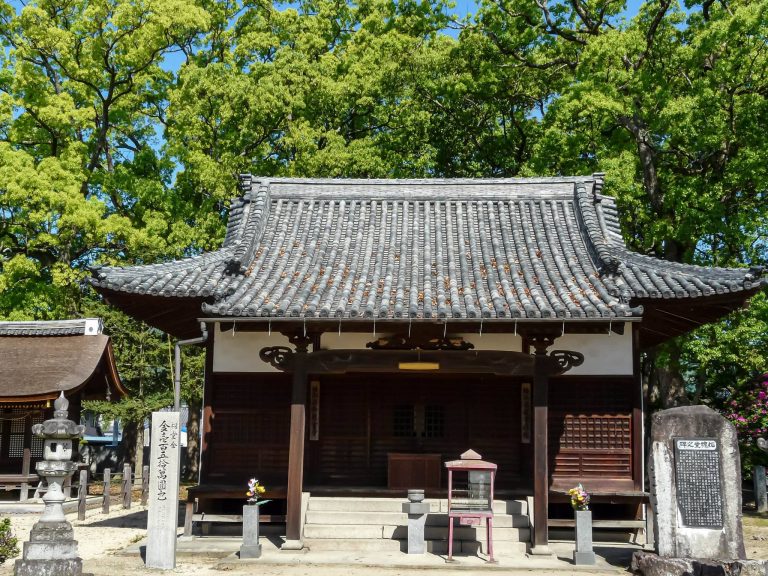
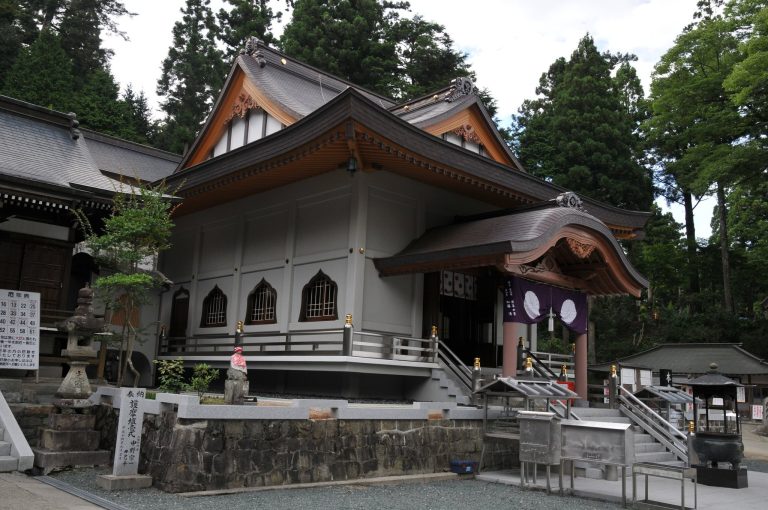
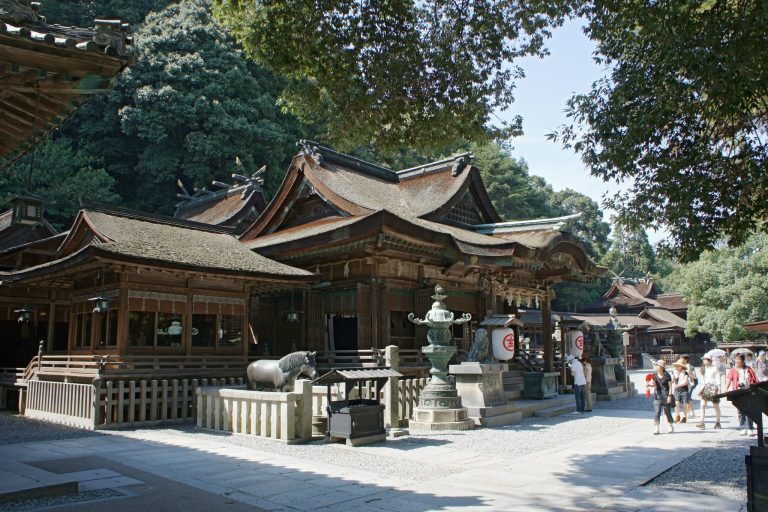
A level approach branches to the left before the final steps in front of the main sanctuary. The principal complex consists of the worship hall, offering hall, and main sanctuary. The main sanctuary follows the irimoya-zukuri style, whose roof combines hipped and gabled forms. To the right of the level approach is the votive-picture hall. To the left are a perpetual lantern, seal office, and lookout point.
Relocated Buddhist image
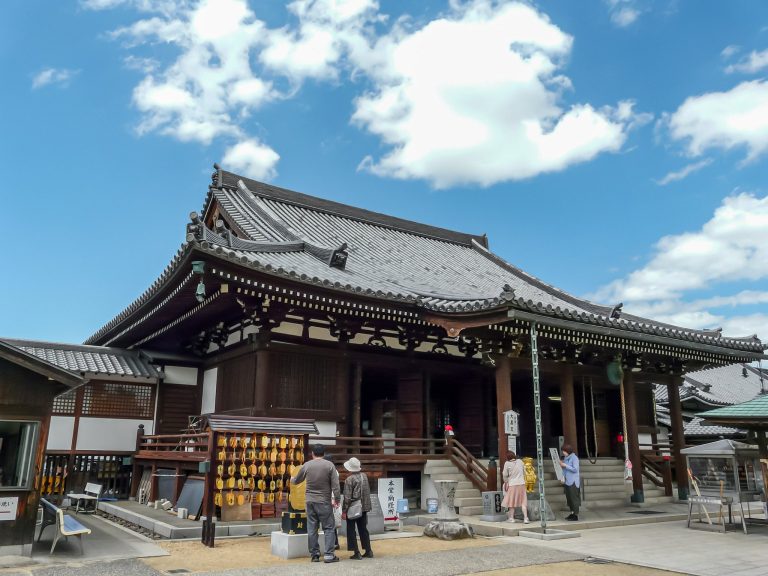
An image of Amida Nyorai was formerly regarded as the Buddhist manifestation of the shrine’s Hachiman deity. During the Meiji separation of Buddhism and Shinto, it was transferred to the west hall of Kannonji. That hall was converted into the main hall of Kanneon-in, preserving a physical connection between the shrine’s former Buddhist and Shinto institutions.