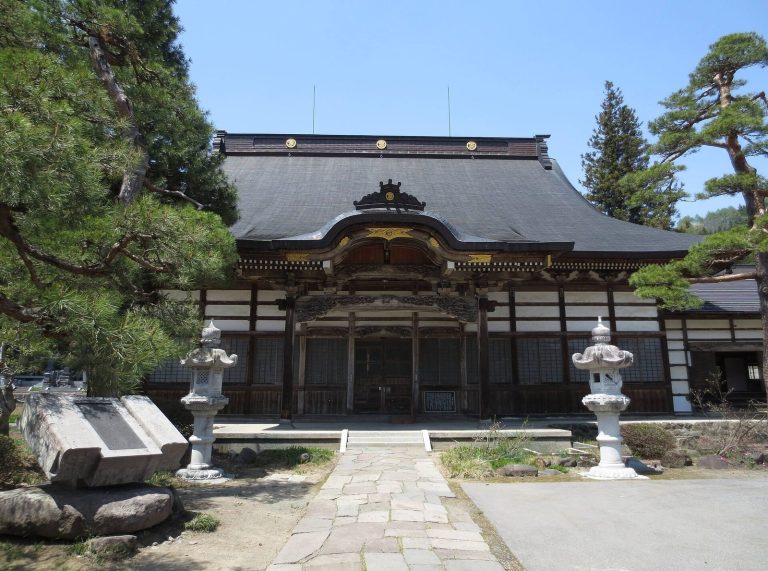
Kankei-ji Temple: A Jodo Buddhist Temple beside Zenkoji in Nagano

Site at a Glance
- Rating
- 4.4
- Popularity
- Very Low
- Country
- Japan
- Primary era
- Medieval
- Eras represented
- Medieval
- Civilizations
- Ashikaga shogunate
- Site type
- Religious
- Remains
- Temple
On this page11 sections
History
Kankei-ji Temple is a Jodo-shu temple in Nagano, Japan, founded by the Kurita family and devoted to Amida Buddha. Its main foundation tradition places its establishment in 1180, while another record gives 1496. The temple belongs to the Chinzei branch, regards Chion-in as its head temple, and stands beside Zenkoji’s eastern gate within the Zenkoji temple precinct.
Kurita foundations and relocation
The earlier tradition says that Kurita Hankaku, the betto, or administrative head, of Togakushi Mountain Kengoji founded the temple at Kurita in 1180 under the name Kuritadera. A second account names Kurita Hirotaka as founder and places the foundation in 1496. The Kurita family controlled Kurita Castle and successively held the betto office for Togakushi Kengoji and Zenkoji, giving the lineage influence from the medieval period into the Sengoku period, an era of prolonged civil warfare among regional powers.
During the Eisho era, from 1504 to 1521, a member of the Kurita family moved the temple to its present site and renamed it Kankeiji after his father, Kurita Kankei. In 1583, a monk from Sainen-ji Temple in Matsushiro was invited to the temple, and its affiliation changed from Tendai Buddhism, a tradition combining meditation, scripture, ritual, and devotion, to Jodo Buddhism.
Zenkoji connections and early modern religious life
During the Sengoku period, Kankei-ji held an established position at Zenkoji when Zenkoji’s principal image was away from the complex. In the early modern period, Kankei-ji, Saiho-ji, and Koraku-ji were respected together as the “Three Temples.” These connections placed the temple within the religious administration and ceremonial life of the Zenkoji precinct.
The temple was affected by fires in 1642 and 1668. It was later destroyed in the fire associated with the 1847 Zenkoji earthquake and rebuilt in 1883. In 1789, Tojun, the eightieth head priest of Zenkoji’s Daikanjin, moved a gate from that institution to Kankei-ji after a new gate had been built there. Tojun’s natal Sakaguchi family regarded Kankei-ji as its bodhi temple, and Tojun’s grave remains within the precincts.
Tokuhon, Issa, and changing religious institutions
In 1816, the itinerant Nembutsu preacher Tokuhon stayed at Kankei-ji from April 23 to May 7, spending thirteen nights there while traveling through Shinano. He distributed more than 20,000 slips printed with the invocation Namu Amida Butsu, the devotional recitation of Amida Buddha’s name. The haiku poet Kobayashi Issa received one of these slips and ten recitations of the Nembutsu at the temple. In connection with the encounter, Issa composed a haiku about remaining upon money even while sitting up, followed by Namu Amida and cherry blossoms.
A tradition associated with Tokuhon’s stay says that Amida Buddha appeared inside the temple one evening and stood on Tokuhon’s outstretched hand. In the early Meiji period, the wooden guardians at the Nio Gate were reportedly moved from the Nio Hall of present-day Togakushi Shrine, then called the Zuishinmon, after the separation of Buddhism and Shinto ended the long-established institutional intermingling of the two traditions.
Religious objects and heritage status
In 1857, the Tendai monk Gankai obtained in Kyoto a Daikokuten image by Shokei and a White-robed Kannon image by Reizei Tamechika. Daikokuten is associated in Japan with prosperity and good fortune, while Kannon is a bodhisattva associated with compassion. The White-robed Kannon is a Nagano City-designated cultural property. The wooden Kongorikishi pair and wooden million pagoda are city-designated tangible cultural properties.
In 1908, Horyuji transferred part of its collection of million pagodas to Kankei-ji, Daibongan, Ojo-ji, and Saiko-ji to provide funds for those institutions. A million pagoda is a small wooden pagoda traditionally made in large numbers as an object of Buddhist merit-making. These transfers and the temple’s surviving images connect Kankei-ji with wider networks of Japanese Buddhist practice.
Remains
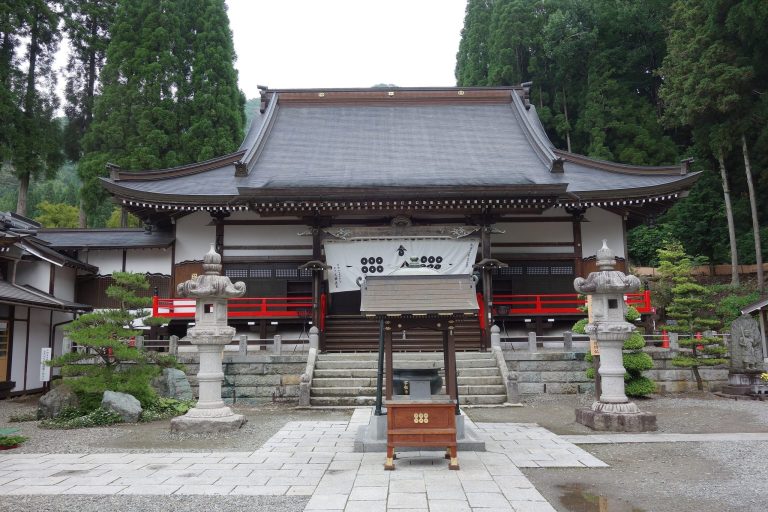
Kankei-ji occupies a temple precinct beside Zenkoji’s eastern gate. Its surviving features include the principal image of Amida Buddha, the Nio Gate and its wooden guardians, the gate associated with Tojun, Tojun’s grave, and religious objects transmitted to the temple during the nineteenth and twentieth centuries.
Gates and guardian figures
Nio Gate and Kongorikishi
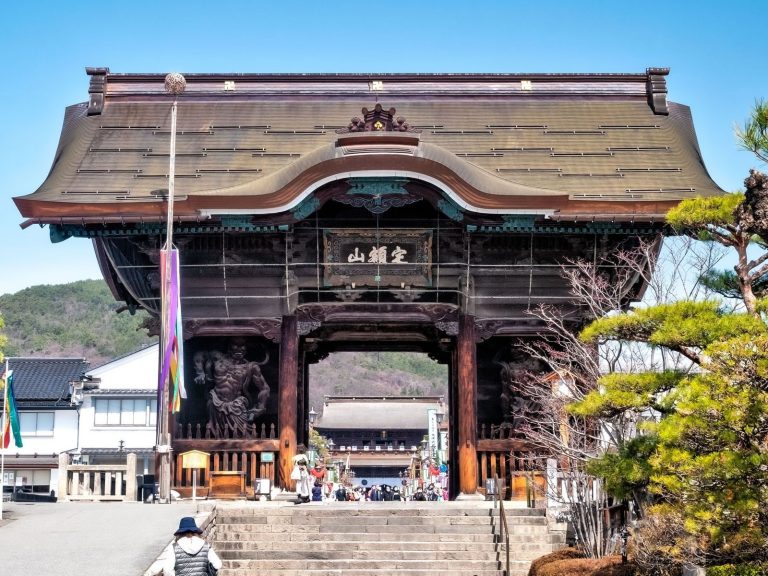
The Nio Gate contains a pair of wooden Kongorikishi, Buddhist guardian figures conventionally placed at temple entrances. Each figure is carved from a single block of hinoki cypress and measures 280 centimeters in height. Both have a single topknot, carved eyes, and red-painted flesh. An inscription dated May 8, 1498, names the religious sponsor and commissioner associated with the pair, while records place repairs in 1707 and 1774. The open and closed mouths of the paired guardians represent the beginning and end of sacred expression.
Gate of the Mist-Blowing Lion
The temple’s front gate was destroyed in the fire connected with the 1847 Zenkoji earthquake. The gate moved from Zenkoji’s Daikanjin to Kankei-ji in 1789 nearly burned in the great fire of 1891. Its carved lions are linked to a tradition that they extinguished the flames by spraying mist, giving the gate the name “Mist-Blowing Lion.”
Images and transferred objects
Kankei-ji’s principal image is a statue of Amida Buddha. The temple also preserves the Daikokuten image made by Shokei and acquired in Kyoto in 1857, together with the White-robed Kannon image by Reizei Tamechika. The wooden million pagoda transferred from Horyuji in 1908 is another surviving object associated with the temple’s religious collections.
Memorial remains
Tojun’s grave lies within the temple precincts. Its presence reflects his connection with Kankei-ji as the bodhi temple of his natal Sakaguchi family, as well as his role in transferring the gate from Zenkoji’s Daikanjin.