Akishino-dera Temple: An Eighth-Century Buddhist Temple in Nara

Site at a Glance
- Rating
- 4.3
- Popularity
- Low
- Country
- Japan
- Primary era
- Medieval
- Eras represented
- Classical, Medieval
- Civilizations
- Kamakura shogunate, Yamato
- Site type
- Religious
- Remains
- Temple
On this page13 sections
History
Akishino-dera Temple is a Buddhist temple in Nara, Japan, traditionally associated with the Nara-period monk Zenju Daitoku and an eighth-century foundation. Its exact beginnings remain uncertain, but excavated roof tiles and early records place the temple in the Nara period. It is also traditionally regarded as the family temple of the local Akishino clan.
Foundation and imperial connections
Zenju Daitoku, a monk of the Hosso school and the younger brother of Emperor Shomu, is traditionally credited with founding Akishino-dera. A later legend dates the foundation to 776, when Emperor Konin is said to have requested its construction. The story connects the temple with the deposition of Konin and the later deaths of Empress Inoue and Crown Prince Otobe.
The earliest documentary reference appears in the Shoku Nihongi, which records that Emperor Konin granted Akishino-dera an endowment of 100 households in 780. The grant shows that the temple already existed by that year, while Nara-period roof tiles support an eighth-century date for its early establishment. The Nihon Koki further records that a memorial service for Emperor Kanmu was held at the temple on the fifty-seventh day after his death in 806. These events demonstrate the temple’s close relationship with the imperial family.
Religious and institutional change
Akishino-dera originally belonged to the Hosso school, a Buddhist tradition focused on consciousness-only philosophy. During the Heian period it became a Shingon temple, joining an esoteric tradition centered on ritual, mantras, mandalas, and the attainment of Buddhahood. From the late Heian period, the growth of its temple estates brought repeated land disputes with Saidaiji, situated to the south.
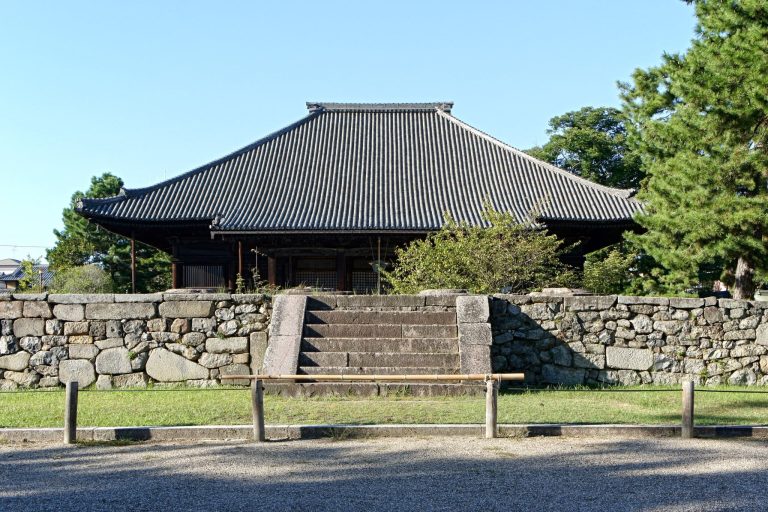
A fire in June 1135 destroyed most of the main complex. A more detailed account of the disaster states that the former lecture hall, the building used for Buddhist teaching, survived. The present Main Hall was rebuilt during the Kamakura period on the site of that lecture hall, rather than being the original eighth-century hall.
In 1595, Toyotomi Hideyoshi, the military ruler who unified Japan in the late sixteenth century, confirmed a land grant of 100 koku to Akishino-dera. After the Meiji era, the temple adopted Jodo-shu, a Buddhist school emphasizing devotion to Amida Buddha and rebirth in the Pure Land. It is now an independent Buddhist temple without sect affiliation or a mountain name.
Akishino-dera is known for its National Treasure Main Hall and for Important Cultural Properties, including the traditionally identified Gigeiten statue, the honzon, or principal sacred image, and several other sculptures. The former guardian shrine, Hachisho Goryu Shrine, stands outside the South Gate and enshrines eight deities, including Prince Sawara, an early Heian imperial prince later venerated among the spirits honored there.
Remains
The temple precinct lies north of Saidaiji in northwestern Nara. The South Gate was the original main entrance, while the East Gate now serves as the principal entrance. Between the South Gate and the Main Hall, a grove and moss garden contain the foundation stones of the former Kondo, the principal Buddha hall, and the East and West Pagodas. Together with excavated Nara-period roof tiles, these remains indicate the arrangement of the eighth-century temple, which included a Kondo and two pagodas.
Main Hall and principal images
Main Hall
The present Main Hall is a Kamakura-period reconstruction built over the site of the earlier lecture hall. It contains an elevated interior platform running along the inner sides of three walls. The hall underwent major dismantling and repair in 1899 and is designated a National Treasure.
Yakushi triad
The honzon is a wooden triad consisting of Yakushi Nyorai, the Buddha of healing and medicine, accompanied by Nikko Bosatsu and Gakko Bosatsu, bodhisattvas associated with the light of the sun and moon. The central Yakushi is unpainted wood and sits on an archaic draped-seat pedestal rather than a lotus pedestal. The painted attendant figures differ in style and were not originally made as a single set. Yakushi is regarded as a Muromachi-period revival work, while the attendants are considered late-Heian images that may originally have represented Brahma and Indra.
Gigeiten
The traditionally identified standing Gigeiten is 206.0 centimeters high and stands at the far left of the altar. Its head was made in the Nara period using hollow dry-lacquer technique, in which lacquered cloth or hemp was formed over a temporary core. Its body was carved from wood during the Kamakura period, and the two parts form a harmonious figure. The attribution of the body to the Kamakura sculptor Unkei, known for powerful naturalistic Buddhist images, remains a theory. Four figures at Akishino-dera share this general combination of Nara-period dry-lacquer heads and Kamakura-period wooden bodies.
Taishakuten and related figures
The wooden standing Taishakuten in the Main Hall also combines a Nara-period hollow dry-lacquer head with a Kamakura-period wooden body. A corresponding Brahma figure and the traditionally identified standing Kyudatsu Bosatsu have the same composite construction. Both of those figures are deposited at the Nara National Museum.
Heian-period sculptures
A wooden standing Jizo Bosatsu from the Heian period is enshrined in the Main Hall. Another Heian-period standing Jizo Bosatsu is deposited at the Kyoto National Museum, while a wooden standing Eleven-Headed Kannon from the same period is deposited at the Tokyo National Museum.
Daigensui Hall and associated works
Daigensui Myoo
On the west side of the Main Hall, Daigensui Hall houses a wooden standing Daigensui Myoo from the Kamakura period. The rare image has six arms and a wrathful form covered with coiled snakes. It was made when Akishino-dera was a Shingon esoteric Buddhist temple and is treated as a hidden image. The sculpture is opened for the May 5 goma rite, a Shingon fire ritual in which offerings are burned before a Buddhist deity, and for the ritual opening on June 6. General viewing is permitted only on June 6.
Other associated works
Associated works include five Godairiki Bosatsu figures, a temple gong dated by carbon analysis to around 1301, and a Nanbokucho-period painting of Daigensui Myoo. Eight fragments of dry-lacquer sculpture and two core frames representing two figures from the Nara period are deposited at the Nara National Museum. Seven Muromachi-period fragments depicting horses are classified as municipal cultural property.