Myōshin-ji Temple: Head Temple of the Rinzai Zen School in Kyoto


Site at a Glance
- Rating
- 4.4
- Popularity
- Medium
- Country
- Japan
- Primary era
- Early Modern
- External website
- Open
- Eras represented
- Medieval, Early Modern
- Civilizations
- Ashikaga shogunate, Tokugawa
- Site type
- Religious
- Remains
- Monastery
On this page11 sections
History
Myōshin-ji Temple is a major Rinzai Zen temple complex in Kyoto, Japan, founded in the fourteenth century from the former residence of Emperor Hanazono. Rinzai Zen is a Japanese Buddhist school centered on meditation, direct insight, and the use of kōan, paradoxical questions or statements used in training. Myōshin-ji became the head temple of its own Rinzai branch, whose network includes approximately 3,350 to 3,400 temples in Japan, as well as associated monasteries and temples overseas.
Imperial Residence and Foundation
The site was first the palace and later the detached residence of Emperor Hanazono. He abdicated in 1318 and became a monk in 1335. In that same year, he decided to transform the residence into a Zen temple. The foundation is dated either to 1337, after the death of Hanazono’s teacher Shūhō Myōchō, or to 1342, when Hanazono formally donated the palace and Kanzan Egen became the founding abbot.
Shūhō Myōchō, who founded Daitoku-ji, recommended his disciple Kanzan Egen to Hanazono as a successor in Zen teaching. Kanzan had practiced at Ibuka in Mino Province before accepting Hanazono’s imperial proclamation. The name Shōbōzan Myōshin-ji was attributed to Shūhō Myōchō and refers to a Buddhist expression concerning the true Dharma and the wondrous mind.
Kanzan established a strict and austere tradition. His successors are revered as the six patriarchs: Kanzan Egen, Jōō Sōhitsu, Muitsu Sōin, Nippō Sōshun, Giten Genshō, and Sekkō Sōshin. This sequence represents a doctrinal lineage rather than the numerical order of abbots. Nippō, Giten, and Sekkō were the seventh, eighth, and ninth abbots respectively.
Confiscation and Restoration
Myōshin-ji suffered a major institutional crisis in 1399. Its sixth abbot, Setchū Sōboku, was closely associated with Ōuchi Yoshihiro, who had rebelled against the Ashikaga shogunate. Shogun Ashikaga Yoshimitsu confiscated the temple’s estates and confined Setchū at Shōren-in. The buildings, grounds, and other estates were granted to Teiyō Sōki of Toku’un-an, a sub-temple of Nanzen-ji. Teiyō renamed the institution Ryōun-ji and made it a branch temple of Toku’un-an, temporarily interrupting Myōshin-ji’s institutional existence.
The temple was revived in 1432, when Nippō Sōshun was invited from Zuisen-ji at Inuyama in Owari Province. The land containing Kanzan Egen’s memorial pagoda, Mishō-tō, was transferred to the Kanzan lineage, and Nippō came to be regarded as the restorer of Myōshin-ji.
The complex was burned during the Ōnin War, the fifteenth-century conflict that devastated much of Kyoto through fighting among rival warrior factions. Sekkō Sōshin secured an imperial restoration decree from Emperor Go-Tsuchimikado, and Myōshin-ji was rebuilt in 1477. Sekkō also limited each abbot’s tenure to three years. Four of his successors, Keisen Sōryū, Gokei Sōton, Tokuhō Zenketsu, and Tōyō Eichō, established the four continuing Myōshin-ji branches: Ryūsen, Tōkai, Reiun, and Seiryō.
Independence and Institutional Development
In 1509, Emperor Go-Kashiwabara granted Myōshin-ji permission to use the purple robe, recognizing its status as equal to that of Daitoku-ji. The grant is treated as a declaration of Myōshin-ji’s independence from Daitoku-ji. In the same year, Ritei-ni, daughter of the regent Ichijō Kaneyoshi and wife of Saitō Myōjun, lord of Kanō Castle, purchased land belonging to Ninna-ji and donated it to Myōshin-ji. The enlarged precinct later acquired a complete seven-hall arrangement and a large network of sub-temples.
During the Eiroku era, approximately 1558 to 1570, Kian Genmitsu reduced the customary term of an abbot from three years to one. In 1578, thirty-six masters, including Nanka Genkō, Kaizen Jōki, and Kosai Sōitsu, established regulations known as the Myōshin-ji Wall Code. The temple also received support from powerful warrior families during the Sengoku and early modern periods. After the Battle of Sekigahara, Shigeie Ishida, the eldest son of Ishida Mitsunari, entered Myōshin-ji and became a monk, escaping execution.
During the Edo period, Ryūkei Shōsen and other monks tried to invite the Chinese Zen master Yinyuan Longqi to Myōshin-ji, but the senior abbot Gudō Tōshoku rejected the proposal. The 1615 Ji’in Hatto regulations placed Myōshin-ji and Daitoku-ji under the supervision of the Edo shogunate. Monks from both temples protested in 1629, and four, including Tanden Shiin and Takuan Sōhō, were punished in the episode later known as the Purple Robe Incident.
Modern Institutional History
The 1868 ordinance separating Buddhism and Shinto, followed by the anti-Buddhist Haibutsu Kishaku movement, affected Myōshin-ji. In 1871, the branch established the office of head abbot, with Gaiten Dōkei of Tōgen-ji in Nagoya as its first holder. Myōshin-ji established Hanazono University in 1872 and developed a Zen training monastery and the Hannya Rin school, which became a predecessor of Hanazono High School and Hanazono University.
In April 1945, during the Pacific War, Myōshin-ji held the six-hundredth memorial service for Emperor Hanazono. The service received an imperial gift of incense funds and flowers, along with the imperial plaque “Musō,” written by Prince Kan’in Kotohito.
The complex is also associated with the institutional nickname “abacus face,” which refers to its emphasis on financial administration and systematic organization. Rice-and-money accounting records begun under Sekkō Sōshin in the mid-Muromachi period and continued until the end of the Edo period survive as an important source for the economic history of Buddhist institutions.
The main precinct and the grounds of its surrounding sub-temples cover approximately 19.5 hectares and are designated a national Historic Site. The Myōshin-ji gardens and the garden of Gyokuhō-in are separately designated as national Historic Sites and Places of Scenic Beauty. Nationally important cultural properties include the temple bell and two calligraphic works by Shūhō Myōchō, the Kanzan inscription and a certificate of dharma transmission.
Remains
Myōshin-ji occupies the northwestern part of the former Heian-kyō area, extending between Ichijō Street to the north and Shimodachiuri Street to the south. High enclosing walls, north and south entrances, side entrances, winding internal paths, and numerous sub-temples organize the extensive precinct. The principal buildings follow a north-south axis from the southern gate, while additional east-west and winding routes connect the central halls with surrounding compounds.
Central Temple Buildings
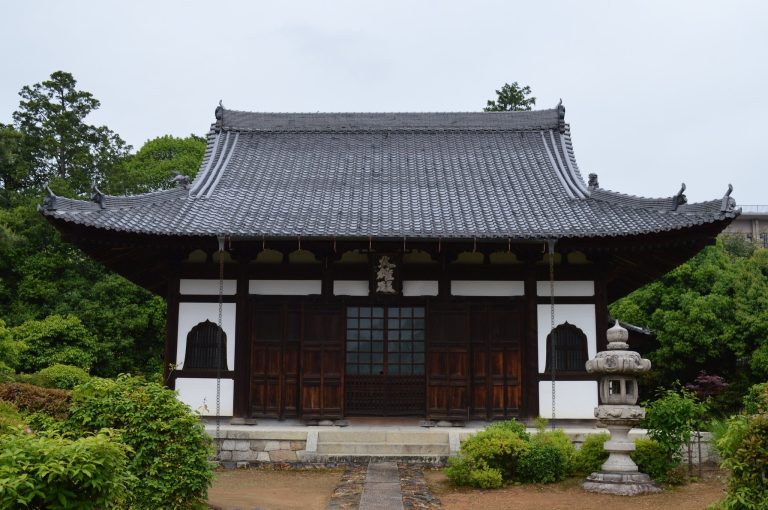
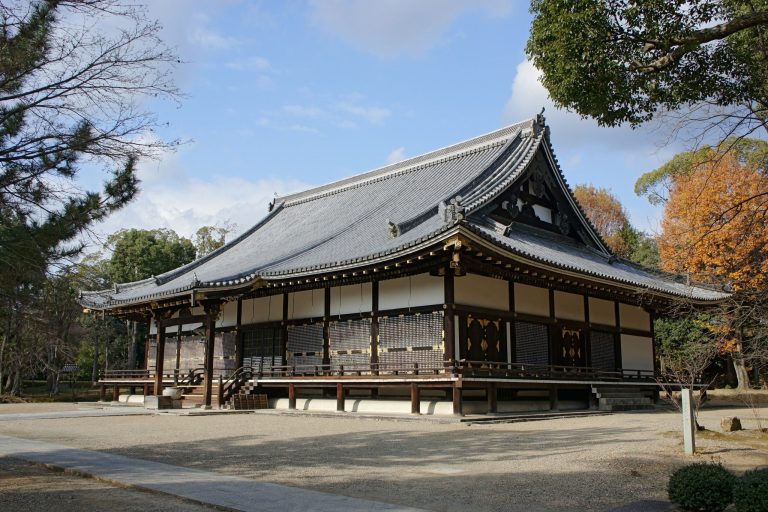
The central sequence from south to north consists of the Sanmon, or principal temple gate, the Butsuden, or Buddha Hall, the Hattō, or Dharma Hall, and the Dai-hōjō, the abbot’s residential and audience hall. The Sanmon dates from 1599. The Butsuden was built in 1827, while the Hattō dates from 1656 and the Dai-hōjō from 1654. Other central buildings include the Sho-hōjō from 1603, the Kuri, or temple kitchen and service building, from 1653, the Yokushitsu from 1656, the Kyōzō from 1673, the Genkan from 1654, and the Shindō from 1656. The Sanmon and Butsuden are important cultural properties.
The Hattō contains a large ceiling painting of a dragon whose appearance changes with the viewer’s position. The building also houses the temple’s oldest bell, which was moved there from its former bell tower. The bell tower burned in an arson attack on 1 September 1962.
Gates, Bell, and Gardens
The Chokushimon, a gate reserved for imperial envoys, was built in 1610, as were the Minamimon and Kitamon. The Chokushimon is distinct from the principal southern gate, the Minami-sōmon. Paths connect the two principal entrances and pass the central halls and surrounding sub-temples, including Tenju-in, Keishun-in, Daishin-in, and Tōrin-in.
The nationally designated temple bell bears an inscription dated to 698, the second year of Emperor Monmu. It was cast in Chikushi in Kyushu and is considered the oldest dated bell in Japan. Its tone corresponds to the kōshō mode of gagaku, the court music tradition, and it has long been known as the “bell of the kōshō mode.” The bell is also mentioned in the medieval miscellany Tsurezuregusa.
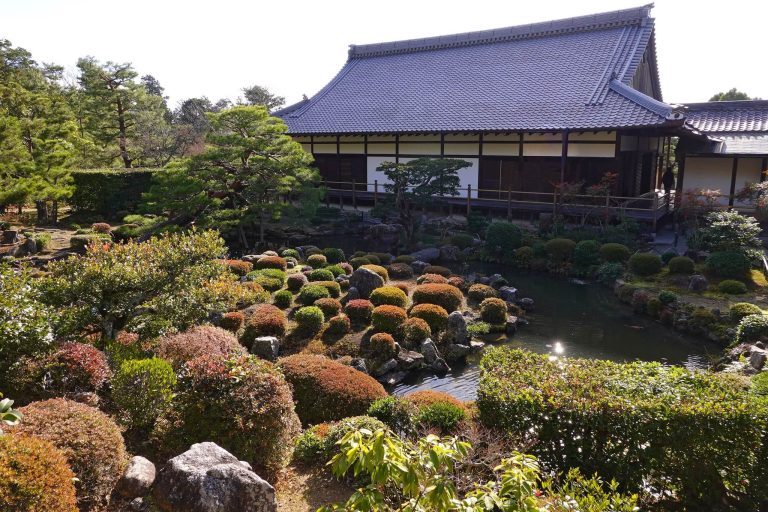
The Myōshin-ji garden consists of three designated areas. The front garden lies between the imperial envoy gate and the Sanmon and includes a release-animal pond and pine plantings around the central buildings. The other areas are the gardens of the Dai-hōjō and Sho-hōjō. The garden of Gyokuhō-in is separately designated.
Gyokuhō-in and Founding-Master Buildings
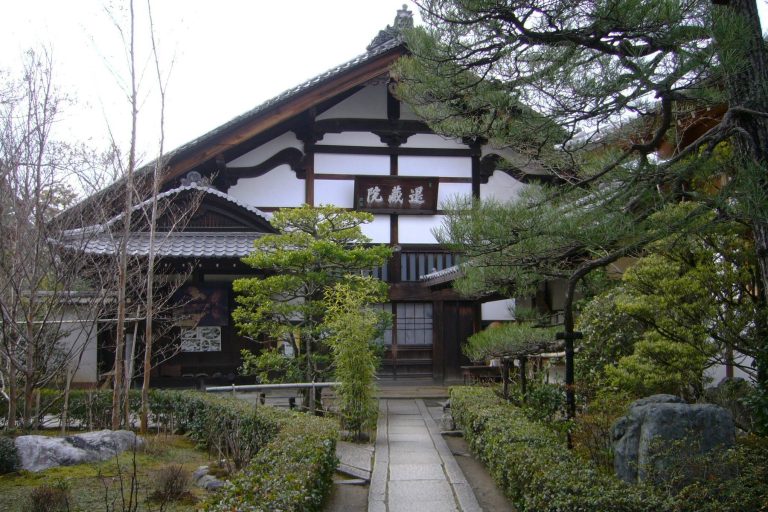
Gyokuhō-in stands on the site of Emperor Hanazono’s former detached palace. It is independent of the four Myōshin-ji branches, and abbots of the sub-temples conduct ceremonies there. Its Hōjō was rebuilt in 1656. The compound also contains the Kaizando, or hall dedicated to a temple’s founding master, also called Mishō-an. This Muromachi-period building was originally erected at Tōfuku-ji and houses an image of Kanzan Egen. Gyokuhō-in also contains the Shōun-in mausoleum for Toyotomi Tsurumatsu, the son of Toyotomi Hideyoshi.
Tenju-in was founded in 1340 by Jōō Sōhitsu, the second patriarch. Taizō-in was founded in 1404 by Muitsu Sōin with the support of Hatano Shigemichi. It belongs to the Reiun branch and preserves Hyonenzu, an early Japanese ink painting by Josetsu that is held at the Kyoto National Museum.
Four Principal Branch Monasteries
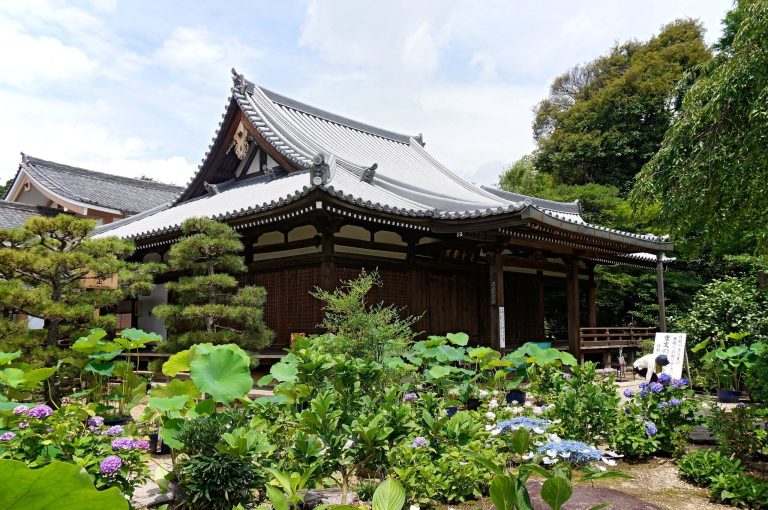
Ryūsen-an, head sub-temple of the Ryūsen branch, was founded in 1481 by Keisen Sōryū. Its main hall, kitchen, study, bell tower, and front gate are designated tangible cultural properties by Kyoto Prefecture. It preserves Hasegawa Tōhaku’s Kokueki enko zu, held at the Kyoto National Museum.
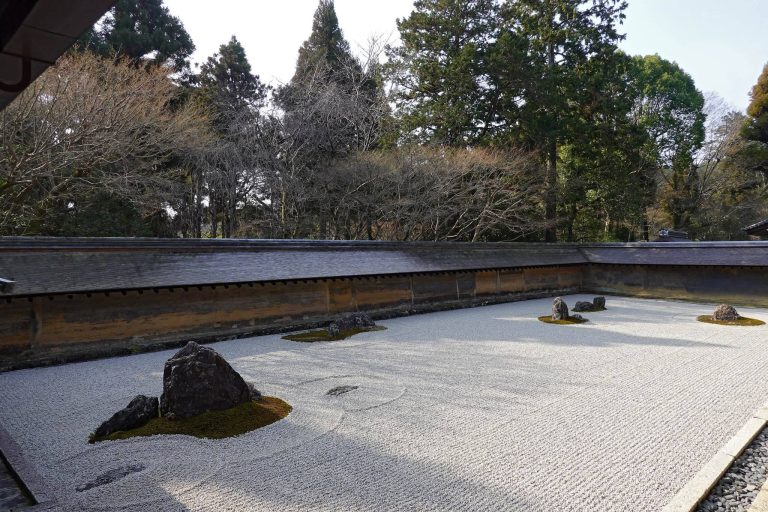
Tōkai-an, head sub-temple of the Tōkai branch, was founded in 1484 by Gokei Sōton and restored in 1599 by Ishikawa Yoriaki. Its front garden uses raked white sand enclosed by a mud-plastered wall, while the study’s southern garden has seven stones set in white sand. Its main hall, kitchen, bell tower, study, and front gate are prefecturally designated tangible cultural properties. The sub-temple also holds paintings of the Eight Views of Xiao and Xiang, an imperial title by Emperor Kōmei, paintings of the Sixteen Arhats, and bird-and-flower paintings.
Reiun-in, head sub-temple of the Reiun branch, was founded in 1526 by Daikyū Sōkyū, with Tokuhō Zenketsu as its invited founding master. Its study, traditionally dated to 1543, is an important cultural property. A reduced-scale dry landscape garden, using stones, sand, and plants to evoke natural forms, is designated a national Historic Site and Place of Scenic Beauty. The sub-temple also preserves an imperial decree granting a posthumous title to a monk and a painting of figures engaged in music, chess, calligraphy, and painting.
Seiryō-in, head sub-temple of the Seiryō branch, was founded in 1523 by Ten’in Tokujū, with Tōyō Eichō as invited founding master. Assisted by Toki Masafusa and the Hosokawa family, it later declined before being restored in 1594 with the support of Hayakawa Nagamasa and Yōzan Keiyō. Its main hall, study, kitchen, and front gate became Kyoto Prefecture tangible cultural properties in 1999. Its holdings include an image of Marici, the Ten Oxherding Pictures by Katayama Naokage, lion paintings, and works depicting qilin and the Seven Sages of the Bamboo Grove.
Other Sub-temples and Memorial Compounds
The surrounding network contains many compounds founded or restored by abbots, aristocratic families, and warrior patrons. Kōbai-in was founded by Sekkō Sōshin, restored in 1604 by Tenshū Tokuzan, and preserves Sekkō’s portrait. Yōgen-in, founded in 1448 by Nippō Sōshun, burned during the Ōnin War and was restored by Sekkō and later by Gōshū Sōki. Its present guest hall dates from the later restoration and is the oldest surviving guest hall in the precinct with a clearly established construction date.
Chōkō-in was founded in 1581 by Takigawa Kazumasu as Yōkoku-an, restored by Tsuda Hidemasa in 1606, and renamed after Hidemasa’s death. Tōrin-in, established in 1556 by Yamana Toyokuni, has a dry landscape garden and a suikinkutsu, a water-filled installation that produces tones as water falls into it. Daishin-in was founded by Hosokawa Masamoto, first stood outside the main precinct, and was later moved within it.
Zakka-in was founded in 1583 by Makimura Toshisada for his younger brother, the abbot Ichchū Tōmoku. Fukujū-in began in 1619 as Yōken-in and later acquired its present name. Nyoze-in originated as Daigu-an, founded by Giten Genshō, and was restored and renamed in 1462. Kaifuku-in, founded in 1616 by Fukushima Masanori, became the cemetery temple of the courtly Machijiri family.
Yōtoku-in preserves a scroll describing a debate between alcohol and tea, an image of a hawk by Soga Chokuan, and an iron alms bowl traditionally transmitted from the Chinese monk Jianzhen. Daiyū-in, founded in 1603 as an Ishikawa family temple, has a Hōjō rebuilt in 1717, with sliding-door paintings depicting Guo Ziyi by Shibata Zeshin. Keishun-in, founded in 1598 and renamed in 1631, has a garden known for moss and azalea plantings that is designated a national Historic Site and Place of Scenic Beauty.
Banto-in became the Date family cemetery temple after its foundation in 1601 by Maeda Geni. Chōkei-in was founded in 1600 by a daughter of Kinoshita Iesada and sister of Kita no Mandokoro, Hideyoshi’s wife. It merged with Myōhō-ji in 1878 and restored its former name in 1905. Unshō-in began as Kisen-an in 1598. It was renamed after its founding master, Kaizan Genju, left the confiscated Shōun-ji carrying wooden images of his teacher Nanka Genkō and Toyotomi Tsurumatsu.
Kōkoku-in was founded in 1620 and merged with Jissō-in in 1878. Rinka-in preserves important sliding-door landscapes by Hasegawa Tōhaku and paintings by Kanō Eigaku. Chishō-in, founded in 1597, holds a silk painting of Inaba Ittetsu. Rinshō-in, established in 1633 or 1634, is the cemetery temple of Kasuga no Tsubone. It moved to its current location in 1897 and contains a former fishing pavilion associated with Emperor Go-Mizunoo and used as Kasuga no Tsubone’s mausoleum. Its Hōjō has sliding-door paintings by Kaihō Yūsetsu.
Daitsū-in contains the mausoleum of Yamauchi Kazutoyo and his wife. Tenkyū-in was founded in 1631 for Tenkyū-in, sister of Ikeda Terumasa, and preserves approximately 152 sliding-door paintings by Kanō Sanraku, Kanō Sansetsu, and others. Jushō-in was founded in 1599 by Ishida Mitsunari as the Ishida family temple; its scale was reduced after the Battle of Sekigahara. Shunkō-in preserves the important “Namban-ji Bell” and sliding-door paintings by Kanō Eigaku.
Other compounds include Reikō-in, which contains the mausoleum of Oinu, sister of Oda Nobunaga; Daihō-in, the cemetery temple of Sanada Nobuyuki; Tsūgen-in, which absorbed Suigetsu-in in 1878; and Shunpo-in, which preserves the Muromachi-period illustrated narrative Fukutomi zōshi and paintings by Yamaguchi Sekkei. Ryōan-ji, founded in 1450 by Hosokawa Katsumoto and rebuilt in 1488 by Hosokawa Masamoto, belongs to the Reiun branch and is noted for its stone garden.
The sub-temples are organized through the Ryūsen, Tōkai, Reiun, and Seiryō lineages, which descend from the four principal disciples of Sekkō Sōshin. The memorial sites of the six patriarchs are known as the Six Patriarchs’ Training Grounds. Inventories count the sub-temples differently, from the low forties to approximately fifty, while Myōshin-ji’s own count is 46 and other inventories list 47 to 49. Together, the precinct and its associated compounds preserve halls, studies, kitchens, gates, bell towers, mausoleums, gardens, paintings, calligraphic works, statues, bells, and ritual objects that reflect the institution’s long development.