Taizō-in: A Rinzai Zen Sub-Temple in Kyoto, Japan


Site at a Glance
- Rating
- 4.5
- Popularity
- Medium
- Country
- Japan
- Primary era
- Early Modern
- External website
- Open
- Eras represented
- Early Modern, Modern
- Civilizations
- Japanese, Tokugawa
- Site type
- Religious
- Remains
- Temple
On this page15 sections
History
Taizō-in is a Rinzai Zen sub-temple in Kyoto, Japan, founded in 1404 during the Muromachi period, the era of the Ashikaga shogunate. It belongs to the Myōshin-ji branch of Rinzai Buddhism and was established by Hatano Shigemichi, a warrior from Echizen Province, with Muin Sōin, the third head of Myōshin-ji, as its founding religious leader.
Foundation and relocation
The temple was first built in Kyoto’s Senbon-dori Matsubara area. It was later moved to the grounds of Myōshin-ji by the Buddhist monk Niho Soshun, becoming a tatchū, or sub-temple established within a larger Zen temple. Muin Sōin continues to be venerated as Taizō-in’s founder, and a statue of him serves as the principal object of worship.
Destruction and rebuilding
Taizō-in and the wider Myōshin-ji complex were destroyed during the Ōnin War, a fifteenth-century conflict that caused widespread destruction in Kyoto. Kinen Zenyu rebuilt the temple in 1597 as a devoted follower of Emperor Go-Nara. The buildings seen today were constructed after 1600, and the abbot’s residence was completed in 1602.
Gardens and artistic heritage
Taizō-in’s garden received designation as both a National Historic Site and a National Place of Scenic Beauty in 1931. The temple also preserves Catching Catfish with a Gourd, a painting from around 1413 that is regarded as a turning point in Muromachi-period painting. Interior decoration has continued to change over time: in 2022, Murabayashi Yuki replaced substantially deteriorated fusuma paintings by Kanō Ryōkei.
Remains
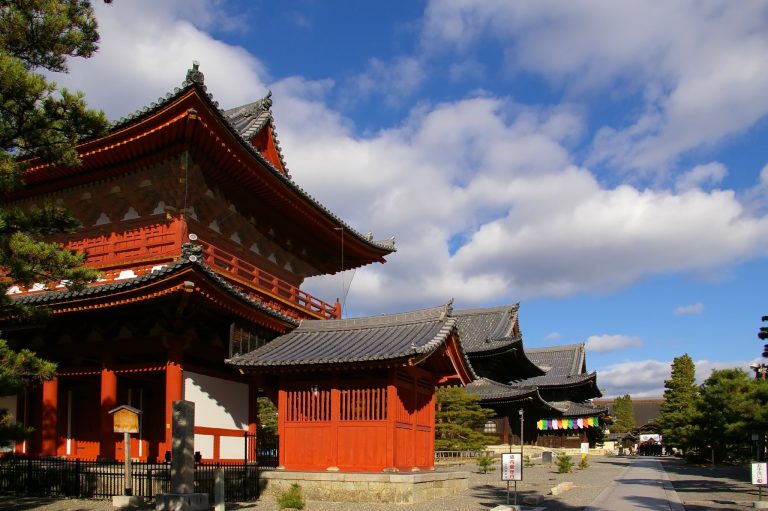
The precinct is arranged along an east-west approach, with the main hall and abbot’s residence at its center and gardens extending principally to the west and south. Its buildings combine simple entrances, reception spaces, sliding-screen paintings, and garden views within the compound.
Approach and principal buildings
Gate and approach
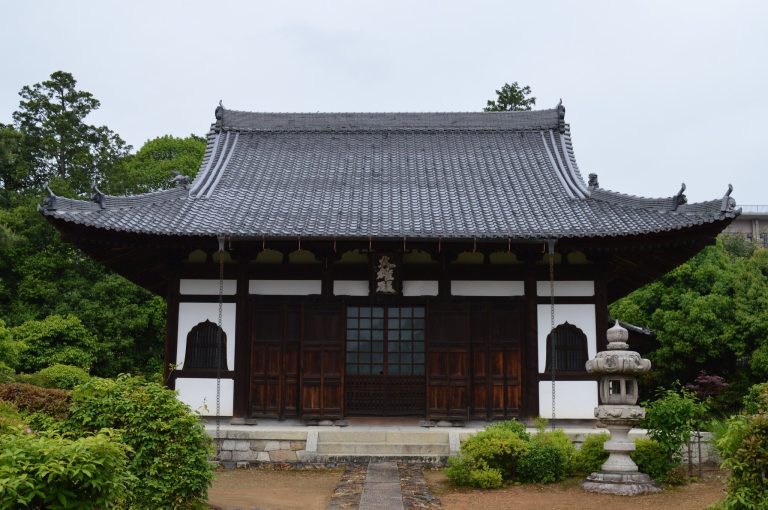
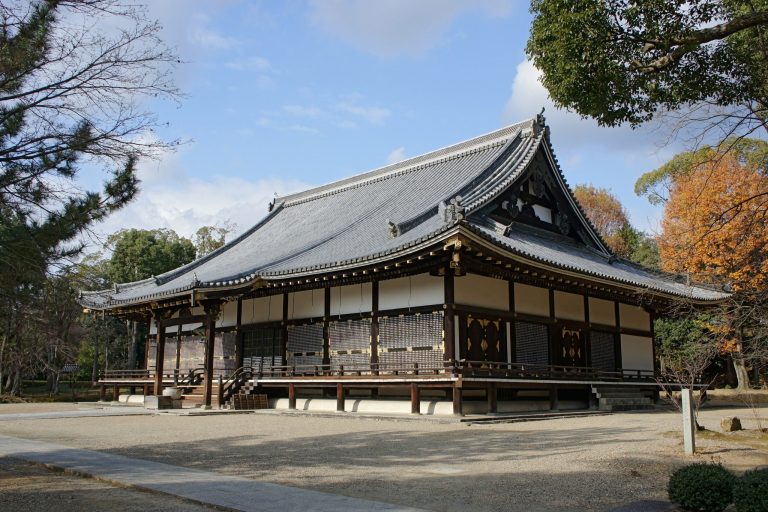
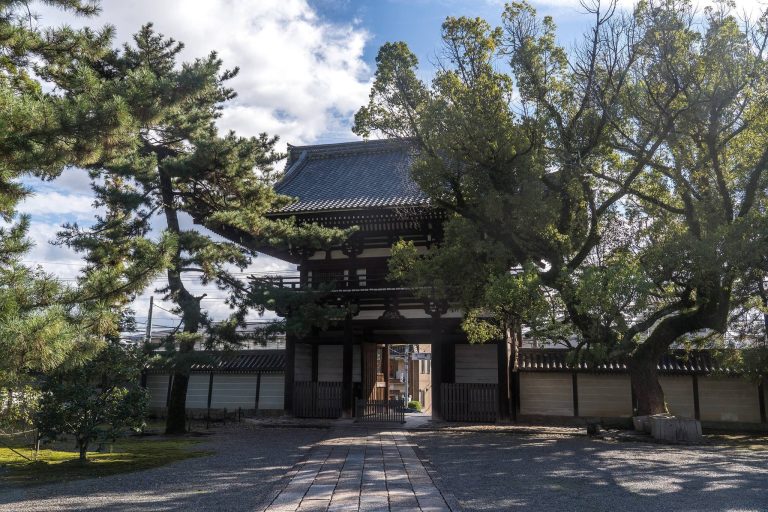
Visitors enter through a simple eastern gate in the Yotsuashi style. The approach passes a small building and the kitchen-refectory before reaching the main hall, which also functions as the abbot’s residence, or Hōjō.
Hōjō and Hakamagoshi Great Entrance
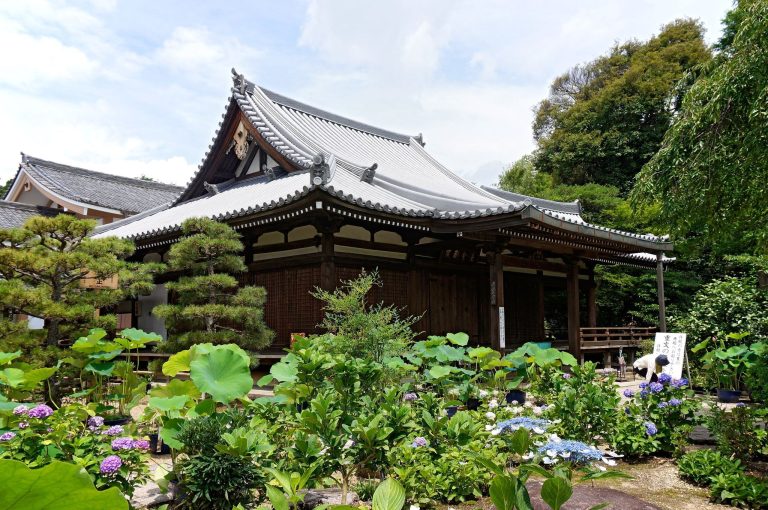
The elaborately designed Hakamagoshi Great Entrance leads into the Hōjō. The residence has an open covered walkway on its southern side, facing the garden, and contains fusuma sliding-screen paintings. The earlier works by Kanō Ryōkei were replaced in 2022 by paintings created by Murabayashi Yuki.
Shoin and Kakoi-no-seki
Adjoining the Hōjō on the north is the Shoin, an abbot’s study and reception building. It includes the Kakoi-no-seki tea-ceremony room.
Gardens
Motonobu’s Garden
A small dry-landscape garden adjoins the Hōjō on the west, while Motonobu’s Garden extends southward. Traditionally attributed to Kanō Motonobu, it covers approximately 50 tsubo, or about 170 square metres. The design uses dynamically arranged stones, including one representing Mount Hōrai, with white sand shaped as a dry waterfall flowing toward an implied ocean. Evergreen planting includes camellias, pine, and Japanese umbrella pine, while borrowed scenery incorporates distant Narabigaoka Hill. This technique, known as shakkei, brings an outside landscape into the garden’s composition.
Yokō-en
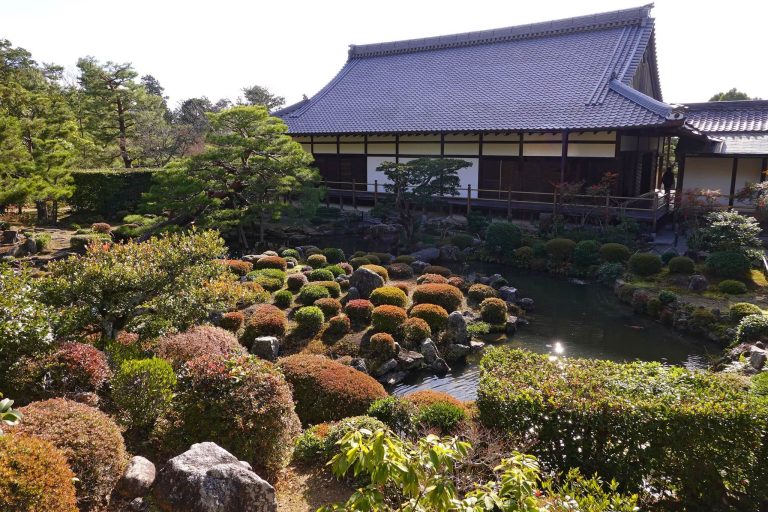
The newer pond garden, Yokō-en, was designed by Kinsaku Nakane between 1963 and 1966. Azaleas, cherry trees, maple trees, and lotus surround a stream that follows the main axis toward the principal viewing position. The water passes around rocks, widens gradually, and empties into a pool.
Yin-and-Yang Garden and water features
Within Yokō-en, the Yin-and-Yang Garden is a dry landscape garden, or karesansui, that represents natural forms through stones and gravel rather than an actual watercourse. Its western section is divided between a Yin side, where stones stand in dark gravel, and a Yang side, where stones are set in light gravel. A hand-washing basin and a water-harp cavern create a resonating system in which falling water reverberates. The garden also contains Daikyū-an, a large traditional rest pavilion where tea is served.
National Treasure painting
Catching Catfish with a Gourd
Catching Catfish with a Gourd is an ink-and-light-color painting on paper, mounted as a hanging scroll and dating to around 1413. It presents the impossible Zen problem of catching a catfish with a bottle gourd, expressing a kōan, a paradoxical question or anecdote used in Zen practice to challenge ordinary reasoning. The upper part carries inscriptions by 31 learned monks, including Daigaku Shūsō. The work is attributed to Josetsu, a Muromachi-period monk-painter associated with the development of monochrome ink painting in Japan, and is designated a National Treasure.