Ryōan-ji Temple: A Zen Temple and Dry-Landscape Garden in Kyoto


Site at a Glance
- Rating
- 4.5
- Popularity
- High
- Country
- Japan
- Primary era
- Early Modern
- External website
- Open
- Eras represented
- Medieval, Early Modern
- Civilizations
- Ashikaga shogunate, Tokugawa
- Site type
- Religious
- Remains
- Temple
On this page17 sections
History
Ryōan-ji Temple in Kyoto, Japan, is a Rinzai Zen Buddhist temple founded in 1450 by the military leader Hosokawa Katsumoto. Its history reaches back to a Fujiwara estate and a twelfth-century pond, while its present identity was shaped by the rebuilding that followed the Ōnin War and later fires.
Imperial Temple and Fujiwara Estate
The site was originally part of En’yūji, an imperial vow temple founded in 983. By the late Heian period, Tokudaiji Saneyoshi of the Fujiwara Hokke lineage had established a mountain villa there. The property later passed to the Tokudaiji family. The large pond and an early small temple called Daiju-in are also associated with this phase of the site.
Foundation as a Zen Temple
Hosokawa Katsumoto acquired the estate in 1450, built his residence there, and founded Ryōan-ji as a Zen temple. Zen Buddhism is a Mahayana Buddhist tradition centred on disciplined practice and meditation. Giten Genshō became the founding abbot, and the monk Nippō Sōshun was invited to serve as the temple’s founding master.
Ryōan-ji joined the Myōshin-ji school of the Rinzai branch of Zen Buddhism. Rinzai traditionally gives an important place to kōans, paradoxical questions or statements used in Zen practice. The temple’s principal image is Shaka Nyorai, the Buddha Shakyamuni, and Ryōan-ji remains a detached subtemple of Myōshin-ji.
War, Destruction, and Reconstruction
The temple was burned in 1468 during the Ōnin War, a conflict that grew from rivalries among powerful military leaders and their supporters. Its institutional base was temporarily transferred to Katsumoto’s residence in the capital before returning to the original site. Katsumoto died in 1473.
Reconstruction began in 1488 under Hosokawa Masamoto, Katsumoto’s son, and Tokuhō Zenketsu, the fourth abbot. Ryōan-ji regards Tokuhō as its restorer-founder. The hōjō, the abbot’s residence, was roofed in 1499. Tradition connects the creation of the stone garden with this rebuilding, but its date, designer, and intended meaning remain uncertain.
During the Azuchi-Momoyama period, Oda Nobunaga and Toyotomi Hideyoshi donated temple lands to Ryōan-ji. Hideyoshi was a military ruler who unified much of Japan. The temple also served as a mausoleum for seven emperors, Uda, Kazan, Ichijō, Go-Suzaku, Go-Reizei, Go-Sanjō, and Horikawa. Their imperial tombs acquired their present arrangement during the nineteenth-century restoration of imperial mausolea ordered by Emperor Meiji.
Changing Interpretations of the Stone Garden
The garden’s early history is difficult to establish with certainty. Descriptions from around 1680 to 1682 mention nine large stones representing “Tiger Cubs Crossing the Water,” whereas the present arrangement contains fifteen stones. Proposed construction dates extend from the late fifteenth century through the sixteenth century and into the Edo period, approximately 1618 to 1680. Suggested designers include Hosokawa Katsumoto, Hosokawa Masamoto, and the monk-painter Sōami. Another possibility is that professional gardeners of the kawaramono class made it, including Hirokojirō and Kotarō, whose names are carved on a stone.
An illustration from 1780 shows the earlier garden divided from north to south by a covered corridor, with a gate on its southern side. Akisato Rito published an illustration in 1799 showing the present arrangement. He may have reorganized or rebuilt the stone groups during the restoration that followed the great fire of 1797.
Fire, Restoration, and Heritage Status
The 1797 fire destroyed much of the complex, including the dining hall, the former hōjō, the founder’s hall, and the Buddha hall. The present hōjō and its entrance gate were transferred from the subtemple Saigen-in to replace the destroyed buildings. The stone garden was probably rebuilt at the same time, either closely following its earlier form or adapting it to the smaller replacement residence.
Ryōan-ji declined during the early Meiji-period policy of separating Buddhism and Shinto. In 1895, ninety Kano-school fusuma paintings from the hōjō were sold to another temple. They were later acquired by the coal magnate Ito Den’emon and dispersed after the Second World War. Some were traced to the Metropolitan Museum of Art and the Seattle Art Museum, while many others remain unlocated. Ryōan-ji recovered four panels of Immortals and two panels of Figures in the Four Accomplishments at a New York auction in 2010, followed by nine panels of Banana Plants through a collector in Shizuoka in 2018.
A bathhouse fire in 1929 destroyed part of the complex and burned one of the thirteen volumes of the temple’s Taiheiki manuscript, a medieval historical narrative in manuscript form. The remaining twelve volumes retain fire damage. In 1951, torrential rain caused a landslide on the rear mountain. Muddy water entered the stone garden and covered it with red earth.
Ryōan-ji forms part of the Historic Monuments of Ancient Kyoto, inscribed on the UNESCO World Heritage List in 1994. The hōjō is an Important Cultural Property. The hōjō garden is a national Historic Site and Special Place of Scenic Beauty, while the wider garden is a Place of Scenic Beauty. Several temples around Kyoyochi Pond, including Saigen-in, are now detached subtemples of Myōshin-ji rather than subtemples of Ryōan-ji.
Remains
Temple Grounds and Pond Garden
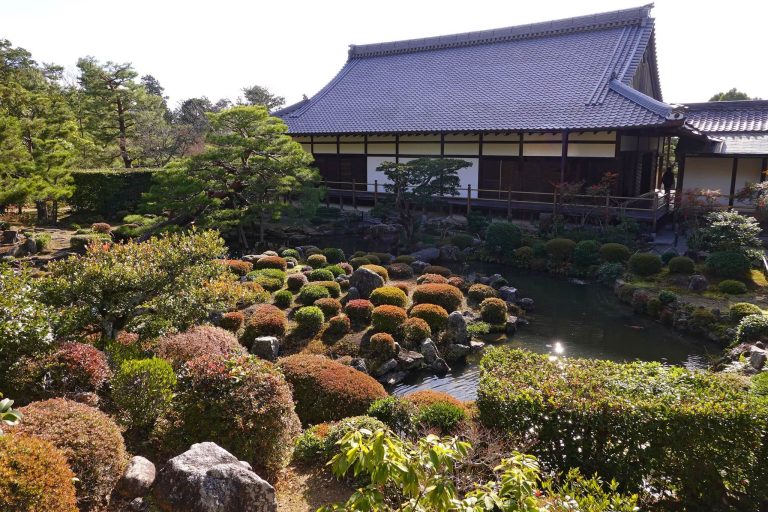
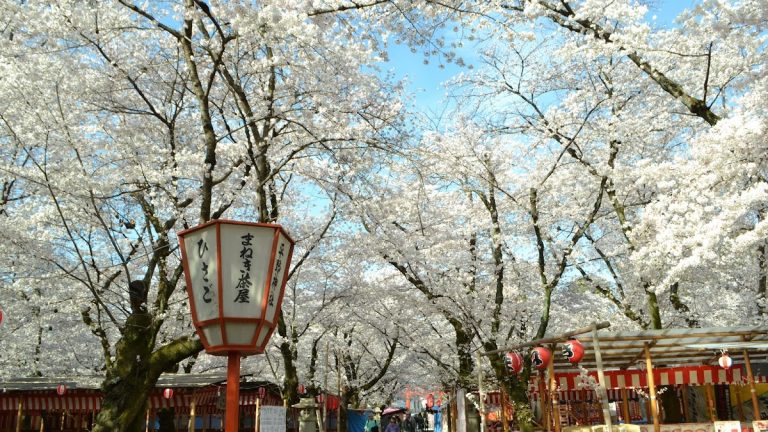
The complex includes the principal temple buildings, associated minor temples, a large surrounding garden, and the artificial Kyoyochi Pond. The pond was created in the twelfth century as part of the earlier Fujiwara estate. The grounds form a pond-and-strolling garden, with later-planted cherry trees in the northwest. The western garden contains the Hosokawa family mausoleum and a commemorative wooden statue of Hosokawa Katsumoto.
Main Temple Buildings
Hōjō and Entrance Gate
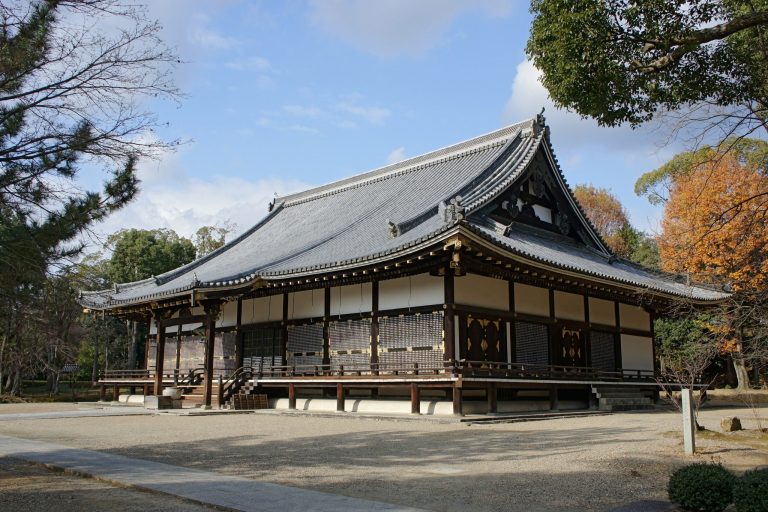
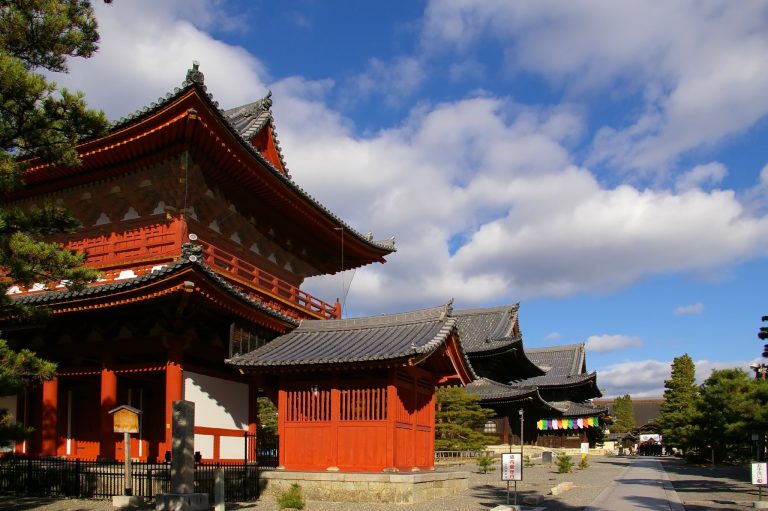
The present hōjō was built in 1606 by Oda Nobukane for Saigen-in and transferred to Ryōan-ji after the 1797 fire. Nobukane was the younger brother of Oda Nobunaga. The Chokushimon, the gate marking the entrance, was moved with the building. Its fusuma paintings were made in 1953 by the Nanga painter Satsuki Kakuo and depict a dragon and Mount Kumgang.
Buddha Hall
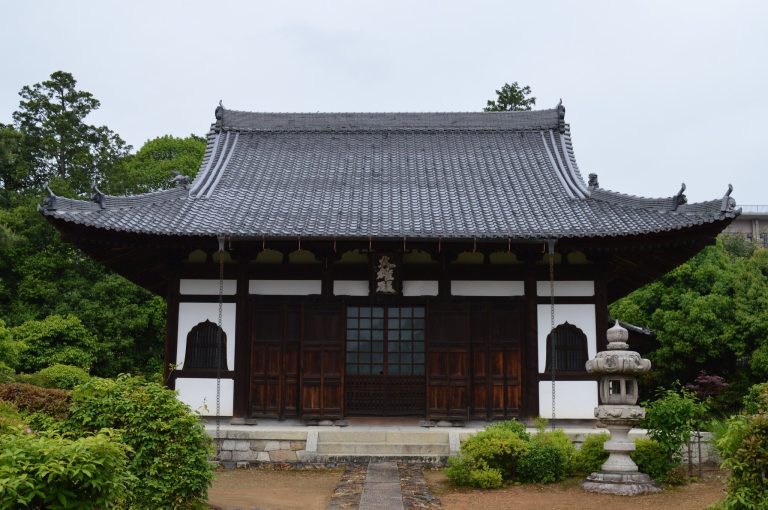
The butsuden, or Buddha hall, stands west of the hōjō. Its left altar contains posthumous memorial tablets for members of the imperial family, including the seven emperors associated with Ryōan-ji. The right altar holds tablets for former abbots. The hall was destroyed in 1797 and rebuilt in 1981 from drawings preserved at Myōshin-ji.
Zorokuan Teahouse
Zorokuan is a seventeenth-century Edo-period teahouse east of the hōjō. Its interior contains four tatami mats divided by a central wooden beam, and it is accompanied by a tea garden.
Wabisuke Camellia and Tsukubai
Near the teahouse stands the camellia known as Wabisuke. Tradition says that it was brought from Korea and admired by Toyotomi Hideyoshi and Sen no Rikyū, a major sixteenth-century tea master. It is also traditionally regarded as Japan’s oldest camellia.
The Ryōan-ji tsukubai is a continuously supplied stone water basin used for ritual purification. A tsukubai is placed low so that a person bends forward when using it, a gesture associated with humility. The circular basin has a square opening at its centre. The four surrounding characters combine with the square, understood as the character component for “mouth” or “opening,” to form a rebus meaning “I know only satisfaction.” Its design expresses Buddhist ideas of humility and inner abundance.
Tradition regards the basin as a donation by Tokugawa Mitsukuni, a seventeenth-century lord of the Mito domain within the Tokugawa shogunate. The basin beside the route north of the hōjō is a precise replica. The original stands in the tea garden.
Hōjō Stone Garden
Dry-Landscape Composition
The famous hōjō garden is a rectangular karesansui, or dry-landscape garden using stones, gravel, and moss rather than flowing water. It measures approximately 25 by 10 metres, covering about 248 square metres. A wall encloses white gravel or pebbles that are regularly raked into linear patterns. Moss surrounds fifteen stones arranged in five groups, comprising one group of five, two groups of three, and two groups of two. From east to west, the sequence is five, two, three, two, and three stones.
Four relatively large stones are chert from the hills behind Ryōan-ji and the western Kyoto area. Two elongated stones beside the wall come from the mountains around Tamba, while the other nine are green schist associated with the Sanbagawa metamorphic belt. The garden is designed to be viewed from the hōjō veranda. At least one stone is hidden from every viewing position because the stones overlap along the sightline, creating layered views.
The arrangement has been interpreted as a tiger family crossing a river, islands in a sea of gravel, mountains above clouds, Chinese mountains, Zen monasteries, characters for heart and mind, or obstacles on the way to enlightenment. Other interpretations understand it as an abstract composition intended to stimulate meditation. It is also described as a visual kōan, based on the traditional interpretation that all fifteen stones can be seen together only after enlightenment.
Analyses by Gert van Tonder and Michael Lyons identify visual structures in the garden’s empty spaces that align with the temple architecture and converge near the centre of the hōjō veranda. Their interpretation emphasizes axial balance, asymmetry, odd-numbered groups, triangular arrangements, and spacing that produces a branching, tree-like structure.
Garden Wall
The garden wall is made of clay boiled or treated with oil. Age has created subtle brown and orange markings, while the oil protects the surface from light reflected by the pale gravel. The inner base is approximately 80 centimetres higher than the outer base, providing stability. The western wall is higher at its northern end and decreases in height toward the south, producing an effect of greater depth.
The wall originally had a tile roof, which was replaced by a bark roof in 1977. After the late-eighteenth-century rebuilding, the wall was higher and permitted a view toward the mountains. Trees now block that view.
Manuscripts and Paintings
Ryōan-ji’s Important Cultural Properties include the former Saigen-in hōjō, now the main hall, with its imperial messenger gate, and twelve surviving volumes of the Taiheiki. The temple’s associated works include a portrait of a woman of the Hosokawa family, Kano Motonobu’s Weishan Pouring Out a Vase, and Kano Motonobu’s portrait of the monk Denglin Zongdong. These paintings are held on deposit at the Kyoto National Museum.