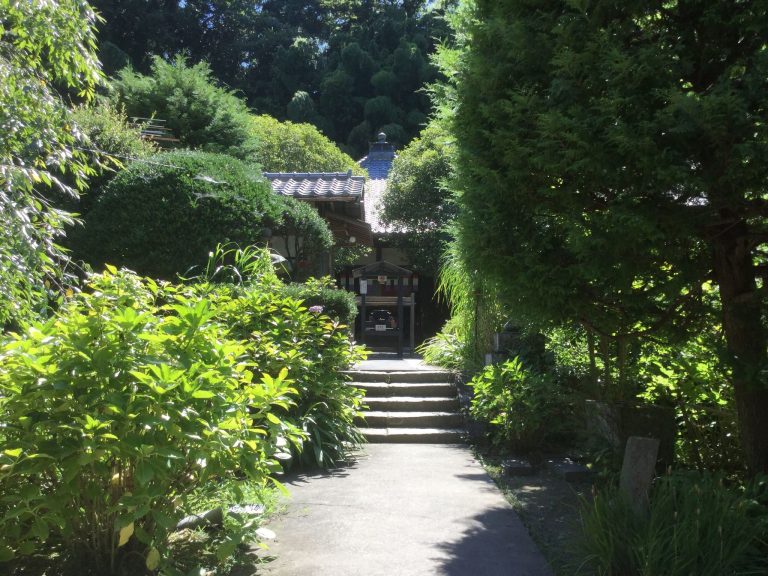
Shōmyō-ji Temple: A Jōdo Buddhist Temple in Kamakura


Site at a Glance
- Rating
- 4.1
- Popularity
- Low
- Country
- Japan
- Primary era
- Early Modern
- External website
- Open
- Eras represented
- Early Modern, Modern
- Civilizations
- Japanese, Tokugawa
- Site type
- Religious
- Remains
- Temple
On this page14 sections
History
Shōmyō-ji Temple is a Jōdo Buddhist temple in Kamakura, Japan, whose foundation tradition traces its origins to a Fudō hall established by Kūkai in 818. Jōdo Buddhism is a Japanese form of Pure Land Buddhism centered on devotion to Amida Buddha and rebirth in the Pure Land. The temple is formally called Imaizumisan Isshin-in Shōmyō-ji and is also known as Imaizumi Fudō.
Foundation tradition
The temple’s origin is connected with a story about Kūkai, the ninth-century founder of Japanese Shingon Buddhism. In the mountains, he is said to have met an elderly hermit couple who directed him to carve and enshrine images of Fudō Myōō and Daikokuten and to establish a religious center. Fudō Myōō is a wrathful Buddhist guardian deity, while Daikokuten is associated especially with prosperity and food.
Following further instructions, Kūkai excavated two holes in a nearby rock and prayed until two streams emerged. The paired falls, later called the “Yin-Yang Falls,” ended a drought in the tradition. The area had formerly been known as Kinsen-san and was thereafter called Imaizumi-san.
The medieval temple
The institutional predecessor of the present temple was founded in 1192 by a monk from the hereditary priestly family of Hakusan Shrine. It oversaw the Fudō hall and functioned as a Shingon center, teaching eight Buddhist schools rather than concentrating on a single tradition. During the Kamakura period, the temple attracted the devotion of successive Kamakura shoguns, Japan’s medieval military rulers based in Kamakura, and the Hōjō regent family.
After the fall of the Kamakura shogunate, religious support declined. The compound was abandoned and became uninhabited, while its Buddhist images were moved into caves.
Edo-period revival
A monk from Edo’s Fukagawa district revived the temple in 1684. The foundation tradition relates that, after receiving an instruction during a pilgrimage to Enoshima Benzaiten, he prayed at the abandoned temple for seven days. Each day, rice was said to spill from Daikokuten’s sack. In June 1684, a new Fudō hall and the Amida hall, which is now the main hall, were built. The temple then drew more worshippers and became associated with prayers for agricultural abundance.
In 1693, the temple became a branch of Zōjō-ji, a major Jōdo Buddhist temple in Tokyo, and changed from Shingon to Jōdo Buddhism. Zōjō-ji’s thirty-seventh head priest gave it the formal name Imaizumi-san Isshin-in Shōmyō-ji.
Later changes
A temple bell dated 1703 was surrendered in 1945 under Japan’s wartime metal-collection order and did not survive. During the Ansei era, a late Edo period lasting from 1854 to 1860, the resident priest distributed the mountain land around the temple, including the area of Sanzai-ga-ike, without payment among the hamlets of Ōfuna, Iwase, and Imaizumi. This division is associated with the name “Sanzai,” meaning scattered or dispersed.
The main hall was repaired in 2013, and the copper-roofed Imaizumi Fudō hall was rebuilt in recent times. A retreat building used by waterfall ascetics was rebuilt in 1915 and 1916, collapsed in the Great Kantō Earthquake of 1923, and was later reconstructed with a grant from the Imperial Household Agency. Its subsequent uses included protecting people recovering from psychiatric hospitalization without providing treatment, serving as a temporary naval first-aid station during the war, and sheltering repatriates after the war.
Remains
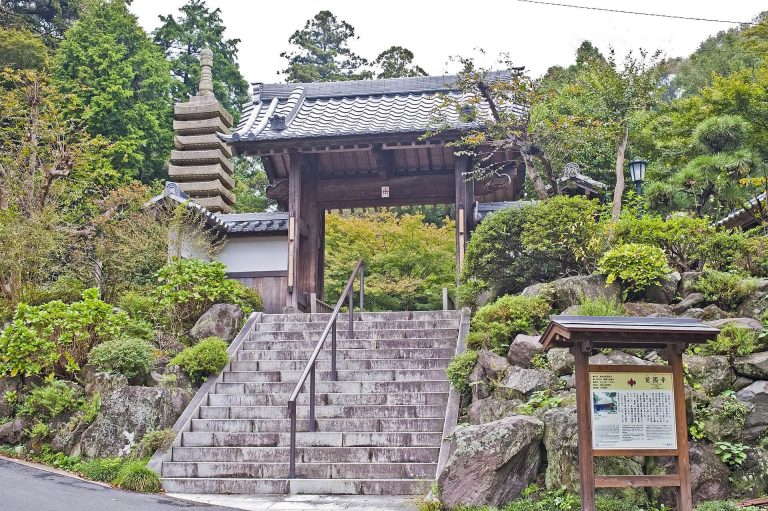
The compound is arranged as a sequence of the priests’ quarters, the main hall, the Benzaiten hall, and the study hall. Stone steps rise above these buildings to the Fudō hall, while the paired Yin-Yang Falls lie below it. Together, the buildings, steps, images, and waterfall form a religious landscape focused on the upper Fudō precinct.
Main buildings and Buddhist images
Main hall
The main hall enshrines a wooden image of Amida Buddha in the raigō form, meaning Amida’s welcoming descent to receive the dead. The image is accompanied by seated Kannon and Seishi bodhisattvas and by twenty-five bodhisattvas holding musical instruments, creating an Amida welcoming assembly. The statue was once incorrectly identified as a Heian-period work, but it was carved during the temple’s Edo-period revival. It is not open to public viewing.
Imaizumi Fudō hall
The copper-roofed Imaizumi Fudō hall stands above the other principal buildings and contains the concealed principal image of Fudō Myōō, commonly called Moto-Fudō or Imaizumi Fudō. The statue visible from outside is a secondary image accompanied by two youthful attendants and statues of the Eight Great Youths.
Benzaiten hall
The Benzaiten hall stands to the right of the main hall. It enshrines Benzaiten, a deity associated with water, music, eloquence, and prosperity, and is connected with the tradition surrounding the temple’s Edo-period revival.
Waterfall precinct and stone images
Yin-Yang Falls
Below the Fudō hall, the Yin-Yang Falls divide into two streams described as male and female. The paired waterfall was formerly used for waterfall ascetic practices, linking the physical feature with the religious activity of the upper precinct.
Images along the steps
Behind the Fudō hall, stone images of Dainichi Nyorai, the central cosmic Buddha of esoteric Buddhism, and thirty-six youthful attendants are arranged in tiers along the steps. A small stone Fudō image marks the site of the former Fudō hall, which stood farther back in the valley. A separate group of six stone Jizō figures is also enshrined within the grounds.
Former ascetic retreat
The former retreat building for waterfall ascetics was rebuilt after its collapse in the 1923 earthquake. The structure later served successively as a protective convalescent facility, a temporary naval first-aid station, and a shelter for repatriates, reflecting the changing uses of one building within the temple compound.