Nago-dera Temple: Buddhist Temple and Kannon Pilgrimage Site in Japan


Site at a Glance
- Rating
- 4.2
- Popularity
- Low
- Country
- Japan
- Primary era
- Early Modern
- External website
- Open
- Eras represented
- Early Modern
- Civilizations
- Tokugawa
- Site type
- Religious
- Remains
- Sanctuary
On this page17 sections
History
Nago-dera Temple is a Buddhist temple in Japan, located in Tateyama at the southern tip of the Bōsō Peninsula. Traditionally founded in 717, it belongs to the Chizan-ha branch of Shingon Buddhism and is devoted to Senjū Kannon, the Thousand-Armed Kannon, a form of the bodhisattva Kannon whose many arms express the ability to respond to beings in many circumstances. The temple is also known as Nago Kannon.
Foundation and temple tradition
The date of Nago-dera’s foundation remains uncertain. Temple tradition attributes its beginnings to the Buddhist holy man Gyōki, who is said to have carved a Thousand-Armed Kannon image from incense wood found in the surrounding sea. According to the legend, Gyōki enshrined the image while praying for the recovery of Empress Genshō, an eighth-century sovereign of the Japanese imperial court. After she recovered, the temple was supposedly established by imperial command. This account remains a religious tradition rather than a confirmed foundation record.
Nago-dera’s principal object of worship is associated with a mantra, and its pilgrimage hymn identifies the temple with the Pure Land of Potalaka. These associations place the temple within a long tradition of Kannon devotion, while its position on several pilgrimage circuits gave it a wider religious role in eastern Japan.
Samurai patronage
The temple became a place of worship for successive samurai groups. Minamoto no Yoritomo, later the founder of Japan’s Kamakura shogunate, prayed at Nago-dera for safety and eventual victory over the Heike after fleeing to Awa Province following his defeat at the Battle of Ishibashiyama. During the Muromachi period, the era of the Ashikaga shogunate, Nago-dera received support from Ashikaga Takauji, founder of that shogunate, and from the regional samurai lord Satomi Yoshizane.
During the Sengoku period, an era of warfare among competing regional powers, Ashikaga Fujiuji is thought to have stayed at the temple after being driven out by Hōjō Ujiyasu. Fujiuji was supported by Uesugi Kenshin and Satomi Yoshitaka in opposition to Ashikaga Yoshiuji and Ujiyasu. His companion was described in tradition either as his younger brother or as his son. The Koga kubō, an Ashikaga military and political office based at Koga, formed part of this conflict among rival branches of the Ashikaga family.
Destruction and rebuilding
A fire following the Genroku earthquake of 1703 destroyed most of Nago-dera. The Kannon-dō, or hall dedicated to Kannon, was rebuilt in 1758, and the other buildings followed somewhat later. Documents of the Takase family preserve details of this rebuilding, including construction costs, fundraising, and the collection of more than 398 ryō, a historical Japanese monetary unit, from villages throughout Awa. The merchant Iseya Jinemon gathered these contributions in 1757. The documents also describe the eye-opening ceremony for the principal Thousand-Armed Kannon.
The Kannon-dō underwent a major restoration during the Heisei era as part of a Chiba Prefecture project for the conservation of tangible cultural properties. The work was completed in 2008, followed by a ceremony and the public opening of the principal image. The restoration preserved the temple’s oldest surviving building and renewed attention to its historic Buddhist images and associated objects.
Pilgrimage and cultural protection
Nago-dera is the 33rd and final temple of the approximately 1,360-kilometer Bandō Thirty-Three Kannon pilgrimage, a circuit of Buddhist temples in the eastern Japanese region historically called Kantō. As the circuit’s final station, or ketsuganji, it completes the route that begins at Sugimoto-dera in Kamakura. Nago-dera is also the first station of the Awa Thirty-Four Kannon pilgrimage and the 56th station of the Kantō Eighty-Eight Temples pilgrimage.
Several buildings and cultural properties connected with Nago-dera have protected status at national, prefectural, or municipal level. The bronze standing Thousand-Armed Kannon is a National Important Cultural Property. The Kannon-dō, the Tahōtō, and several associated objects have prefectural protection, while the Kabuki votive tablet and the Takase family documents are protected by Tateyama City.
Remains
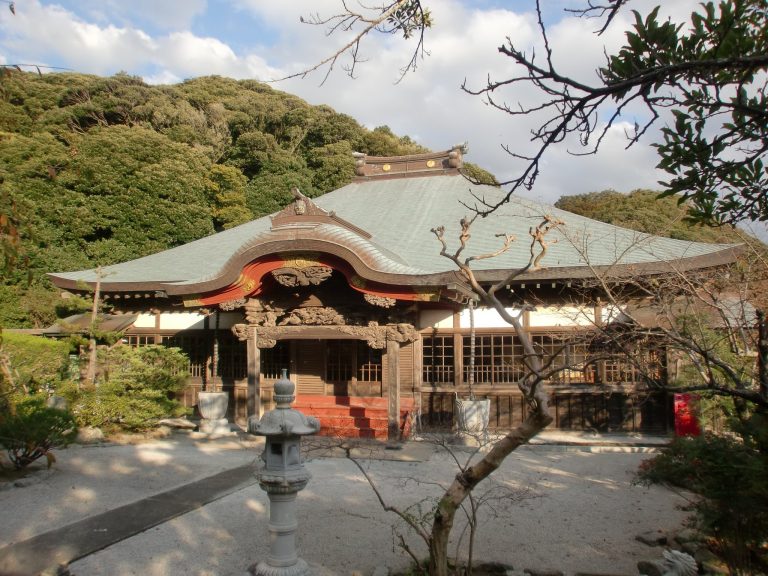
Nago-dera stands on the middle slopes of Mount Nago, within surrounding forest that includes sudajii, tabunoki, yabunikkei, camellias, and himeyuzuri. The compound includes the Niō-mon gate, the Kannon-dō, the Tahōtō pagoda, and other buildings. The principal structures occupy a sloping temple site in which the Kannon hall and pagoda form the central surviving architectural group.
Temple buildings
Kannon-dō
The Kannon-dō is an Edo-period building completed in 1758. Its plan measures five bays by five bays, with a bay representing the structural interval between columns. It is the oldest surviving structure at Nago-dera and was the principal subject of the major modern restoration. The hall’s date links its present form to the rebuilding that followed the fire after the 1703 earthquake.
Tahōtō
The Tahōtō was completed in 1761 and stands between the Kannon-dō and the Niō-mon. This Japanese pagoda form combines a lower square section with an upper cylindrical structure. A wooden Hōtō, another traditional Japanese pagoda form, occupies the central altar inside the building.
Buddhist images and paintings
Thousand-Armed Kannon
The principal image is a bronze standing Thousand-Armed Kannon from the Kamakura period and is approximately 105 centimeters high. Its head and central body were cast as one piece, while the hands were cast separately and attached at the shoulders. On each side, the hands are arranged in three levels, with six front hands, seven middle hands, and six rear hands. The front and rear hands were nailed to the middle row, whose hands were inserted into the body.
Each strand of the figure’s hair is depicted distinctly and realistically, demonstrating the high level of bronze-casting technology associated with its period. An inscription reading "Taira Tanetoki" appears on a side joint. It is thought to refer to Chiba Hachirō Tanetoki and supports an attribution to the early Kamakura period.
Hachiman as a monk
A silk painting of Hachiman as a monk was passed down to Nago-dera from Tsurudani Hachiman-gū, a Shinto shrine formerly under the temple’s control. Dating from the Nanboku-chō period, the era of rival Northern and Southern Imperial Courts in the fourteenth century, the painting measures approximately 160.5 by 106 centimeters. Hachiman sits in the lotus position beneath a red sun wheel, holding a staff in his right hand and a rosary in his left, with smaller figures placed on either side.
Seated Amida Nyorai
An approximately 140-centimeter seated wooden image of Amida Nyorai, the Buddha of the Pure Land tradition, dates from the Kamakura period. The figure was carved from a single piece of cypress and coated with black lacquer. Its wooden eyes are thought to have replaced original crystal eyes. An ink inscription inside the statue records a repair carried out in 1324.
Manuscripts and votive objects
Embroidered Lotus Sutra chapter
The embroidered Universal Gateway chapter of the Lotus Sutra was produced in China during the Yuan dynasty, the Mongol-led dynasty that ruled China from 1271 to 1368. It is worked on white silk with indigo silk thread, while the character for Buddha is sewn in gold thread. Its endpapers contain colored miniature paintings of the Buddha, Fugen Bosatsu, the bodhisattva Samantabhadra, and two Tenbu, or Buddhist celestial beings, together with a depiction of the Eleven-Headed Kannon. A colophon records its production in 1361 by a daughter of the Yao clan of Jiading in Pingjiang Prefecture, with the cooperation of many women. The manuscript was given to Nago-dera in 1702, while the circumstances of its arrival in Japan are unknown.
Kabuki votive tablet
The Kabuki votive tablet is painted on a cedar board measuring 121 by 152 centimeters. It presents a scene from the play Kokin Brothers Hei Soga, in which Asahina Saburō pulls at Sōga Gorō’s armor. Sōga Gorō is thought to represent Ichikawa Danjūrō I, while Asahina Saburō is believed to represent Nakamura Denkuro. The artist used a distinctive gourd-foot worm painting technique, combining earthworm-like lines with inverted-gourd forms to convey physical force. The painter is therefore speculated to have been Torii Kiyomasu. An inscription on the reverse dates the tablet to April 15, 1725.
Takase family documents
The Takase family documents preserve the practical and ceremonial history of the post-earthquake rebuilding. They record the reconstruction of the Kannon-dō and Tahōtō, construction expenses, fundraising, and the contributions collected from villages throughout Awa. They also preserve an account of the eye-opening ceremony for the principal Thousand-Armed Kannon, connecting the surviving buildings with the religious renewal that followed the destruction of 1703.