Honnō-ji Temple: A Nichiren Buddhist Temple in Kyoto


Site at a Glance
- Rating
- 4.1
- Popularity
- Medium
- Country
- Japan
- Primary era
- Modern
- External website
- Open
- Eras represented
- Early Modern, Modern
- Civilizations
- Japanese
- Site type
- Religious
On this page16 sections
History
Honnō-ji Temple is a major Hommon-branch Nichiren Buddhist temple in Kyoto, Japan, founded in the fifteenth century and centered on devotion to the Lotus Sutra. Its principal object of worship is Namu Myōhō Renge Kyō, the devotional formula affirming dedication to the Lotus Sutra and its eight-chapter teaching. The temple later became one of Kyoto’s 21 Lotus Buddhist temples and developed a wide religious and political network.
Foundation and early relocations
In 1415, the monk Nichiryū left Myohon-ji after a dispute over the interpretation of the Lotus Sutra. With the support of his uncles, he established a predecessor institution called Hon’ō-ji. Its first site lay between Gojo-Bomon, Takatsuji, Nishitōin, and Aburanokōji streets.
Myohon-ji’s fifth abbot ordered the destruction of the first temple in 1418 after the doctrinal dispute. Nichiryū then moved first to Mitsui in Kawachi and later to Amagasaki, where he was associated with Honkō-ji. He returned to Kyoto in 1429 and rebuilt the institution near Senbon-Gokuraku in Uchi, at the site of the former imperial palace. The donor Kosodeya Sōku supported this reconstruction.
In 1433, Nyoio Maru gave the temple land west of Rokkaku-Ōmiya and north of Shijō-Bōmon. The institution moved there and adopted the name Honnō-ji. It prospered as a center for spreading the Lotus Sutra, and in the later medieval period it became one of Kyoto’s 21 Lotus temples under the protection of the Ashikaga shogunal house.
Growth and destruction in the sixteenth century
After the Ōnin War, Kyoto was rebuilt in large part by townspeople affiliated with the Lotus tradition. Their religious support helped the faith expand through the city, and Honnō-ji became particularly prosperous. Its precinct occupied approximately one square town block between Rokkaku and Shijō-Bōmon streets and between Kushige and Ōmiya avenues, with numerous subsidiary institutions.
In 1536, the Tenbun disturbance, an armed conflict between Enryaku-ji’s warrior-monks and adherents of the Lotus tradition, brought destruction to Honnō-ji. The attackers burned every building in the temple complex, and the religious community evacuated to Kenpon-ji in Sakai.
After the community returned to Kyoto, Nisshō entered Honnō-ji and became its eighth abbot. He was a son of Prince Kunitaka of the Fushimi-no-miya line. In 1545, the temple was re-established between Nishitōin and Aburanokōji avenues and between Rokkaku and Shijō-Bōmon streets. More than 30 subsidiary institutions were associated with this complex.
Honnō-ji and Honkō-ji of Amagasaki maintained a distinctive organization in which one head abbot served both temples. Under Nisshō, affiliated temples spread through Kinai, the region surrounding Kyoto, Hokuriku along the Sea of Japan, the Inland Sea region, and as far as Tanegashima. This network formed a Hommon religious organization centered on Honnō-ji.
The temple’s missionaries reached Tanegashima at an early date, bringing Honnō-ji into contact with the acquisition of firearms and gunpowder. These connections also brought the institution into close relationships with warlords of the Sengoku period, the era of political fragmentation and military competition in sixteenth-century Japan.
The Honnō-ji Incident
Oda Nobunaga, a powerful warlord who sought to consolidate political control in Japan, used Honnō-ji as lodging during visits to Kyoto. He generally stayed at Myōkaku-ji and used Honnō-ji four times. On 21 June 1582, while his son Oda Nobutada was staying at Myōkaku-ji, Nobunaga lodged at Honnō-ji and was attacked there by forces led by his general Akechi Mitsuhide.
The attack, known as the Honnō-ji Incident, set the temple buildings on fire. Nobunaga is traditionally said to have started the fire himself before performing seppuku, a form of ritual self-disembowelment historically practiced by samurai. The contemporary Shinchō kōki also records that he disemboweled himself at Honnō-ji, but no body was found, leaving the precise circumstances uncertain. Honnō-ji is nevertheless generally regarded as the place of his death.
On 16 June 1582, Oda Nobutaka displayed the severed head and body of Mitsuhide, together with the remains of 3,000 of his followers, at the burned site as an offering for Nobunaga. On 4 July, Nobutaka ordered the area developed as Nobunaga’s residence to become a burial ground and instructed the dispersed priests to return.
Relocation and later rebuilding
In 1591, Toyotomi Hideyoshi, who succeeded Nobunaga in the political struggle that followed his death, ordered Honnō-ji to move to its present precinct in Shimohonnoji-mae-cho, Nakagyo Ward. The new buildings were completed in 1592 on an extensive site that included parts of the present Oike Street and the Kyoto City Hall area.
In 1615, the Edo shogunate granted Honnō-ji a 40-koku red-seal estate. A koku was a historical Japanese measure of rice-based land income, so the grant expressed officially assigned revenue. A register from 1633 lists 92 affiliated temples, confirming the institution’s scale during the Edo period.
The Great Tenmei Fire of 1788 destroyed the temple, which was rebuilt in 1840 by the priest Nichion. The buildings burned again in 1864 during the Kinmon Incident, an armed clash in Kyoto near the gates of the imperial palace, and the associated citywide fire. The spread of the fire has been explained in two ways: a traditional account attributes it to the neighboring Chōshū domain residence, while another holds that Satsuma artillery fire destroyed that residence and Honnō-ji beforehand.
Reconstruction of the main hall was delayed by the Meiji suppression of Buddhism and related institutional changes. The precinct was also reduced when Oike Street was widened. The lecture hall of Daikigatani Danrin, formerly Ryūkan-ji in present-day Fushimi Ward, was moved to Honnō-ji for use as a temporary main hall. A new main hall designed by Kyoto University professor Shun’ichi Amanuma was completed in 1928, and the main halls of the seven subsidiary institutions were rebuilt in the same year.
Honnō-ji’s chief priest is called the kanju, meaning the head abbot of a major temple. The 140th kanju is Momoi Nichiei, who entered the position from Honshō-ji in Tsuruga, Fukui Prefecture. Archaeological investigations after the closure of Kyoto Municipal Honnō Elementary School in 1992 identified remains associated with the former Honnō-ji complex where Nobunaga had regularly lodged. Apartment construction in 2007 led to a further investigation that recovered roof tiles believed to have been burned in the Honnō-ji Incident.
Remains
Present precinct
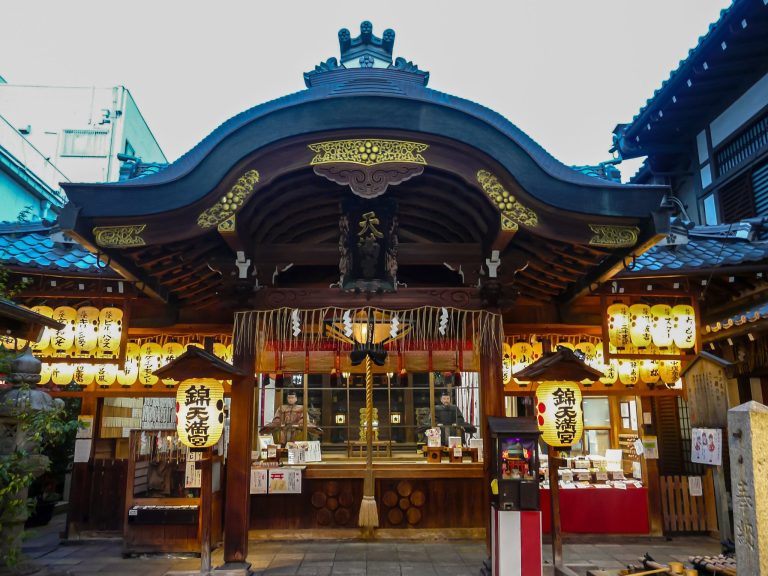
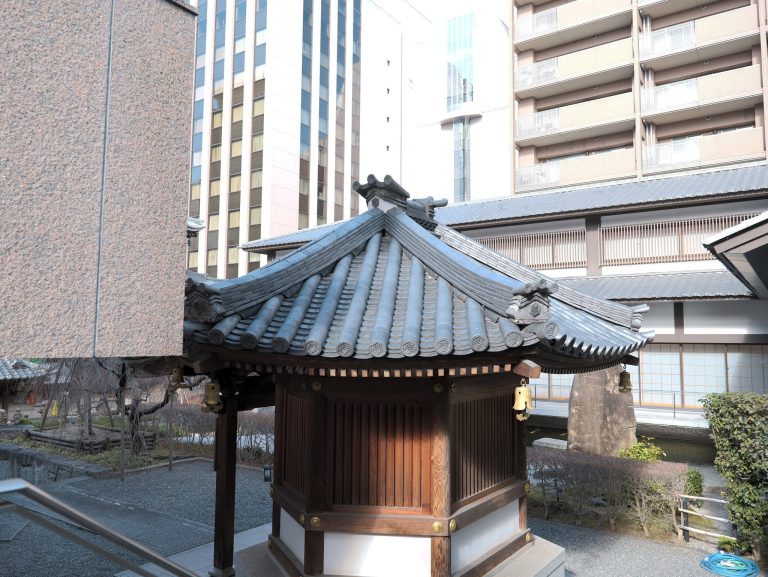
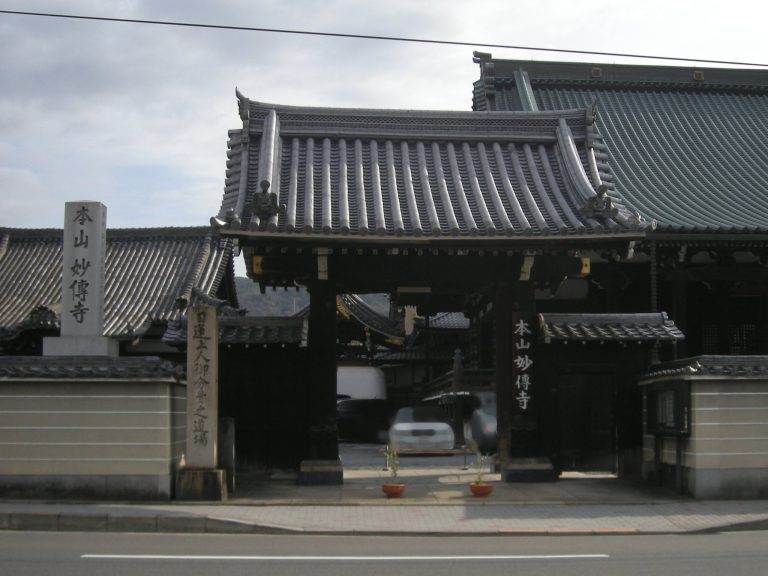
Honnō-ji now stands in Shimohonnoji-mae-cho in Nakagyo Ward. Its gate faces the Teramachi specialist shopping street, and the precinct contains the main temple and seven subsidiary institutions: Eshoin, Renshoin, Jōshōin, Kōshun-in, Hongyoin, Genmyoin, and Ryūun-in. The present complex reflects the rebuilding that followed the destruction of the nineteenth century.
Main hall
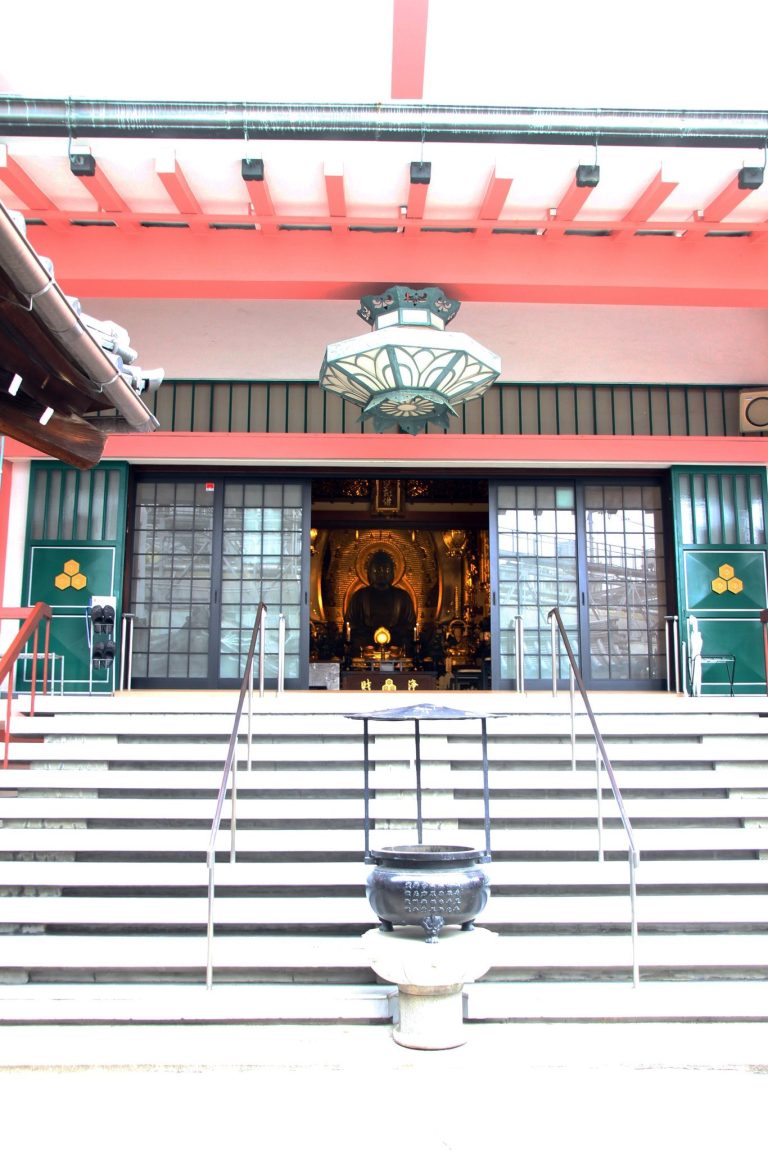
The present main hall was completed in 1928 to a design by Shun’ichi Amanuma. It houses the temple’s principal image, Namu Myōhō Renge Kyō, associated with the eight chapters of the Lotus Sutra and the teaching transmitted by Jōgyō. Its construction formed part of the wider rebuilding of Honnō-ji and its subsidiary institutions in the same year.
Subsidiary institutions
The seven subsidiary institutions preserve the internal organization of the precinct. Ryūun-in was founded by Ryūun-in Nissei Daitoku, with Sugiwaka Echigo-no-kami as founder-donor, and its present main hall dates from 1928. Genmyoin was founded by Nichigyō, Honnō-ji’s 13th abbot, while Hongyoin was founded by Nisshō, the temple’s 12th abbot. The main halls of Hongyoin, Kōshun-in, Jōshōin, Renshoin, and Eshoin were rebuilt in 1928. Eshoin had originally been founded in 1574 by the monk Kusebo Ryūei.
Former precinct and archaeological remains
Medieval complex
The medieval Honnō-ji precinct occupied approximately one square town block. The complex established in 1545 extended for roughly 120 metres on each side and contained more than 30 subsidiary institutions. Descriptions of the late sixteenth-century temple also record about 30 buildings and substantial fortifications, reflecting the scale of the institution before its relocation under Toyotomi Hideyoshi.
Excavated structures
The former site lies around present-day Motohonnoji-minami-cho, where a stone monument marks its location. Excavations have revealed structural remains associated with the temple and with the lodging complex used by Oda Nobunaga. These discoveries connect the surviving urban landscape with the sixteenth-century institution destroyed during the Honnō-ji Incident.
Burned roof tiles
Excavation at the former site recovered roof tiles apparently burned in the Honnō-ji Incident. A round roof tile found in sludge from the moat bears an older graphic form of the character used in the temple’s name. Honnō-ji is widely associated with this older form of the character “能.” Temple tradition explains its use as an avoidance of a fire-related element linked with repeated burnings, although the form was a widely used traditional regular-script variant before the modern form became dominant after the spread of the Kangxi Dictionary in the Meiji period.
Objects and memorials
Calligraphic scroll
Among the cultural properties associated with Honnō-ji is an eleventh-century, late-Heian calligraphic scroll attributed to Fujiwara no Yukinari. Known as the “Honnō-ji fragment,” it consists of four sheets of paper joined into a scroll. The text contains Chinese prose by Ono no Takamura, Sugawara no Michizane, and Ki no Haseo, written in Japanese-style calligraphy.
Nobunaga mausoleum
A mausoleum honoring Oda Nobunaga stands within the present temple precinct. The temple’s cultural properties also include an imperial calligraphic greeting by Emperor Hanazono and a bronze mirror, both designated Important Cultural Properties. In 2020, 319 artifacts from the former Honnō-ji site were designated Kyoto City tangible cultural properties.