Zenpuku-ji Temple: A Historic Jōdo Shinshū Temple in Tokyo


Site at a Glance
- Rating
- 4.2
- Popularity
- Low
- Country
- Japan
- Primary era
- Early Modern
- External website
- Open
- Eras represented
- Early Modern, Modern
- Civilizations
- Tokugawa
- Site type
- Religious
- Remains
- Temple
On this page16 sections
History
Zenpuku-ji Temple is a historic Buddhist temple in Tokyo, Japan, traditionally founded in 824 by Kūkai as a Shingon Buddhist temple. Also known as Azabu-san, it is now a Jōdo Shinshū Honganji-ha temple and is regarded as one of Tokyo’s oldest temples. Its history encompasses the transformation of Japanese Buddhist institutions, the protection of military governments, and the establishment of the first American diplomatic legation in Tokyo.
From Shingon foundation to Jōdo Shinshū temple
During the Kamakura period, an era politically dominated by warrior governments, the monk Shinran visited Zenpuku-ji. Shinran founded the Jōdo Shinshū tradition, a major school of Japanese Pure Land Buddhism centered on devotion to Amida Buddha. His disciple Ryōkai later converted the temple to Jōdo Shinshū, after which it developed under the protection of successive emperors and military governments. Zenpuku-ji came to be regarded as one of the seven major Jōdo Shinshū temples in the Kantō region.
Conflict and military protection
During the Ishiyama Hongan-ji War of 1570 to 1580, a prolonged conflict between Oda Nobunaga and fortified religious leagues known as the Ikkō-ikki, Zenpuku-ji sent reinforcements to the Ishiyama Hongan-ji forces in Osaka. After the conflict, Toyotomi Hideyoshi declared peace and pledged to protect the temple’s holdings.
The third shogun, Tokugawa Iemitsu, later donated a new main hall to Zenpuku-ji. A shogun was Japan’s military ruler under the Tokugawa shogunate, and this hall eventually became the site of an important diplomatic development.
The first American legation
Under the 1859 Treaty of Amity and Commerce, the first American diplomatic legation in Tokyo was established at Zenpuku-ji under Consul-General Townsend Harris. A diplomatic legation was the official mission of a foreign government in another country. The legation’s 18 or 19 members occupied the south side of the main hall and several rooms in an annex. Samurai from the Mito Domain who opposed foreign influence later attacked and burned the annex.
When Harris returned to the United States, he gave the temple’s abbot 100 ryō of gold in appreciation for the temple’s hospitality. Henry Heusken, Harris’s interpreter, was attacked by rōnin, or masterless samurai, on January 14, 1861. He was taken to Zenpuku-ji, where he died. His funeral procession from the temple to nearby Korinji became a major confrontation between the shogunate government and foreign diplomatic missions.
Masuda Takashi, who later founded Mitsui, served as an interpreter at the legation when he was 14. Fukuzawa Yukichi, the founder of Keiō University, also had connections with Zenpuku-ji and was buried there.
War damage and later continuity
The temple was damaged during the Great Tokyo Air Raid in 1945. The main hall that had housed the American legation was destroyed in an air raid in May of that year. A replacement hall was moved from Higashi-Hongan-ji Yao Betsuin and rebuilt at Zenpuku-ji in 1961; it was renovated in 2008.
The temple’s precincts and surrounding land influenced the development of nearby place-names. The settlement in front of the gate was formally recognized as a temple-front town in 1652 and renamed Yama-moto-cho in 1869. Neighboring districts formerly known as the eastern and western temple-front areas were likewise renamed Azabu-higashi-cho and Azabu-nishi-cho. The belief that Azabu derives from the temple’s mountain name remains one explanation among several.
Zenpuku-ji is designated as a historical site by the Tokyo Metropolitan Government. Its ginkgo tree received national designation as a natural monument in 1926. The temple continues to serve religious and commemorative purposes. A memorial observance for Fukuzawa Yukichi is held on February 3, and people connected with Keiō University visit his grave. In 2000, the funeral of Andy Hug was held at the temple.
Remains
Zenpuku-ji’s surviving precinct includes the temple buildings, an approach with a historic well, a cemetery, commemorative monuments, and a large ginkgo tree at the cemetery entrance. The formal name of the temple is Azabu-san Zenpuku-ji, its principal Buddhist image is Amida Nyorai, or Amitabha Buddha, and its middle gate is a chokushimon, an imperial-messenger gate.
Temple buildings and diplomatic memorials
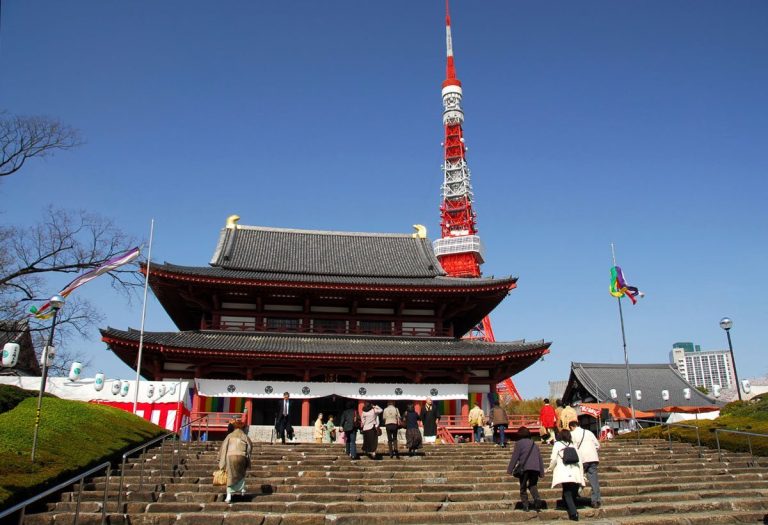
Main hall
The present main hall was moved from Higashi-Hongan-ji Yao Betsuin and rebuilt at Zenpuku-ji in 1961 after the earlier hall was destroyed in 1945. The replacement preserves the function of the temple’s principal building and was renovated in 2008.
American legation monument
A monument stands on the former site of the American legation. Its inscription commemorates Townsend Harris’s opening of the first American Legation in Japan in 1859 and records its dedication by the America-Japan Society on December 19, 1936. During the Second World War, anti-American sentiment made the monument a target, but the temple’s abbot protected it from damage.
Historic water source and ginkgo
Upside-down ginkgo
The upside-down ginkgo stands at the entrance to the cemetery. Tradition attributes its planting to Shinran, who is said to have struck or planted his staff in the ground before it took root and grew into the tree. Estimated to be more than 750 years old, it is approximately 20 meters tall and 10 meters in circumference, and is described as the largest ginkgo in Tokyo. Its lower branches extend downward, creating the appearance that gave rise to its name. Air-raid damage reduced the tree’s size.
Willow Well
The Willow Well lies along the approach to the temple. Tradition attributes its spring to Kūkai, who is said to have planted his ritual staff beneath a willow tree. A small amount of water still emerges from the well. It supplied drinking water to many people during the Great Kantō Earthquake and the 1945 air raid.
Cemetery and commemorative features
Fukuzawa Yukichi’s grave
The cemetery contains the grave of Fukuzawa Yukichi. It was moved to Zenpuku-ji in 1977 from a temple in Kami-Osaki, Shinagawa, linking the cemetery with the university community that continues to commemorate him.
Koshiji Fubuki monument
A stone monument to the Shōwa-era singer Koshiji Fubuki stands within the temple precincts. It bears the lyrics of her signature song, “Hymn to Love.” Her grave is elsewhere, in Kawasaki.
Land associated with the precinct
Azabu-san Kindergarten adjoins the temple precincts. The high-rise complex now known as Motoazabu Hills occupies land formerly owned by Zenpuku-ji. Mori Building acquired the property in 1983 and later developed the complex. Tradition also associates the name Toranomon with a former gate of Zenpuku-ji, although another explanation connects it with a gate of Edo Castle.
Another tradition holds that Zenpuku-ji Pond in present-day Suginami takes its name from a former inner sanctuary of this temple in the pond area. The relationship remains disputed because the Suginami temple bearing the name was abandoned during the Edo period and has limited historical documentation.