Omura Shrine: A Historic Shinto Shrine in Kochi, Japan
Site at a Glance
- Rating
- 5
- Popularity
- Very Low
- Country
- Japan
- Primary era
- Early Modern
- External website
- Open
- Eras represented
- Early Modern
- Civilizations
- Tokugawa
- Site type
- Religious
- Remains
- Sanctuary
On this page15 sections
History
Omura Shrine is a Shinto shrine in Hidaka, Japan, traditionally said to have been founded in 587 during the reign of Emperor Yomei. Its foundation date and circumstances remain uncertain, but the shrine’s long history is connected with Kunitokotachi, a primordial Shinto kami associated with the establishment and ordering of the land, and with an ancient sword preserved as its sacred object.
Origins and early traditions
Several traditions explain the shrine’s beginnings. One connects Kunitokotachi and the sword shintai, a physical object believed to embody or house a kami, with the ancient Takadake and Kusakabe lineages and their ancestral ties to Kusaka Estate in Takaoka District. Another attributes the foundation to Ochi no Mikoto, a legendary ancestor associated with the Ochi kuni no miyatsuko, a hereditary local chieftaincy. In that account, Ochi no Mikoto reached the area and enshrined Kunitokotachi as a deity concerned with developing the land. A further interpretation holds that the sword itself was the original focus of worship, before the deity was defined in its later form.
The shrine’s position is understood in relation to an ancient elite that controlled the Niyodo River system. A foundation tradition says that the shrine first stood in what is now Kuma Kogen Town in Ehime Prefecture. A flood carried it to Miyaji in present-day Ochi, and another major flood in 861 swept away both the sword and the buildings. The shrine was then moved first to Kamiya and later to its present location in Hidaka.
Recognition and medieval rebuilding
The deity Omura no Kami received promotion from junior fifth rank, lower grade, to junior fifth rank, upper grade, on March 5, 870. The promotion is recorded in the Nihon Sandai Jitsuroku, an official historical chronicle. Omura Shrine is therefore classified as a kokushi genzaisha, a shrine known from the ancient official histories but not included in the Engishiki, a shrine register compiled in the early tenth century. In medieval religious practice, the shrine’s Buddhist counterpart, or honji, was Dainichi Nyorai, the Buddha of supreme cosmic illumination.
Two roof plaques, from 1240 and 1347, preserve details of rebuilding and repair. These munafuda, wooden roof plaques that record construction information, show that responsibility for the work increasingly shifted from provincial governors to local estate stewards. They also identify the middle and upper Niyodo River areas of Agawa, Beppu, and Yokokawa as sources of timber.
By the medieval period, Omura Shrine was regarded as Tosa Province’s second-ranking shrine, subordinate to Tosa Shrine, and was styled “Second Shrine, Omura Great Tenjin.” The Ohira family, lords of Hasuike Castle, later protected it. In 1503, Ohira Kunio is said to have dedicated a set of painted plaques depicting the Thirty-Six Poets.
Warring States and early Edo periods
During the Warring States period, a head-house organization came to administer the shrine’s rites. A record from 1543 lists eleven head-house households. This system continued into the annual autumn festival, preserving a form of communal worship from a time when the shrine had no permanent resident priests.
A land survey conducted in 1588 lists shrine-owned rice lands extending across Kusaka Village and neighboring Namikawa Village. The areas known as Miyatoko and Baba were exempted from the survey. After the Yamauchi family entered Tosa Province in the early Edo period, the shrine’s former estates were confiscated. Under the allocation of holdings in 1602, the shrine received two tan of rice land, while another two tan were assigned to its associated temple.
That temple, Jinguji, was known as Omurayama Shoko-in Jinguji. It was abolished during the Meiji-period separation of Buddhism and Shinto, a government policy that formally divided the two religious traditions.
Modern status and continuing rites
Omura Shrine was classified as a prefectural shrine in February 1868. Its official name, which had included forms such as Omura Great Tenjin, was changed to Omura Shrine in 1870. Its status was later reduced to that of a district shrine, but prefectural-shrine rank was restored in 1924.
The shrine’s present buildings date from 1705. The complex and its sacred Botansugi cedar are designated cultural properties by Hidaka Village. Other protected objects include the gilt-bronze sword, bodhisattva masks, Hōrai-design mirrors, historical plaques, and ritual objects. The 1240 and 1347 roof plaques became prefectural cultural properties in 2000.
The autumn festival takes place on November 15. A representative parishioner is selected, and rites are held at that person’s head-house. The Onabare procession then leaves the house with a mikoshi, a portable shrine, and large drums before traveling through the village. Known as the Head-House Onabare, this practice is designated an intangible folk cultural property by Hidaka Village. Other observances include the spring prayer festival on March 7, the summer grand festival on July 20, and the Niiname Festival on December 14.
Remains
Omura Shrine’s surviving complex combines a principal sanctuary, offering hall, and worship hall in a connected arrangement. Its most important sacred object is a gilt-bronze straight sword dating from the first half of the seventh century, while wooden masks, bronze mirrors, plaques, and other ritual objects preserve evidence of the shrine’s long religious history.
Shrine buildings and sacred tree
Main sanctuary and halls
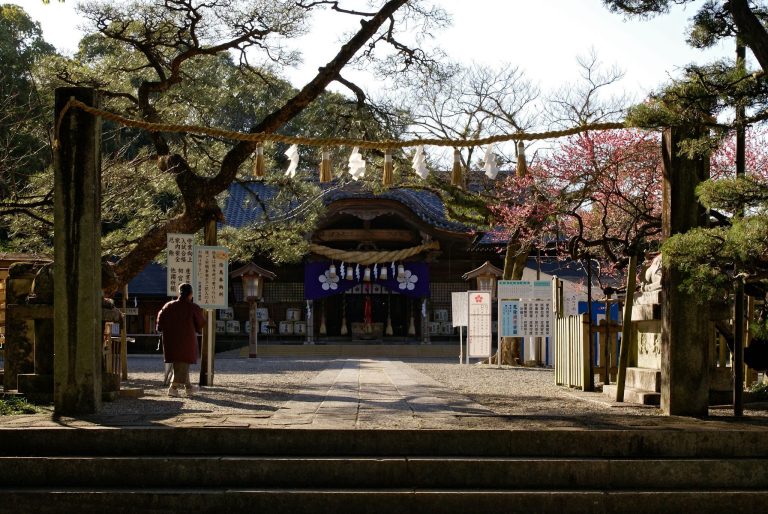
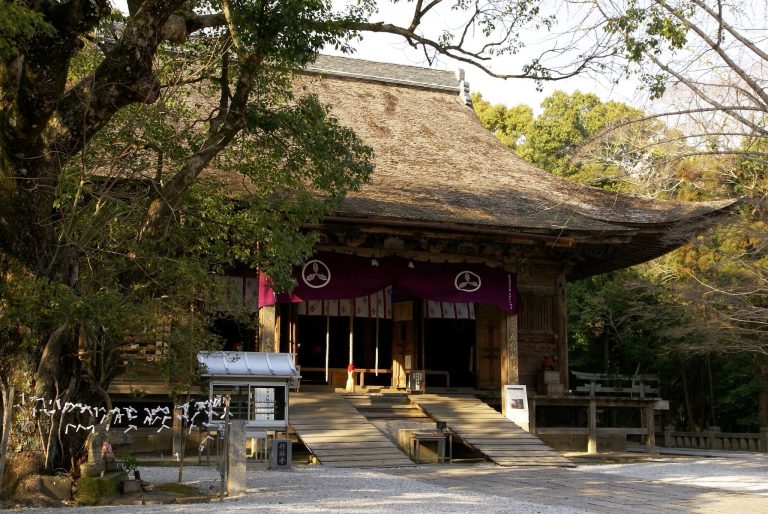
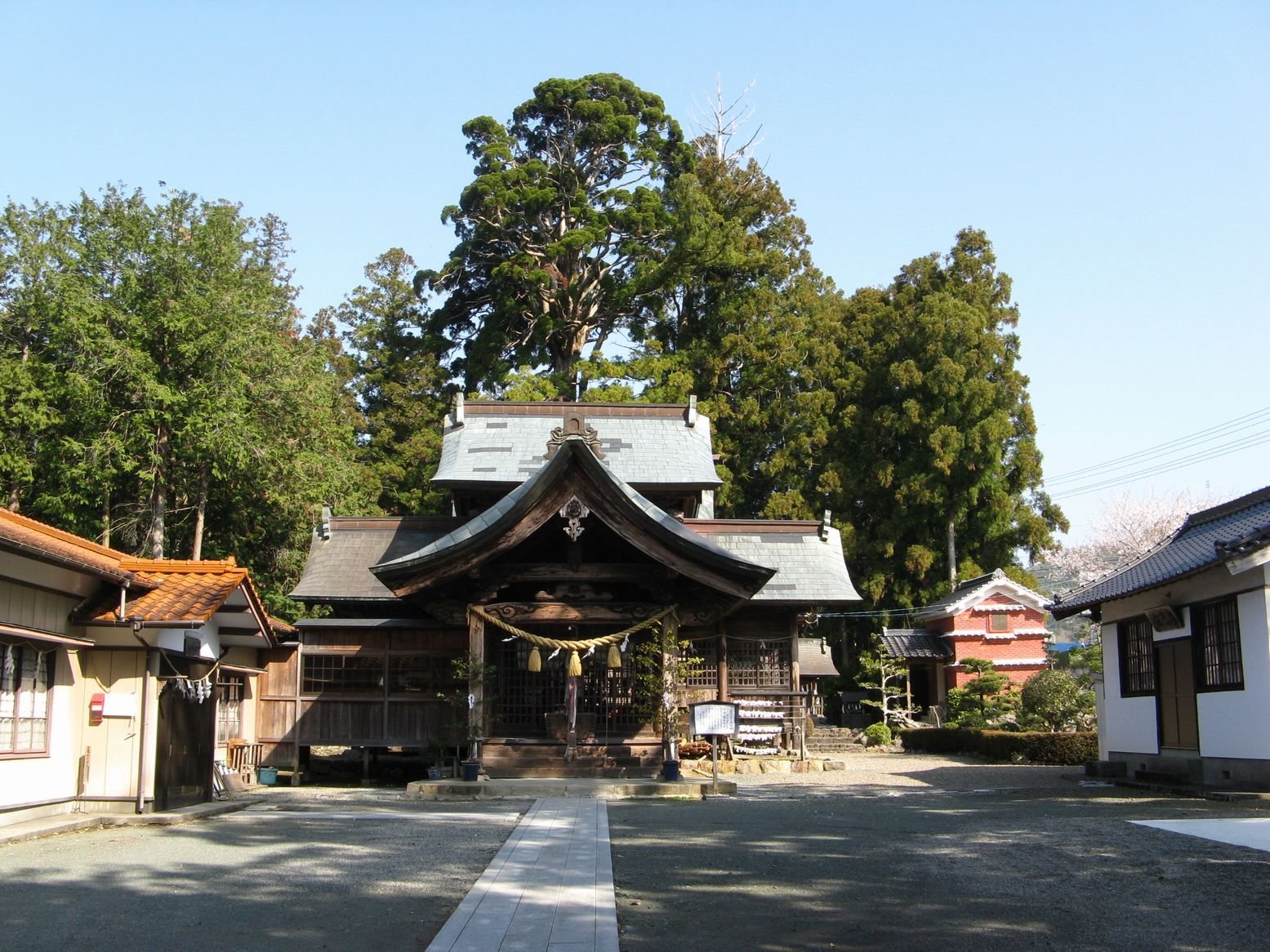
The complex consists of a honden, the principal sanctuary, a heiden, or offering hall, and a haiden, or worship hall. The honden follows the nagare-zukuri style, characterized by a sweeping gabled roof whose front slope extends over the worship space. It has a copper-sheet roof, as do the connected offering and worship halls. Together, the buildings form a cross-shaped plan described as an “emerging dragonfly” arrangement, with the worship hall serving as the head. A comparable arrangement is found at Wakamiya Hachimangu in Nagahama, Kochi.
Botansugi cedar
Behind the main sanctuary stands the sacred Botansugi, also called Tōmyō-sugi, or “votive-light cedar.” The Japanese cedar is traditionally regarded as 1,000 years old. It is about 25 meters high, with a trunk diameter of approximately 270 centimeters measured at breast height. Its lower branches have ordinary cedar leaves, while the upper branches carry unusual peony-cedar-type leaves. Hidaka Village designates the tree as a natural monument.
Local tradition says that a sacred fire appeared in the tree’s crown during extraordinary events, including the Niyodo River flood of 1705, the Ansei-Nankai earthquake of 1854, and the Russo-Japanese War. This tradition is associated with the tree’s name and religious meaning.
Sacred sword and ritual objects
Gilt-bronze sword
The shrine’s shintai is a gilt-bronze ring-pommeled straight sword and its fittings. It is a National Treasure dating from the first half of the seventh century, at the end of the Kofun period and during the Asuka period. Its precise connection with the shrine is unknown, but it has been enshrined deep within the main sanctuary since at least the tradition preserved in the Nanroshi.
The sword has a straight, single-edged blade, with a gilt-bronze-covered hilt and scabbard. It measures approximately 119 centimeters overall. The pommel is 7.4 centimeters, the hilt 19.4 centimeters, the scabbard 92.1 centimeters, the blade 68.3 centimeters, and the tang 11.2 centimeters. The sword weighs 527 grams.
Its openwork gilt-bronze pommel contains a double-dragon design. Gilt-bronze plates cover the wooden hilt and scabbard. Metal bands divide the hilt into two sections, one decorated with an X-shaped pattern and the other with a continuous zigzag made by dotted punching. Fittings and bands divide the scabbard into four sections. Its central exterior has a raised beaded pattern, while the reverse carries a zigzag design.
The sword is an important surviving example in the history of Japanese blades because it was transmitted as an heirloom rather than excavated. It was examined during a national investigation in 1955, designated an Important Cultural Property in 1956, and elevated to National Treasure status in 1958. The original is displayed publicly during the autumn grand festival on November 15. A replica made in 2014 is displayed in Hidaka Village Hall.
Masks, mirrors, and other treasures
Two late-Heian wooden bodhisattva processional masks are preserved at the shrine. Each was carved from a single block of camphor wood and retains painted surfaces. One measures 36.0 by 21.0 centimeters and the other 36.0 by 21.2 centimeters. Their full cheeks and gentle expressions are characteristic of masks made for processions in the late Heian period. A third wooden bodhisattva processional mask dates from the Kamakura period and is regarded as the same type as the two older masks, though secondary in status.
Two Japanese bronze mirrors made in 1362 have Hōrai designs, referring to the legendary island or mountain paradise associated with immortality in East Asian tradition. One is rectangular, measuring 15.7 by 10.2 centimeters, and the other is circular, with a diameter of 19 centimeters. The rectangular mirror bears an inscription recording its dedication by Fujiwara Shigetoshi on August 17, 1362. The pair appears to have been treated together as a sacred mirror.
The shrine also preserves two bronze hoko, or halberds, from the Yayoi period. They are interpreted as Chikushi-type weapons and measure 76.3 and 82.2 centimeters. A middle-Heian Sue-ware jar with two handles is said to have been recovered from a pond, with a tradition that three swords were inside it. A vertical plaque bearing the surviving words “Village Great Tenjin” is traditionally attributed to the Heian-period calligrapher Ono no Michikaze and is said originally to have carried the longer inscription “First Rank, Omura Great Tenjin.”
Among the shrine’s literary objects is a waka, a classical Japanese poem of thirty-one syllables, written on a tanzaku, a narrow poem strip, in the hand of Emperor Go-Nara. His handwriting was authenticated in 1960 during an examination conducted for national museum cultural-property protection authorities. Nine painted wooden hengaku, or dedicatory plaques, depict the Thirty-Six Poets and are traditionally attributed to Ohira Kunio, with a reported dedication in December 1503.
Subsidiary shrines
Niida, Tsurugi, and Akiba shrines
The precincts include Niida Shrine, dedicated to Yamanokami and five other deities; Tsurugi Shrine, dedicated to Soga Goro and Soga Juro and associated with the legend of “Sword Climbing the Rapids”; and Akiba Shrine, dedicated to Okuninushi and other deities. Like the main shrine, all three use swords as their sacred objects.
Branch shrines
Wakamiya Shrine and Suijin Shrine are branch shrines situated on separate parcels of shrine land. Their relationship to the wider shrine estate forms part of the surviving religious organization associated with Omura Shrine.