Urasoe yōdore: Royal Mausoleum of the Ryukyu Kingdom


Site at a Glance
- Rating
- 4.4
- Popularity
- Very Low
- Country
- Japan
- Primary era
- Medieval
- External website
- Open
- Eras represented
- Medieval, Early Modern
- Civilizations
- Ryukyu Kingdom
- Site type
- Religious
- Remains
- Tomb
On this page11 sections
History
Urasoe yōdore is a royal mausoleum of the Ryukyu Kingdom in Urasoe, Japan, traditionally associated with the thirteenth-century ruler Eiso and with King Shō Nei and their families. Tradition dates its foundation to 1261, during Eiso’s reign, while archaeological investigations place its initial construction in the thirteenth century. A Korean roof tile bearing a cyclical date corresponding to 1273 has made that year the leading proposed date for the mausoleum’s construction.
Royal Mausoleum and Remodelling
The complex was substantially remodelled twice after its initial construction, first during the reign of King Shō Hashi and later during the reign of King Shō Nei. Urasoe yōdore is one of three royal mausoleums associated with the Ryukyu Kingdom, together with Tamaudun at Shuri Castle and Izena Tamaudun near Izena Castle. The Ryukyu Kingdom was the historic kingdom centred on the Ryukyu Islands, including Okinawa, before its annexation by Japan in the nineteenth century.
The burials at Urasoe yōdore are associated with Eiso, Shō Kōgō of the Oroku Palace line, Shō I, King Shō Nei, and Shō Ransō, Shō Nei’s queen consort. The complex is also described as containing the remains of three rulers of the Ryukyu Islands and one later Ryukyu king whose burial was separated from the earlier interments by several centuries.
King Shō Nei
King Shō Nei, who lived from 1564 to 1620, was buried at Urasoe yōdore rather than at Tamaudun, the mausoleum of the Shō family. His reign included Satsuma’s invasion of Ryukyu and the kingdom’s subsequent subordination to Satsuma suzerainty. Satsuma was a Japanese domain based in southern Kyushu. Its military intervention left the Ryukyu Kingdom with a formal royal government while placing it under Satsuma’s authority. A tradition holds that Shō Nei considered himself unworthy of burial with his ancestors because of these events.
A prewar stone monument called the Yōdore Inscription described Shō Nei’s succession to the throne from Urasoe and identified the mausoleum as Eiso’s tomb. It also stated that the complex had been repaired to receive the remains of Shō Nei’s grandfather, Shō Kōgō, and his father, Shō I, and that Shō Nei would eventually be buried there.
War Damage and Restoration
Urasoe yōdore suffered extensive damage during the 1945 Battle of Okinawa. The upper rock above the artificial tunnel collapsed, and the right-hand stone lion at the eastern burial chamber was lost. The Government of the Ryukyu Islands carried out an earlier repair of the burial chambers in 1955. Archaeological excavations took place from 1996 to 2004, and restoration of the mausoleum was completed in 2005.
The mausoleum forms part of the nationally designated historic site of the Urasoe Castle ruins. In October 2024, graffiti apparently made with spray paint was discovered at the site, and two people in their twenties were arrested on suspicion of violating Japan’s cultural-property protection law.
Remains
Cliffside Chambers and Courtyards
Urasoe yōdore lies on the cliff face of a limestone hill immediately below the north side of Urasoe Castle, at an elevation of approximately 115 metres. The cave mausoleum occupies a cliff northeast of the castle. Its burial complex consists of two horizontal chambers artificially cut into exposed Ryukyu limestone. The western chamber, on the right when viewed from outside, is identified as Eiso’s royal tomb, while the eastern chamber, on the left, is identified as Shō Nei’s royal tomb. No decisive evidence confirms the western chamber’s identification as Eiso’s tomb.
Western Chamber
The western chamber contains three funerary containers. One is a diorite container thought to have replaced an earlier lacquered wooden container during the second major remodelling. Of the three stone containers in this chamber, the largest is considered to be Eiso’s, although the identification of the chamber itself remains unproven.
Eastern Chamber
A stone funerary container regarded as Shō Nei’s was found in the eastern chamber. A pair of stone lions formerly stood on the chamber’s side masonry, but the right-hand lion was lost during the Battle of Okinawa.
Approach and Garden Enclosures
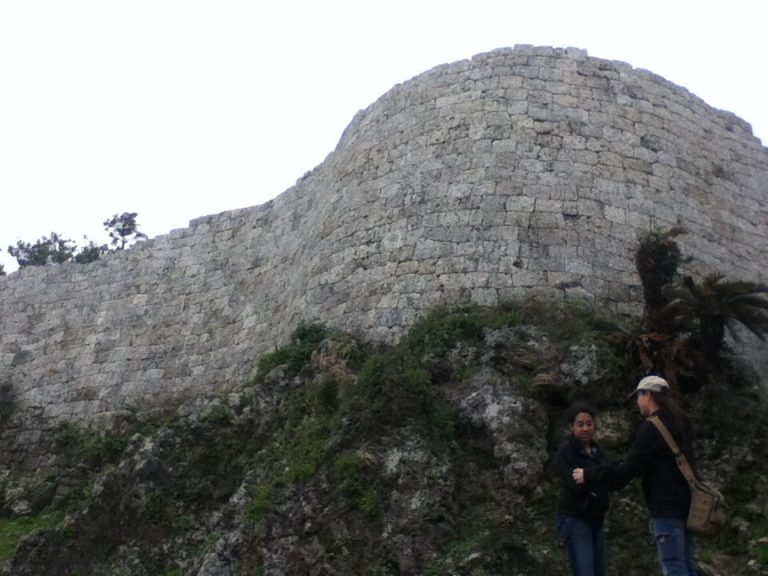
A high stone wall stands in front of the chambers and encloses the first garden, or Ichibannā, which serves as the main burial courtyard. The second garden, or Nibannā, lies west of the first. An arched gate called Nāka Ujō connects the two courtyards.
The original approach entered through a natural-rock tunnel that had been artificially excavated at the entrance. Called Kurashin Ujō, the tunnel led towards the second garden before the route continued to the first garden. The Yōdore Inscription, a stone monument with Japanese and Chinese text on its two sides, stood in the burial courtyard before the war.
Funerary and Ritual Features
Ten funerary urns, called zushi, are distributed between the eastern and western chambers. A zushi is a container used to preserve human remains or ashes. Three urns in the western chamber and four in the eastern chamber are designated as tangible cultural properties of Okinawa Prefecture.
Statues of the Buddhist bodhisattvas Kannon and Jizō were located inside the cave. A bodhisattva is a Buddhist figure associated with the pursuit of enlightenment and compassionate aid to other beings. Kannon is associated with compassion, while Jizō is especially associated with protecting beings in difficult circumstances.
Metalworking Evidence
Near the stone masonry of the second garden, excavations revealed the remains of a metalworking workshop. The finds include crucibles, an anvil stone, iron slag, nails, and decorative metal fittings, indicating work in iron, copper, and other metals within the mausoleum complex.