Iba Ruins: An Archaeological Record of Yayoi Settlement and Early Provincial Administration in Japan


Site at a Glance
- Rating
- 3.7
- Popularity
- Low
- Country
- Japan
- Primary era
- Classical
- External website
- Open
- Eras represented
- Classical, Medieval
- Civilizations
- Yamato, Yayoi
- Site type
- Civic
On this page16 sections
History
Iba Ruins in Hamamatsu, Japan, is an archaeological complex occupied from the Yayoi period through the Heian period. The site lies on lowland dune ridges west of Hamamatsu Station along the Enshu-nada coast and preserves evidence of a Yayoi settlement, Kofun-period ironworking, and an early regional government complex.
Discovery and Yayoi Settlement
The Yayoi period was an age of wet-rice agriculture, metalworking, and increasingly stratified communities before the formation of Japan’s early state. At Iba, this phase included a settlement enclosed by three concentric ditches. Pottery from the first half of the later Yayoi period, wooden agricultural tools, bronze objects, and an exceptionally rare wooden cuirass show the range of activities and materials associated with the community. The site later became the type site for Iba-style pottery, a term used for a pottery tradition that helps identify the first half of the later Yayoi period in western Enshu.
Iba Ruins came to modern attention in February 1949, when Yayoi pottery was found in a large crater made by Allied naval shelling during the Pacific War. Excavation by the Kokugakuin University Archaeological Research Laboratory began in April of that year. By 1986, fourteen investigations had taken place, revealing the extent of the occupation and its succession of later uses.
From Kofun Settlement to Regional Government
The Kofun period, named after the large burial mounds associated with powerful regional elites and the growth of centralized authority, brought further activity to the area. West of the Yayoi settlement, excavations found a settlement with ironworking installations. Groups of buildings supported by upright timbers set in postholes were added during the Nara period, when Japan developed more formal provincial administration.
The wider Iba Ruins Group includes Iba Ruins and seven surrounding archaeological sites spread across an area of approximately 2 square kilometers. Together, these places represent a regional government complex dating from the Nara period to the beginning of the Heian period. Evidence from the group relates to the ancient Fuchi District government office and the Kurihara station post, an official facility serving travel and communications routes.
The earliest wooden tablet found at Iba itself was recovered during the third excavation in October 1970. It bears the date 695, several years before the implementation of the 701 Taiho Code, the legal framework that formalized early Japanese government. Its discovery challenged the expectation that wooden administrative tablets from before 701 would not be found at a regional government site. Another tablet, dated 699, records a local administrative district corresponding to the later Fuchi District. Across the wider group, wooden tablets range from 679 to 924.
Administrative Evidence and Ceramic Chronology
Wooden tablets, narrow pieces of wood used for early records, labels, messages, and accounts, provide direct evidence of administration at Iba. Ink inscriptions on pottery refer to a district-government food-service facility, a deputy official of a military corps, and the head of the Kurihara station post. A Sue ware vessel found at four sites in the group bears the personal name Inamaro and a drawing probably representing rice grains. Inamaro’s identity is unknown, while pottery marked “upper hall” suggests that he may have been a prominent person connected with the district government.
The ceramics and tablets also changed the chronology of early Japanese pottery. Most of the Sue ware, a high-fired ceramic, came from the Kosai kilns in present-day Kosai. Many ash-glazed and green-glazed ceramics came from the Sanage kilns in present-day Aichi. These materials were found with dated tablets and coins whose minting dates are known, including Wado Kaichin, first minted in 708, and Fuju Shinho, first minted in 818. The combination helped establish an absolute chronology for Kosai Sue ware and placed the appearance of ash-glazed ceramics in the first half of the ninth century, earlier than the tenth-century date previously assigned to them.
At a northern site within the group, buildings from the first half of the Heian period, probably the first half of the tenth century, were arranged in an orderly U-shaped plan. They are considered the district-government office of that period. The earlier Nara-period office has not been conclusively identified, although a nearby site with wooden-tablet shavings, a Chinese three-color glazed ceramic pillow, and a bronze stirrup with a jar-shaped fitting is a leading candidate for the earlier government center.
Protection and Modern Interpretation
Iba Ruins was designated a prefectural historic site in 1954, but that designation was lifted in 1973. An administrative lawsuit seeking to cancel the decision began in 1974, but the revocation was not overturned. Part of the ruins was later developed as Iba Ruins Park. The Iba Ruins Museum opened in 1975, closed in 2010 because of aging facilities and municipal consolidation, and was demolished in 2013. Its collections were transferred to the Hamamatsu City Museum.
On September 26, 2025, excavated artifacts from the Iba Ruins Group were designated National Important Cultural Properties. Separately, 1,073 wooden tablets and pieces of pottery with ink inscriptions had received designation as prefectural tangible cultural properties in 2002. The excavated wooden tablets had also been recommended for national designation pending formal notification.
Remains
The surviving archaeological landscape extends across the Iba Ruins Group, where a Yayoi moated settlement, later settlements, administrative buildings, and a winding natural watercourse occupy related areas. Excavated materials range from Yayoi bronze and wooden objects to Nara- and Heian-period ceramics, coins, wooden tablets, and inscribed pottery. A raised-floor storehouse has been reconstructed at the site.
Yayoi Settlement
Moated Enclosure
The Yayoi settlement was surrounded by three concentric ditches, forming a moated enclosure that marked its boundary and may also have served a defensive purpose. Inside were flat-ground buildings supported by posts set into postholes, together with burial features. The excavated settlement produced pottery of the first half of the later Yayoi period, wooden agricultural tools, a bronze bracelet, a small bronze bell, bronze arrowheads, and a rare wooden cuirass.
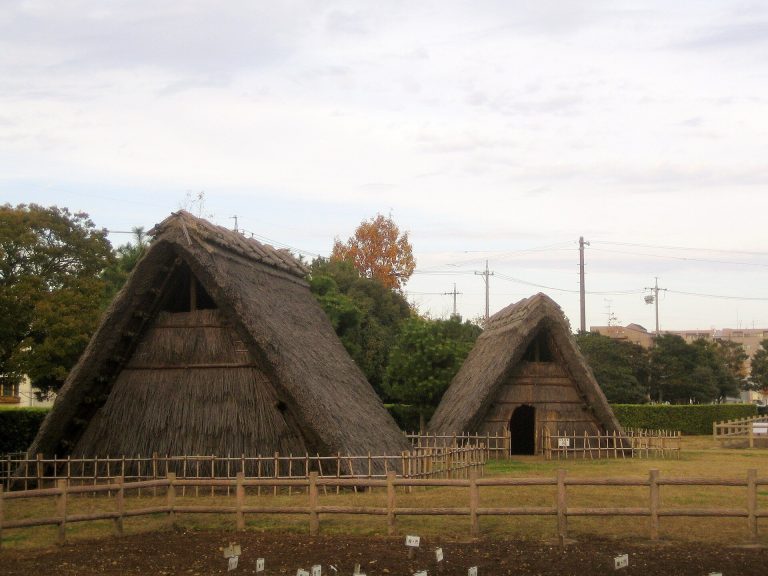
Reconstructed Storehouse
A raised-floor storehouse has been reconstructed within the site. Its form represents a type of building associated with the Yayoi settlement, whose structures included buildings raised above the ground rather than resting on continuous masonry foundations.
Later Settlements and Watercourse
Kofun Ironworking Area
West of the Yayoi enclosure are the remains of a Kofun-period settlement with ironworking installations. This area represents a later phase of occupation and is physically distinct from the earlier moated community.
Iba Great Ditch
The Iba Great Ditch is a former river channel that followed a winding course through the wider ruins group. It was initially considered possibly to be an artificial canal, but it is now identified as a natural watercourse dating from after the middle of the Kofun period. Its channel and margins yielded large quantities of Nara- and Heian-period material, including Haji ware, a generally unglazed earthenware, Sue ware, ash-glazed and green-glazed ceramics, ink-inscribed pottery, coins, and dated wooden tablets.
Government Buildings and Finds
Heian-Period Office
At the northern site, post-built buildings from the first half of the Heian period were arranged in a U-shaped plan. Their orderly layout is considered to represent the district-government office of that period. The buildings form part of the administrative remains associated with the Fuchi District.
Earlier Government Center
A separate site associated with the earlier administrative center produced wooden-tablet shavings, a Chinese three-color glazed ceramic pillow, and a bronze stirrup with a jar-shaped fitting. These finds support its identification as a leading candidate for the Nara-period government office.
Inscribed and Dated Materials
The wooden tablets include examples dated 695, 699, and 924, while the wider group contains examples ranging from 679 to 924. Their inscriptions concern local administration, food provision, military office, and station-post administration. The designated excavated collection includes one wooden cuirass, 529 pottery and clay objects, 14 wooden objects, 42 stone objects, 10 bronze objects, and nine glass objects. These materials are held by the Hamamatsu City Museum.