Shōsōin: The Nara-Period Treasure Repository of Tōdai-ji


Site at a Glance
- Rating
- 4.3
- Popularity
- Low
- Country
- Japan
- Primary era
- Classical
- External website
- Open
- Eras represented
- Classical
- Civilizations
- Yamato
- Site type
- Economic
- Remains
- Warehouse
On this page11 sections
History
Shōsōin is the former treasure repository of Tōdai-ji in Nara, Japan, built in the Nara period as part of the Buddhist temple complex founded under Emperor Shōmu. Located northwest of the Great Buddha Hall, it is the sole surviving example of the numerous temple storehouse compounds once known as shōsōin. The general term eventually became the proper name of Tōdai-ji’s surviving repository.
Foundation and Imperial Offerings
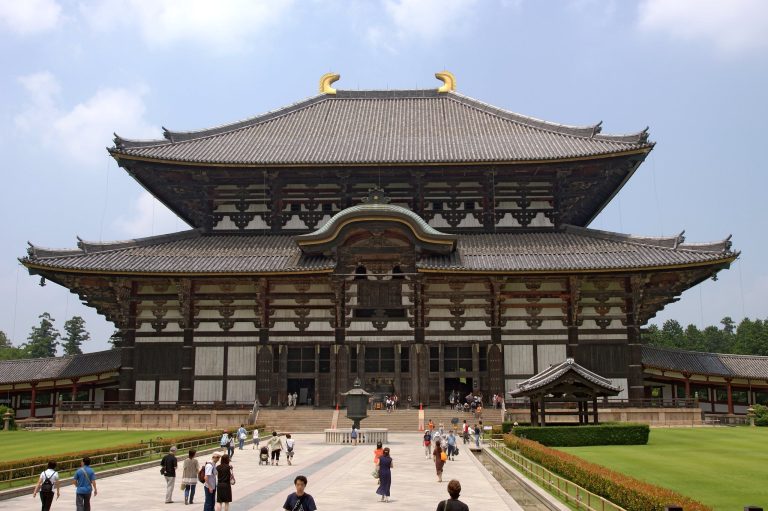
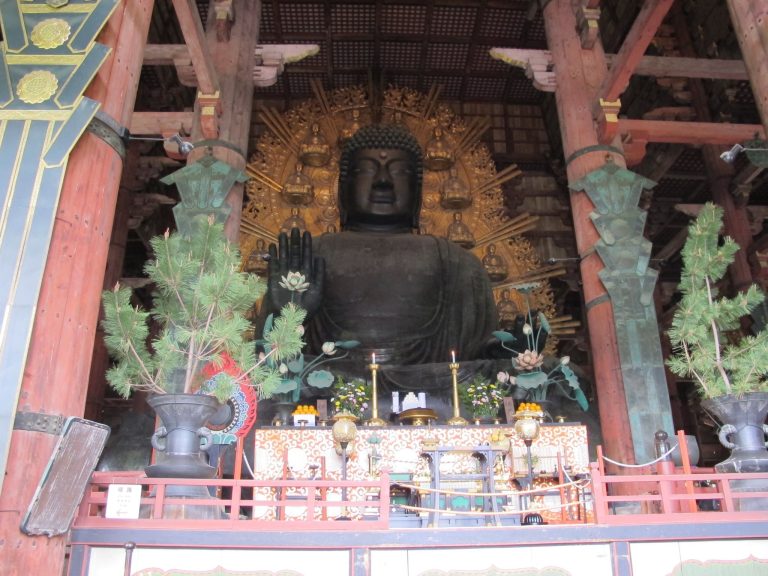
Emperor Shōmu ordered the construction of Tōdai-ji during the Tenpyō period, an eighth-century era associated with major Buddhist, artistic, administrative, and international developments in Japan. The nationwide temple project began amid disasters, political unrest, and epidemics. Buddhism was intended not only to provide religious protection but also to strengthen central authority. Tōdai-ji became the head temple of this undertaking, with Vairocana, the cosmic Buddha known in Japan as the Great Buddha, as its principal image.
The collection associated with Shōsōin began in 756, after Shōmu’s death. On the forty-ninth-day memorial for her husband, Empress Kōmyō dedicated approximately 650 of his possessions and 60 kinds of medicinal substances to the Great Buddha. Kōmyō, an important patron of Buddhist institutions, made three further offerings of objects associated with herself and Shōmu. The donated material was placed in the repository, whose exact construction date remains uncertain. Work probably began soon after the 756 offering and had been completed by 759, when the storage inventories were prepared.
The donation records became known collectively as the Tōdai-ji Offering Registers. They were preserved in five volumes: the National Treasures Register, Register of Various Medicines, Register of Screens and Carpets, Register of the Handwriting of the Great and Lesser Kings, and Register of Screens with Fujiwara Handwriting. Together, the objects and inventories linked the repository to the devotional practices of the imperial household and to the ceremonial life of Tōdai-ji.
The Three Storehouses
Shōsōin was historically divided into Northern, Middle, and Southern Storehouses. The Northern Storehouse held objects associated chiefly with Shōmu and Kōmyō. The Middle Storehouse contained Tōdai-ji ritual objects, documents, records, and materials connected with the Office for the Construction of Tōdai-ji. The Southern Storehouse held Buddhist implements and objects used during the Great Buddha’s eye-opening ceremony, the ritual that consecrated the image by opening its eyes.
In 950, objects from Tōdai-ji’s Kensakuin paired storehouse were moved to the Southern Storehouse after that repository was damaged. Some of these Buddhist implements were later used in the 1185 eye-opening ceremony held for the restoration of the Great Buddha under Retired Emperor Go-Shirakawa, a former sovereign who continued to exercise political and religious influence after abdication.
The arrangement of objects changed substantially after cultural-property investigations began in the Meiji period. Items were repeatedly removed for repair or other purposes, and some returned to different storehouses. The original registers therefore do not correspond exactly to the surviving contents. Weapons, medicines, scrolls, and musical instruments were taken out when required, and many were never returned. Large numbers of swords were removed during the Fujiwara no Nakamaro Rebellion, an eighth-century uprising led by the court official and military leader Fujiwara no Nakamaro. Replacement swords were later deposited.
Losses, Fires, and Repairs
The repositories faced repeated threats from fire, storms, theft, and other damage. A fire in 917 destroyed the lecture hall and monks’ quarters. Severe winds damaged the imperial-sealed and Southern Storehouses in 1031, several storehouses burned in 1095, and lightning caused a fire in 1254. In that last incident, the treasures were removed safely. The wider temple complex suffered particularly severe destruction in the 1180 Southern Capital attack led by Taira no Shigehira, a Taira military commander. The area south of the Shōsōin storehouses became a firebreak. Tōdai-ji’s Great Buddha Hall and other buildings were burned again by the forces of the sixteenth-century warlord Matsunaga Hisahide in 1567. Shōsōin was the only building to survive the Heian-period Siege of Nara.
Three recorded thefts involved monks. In 1039, monks set fire to an imperial-sealed storehouse and stole treasures. In 1230, two monks broke a lock and took objects, including mirrors whose metal components they tried to sell. In 1610, three monks clearing storm damage stole old objects from the Northern Storehouse. Each case was detected, and the perpetrators were apprehended.
The building’s roof was severely damaged in 1830. Repairs are recorded in 1031, 1079, 1100, 1193, 1230, 1243 to 1246, 1254, 1603, 1693, 1833 to 1836, and 1877. A dismantling and repair campaign followed from March to December 1913. Approximately a century later, a major facilities-renewal project began in September 2011, adding a modern phase to the conservation history of the surviving storehouse.
Administration and Modern Preservation
Until the Edo period, Tōdai-ji administered Shōsōin and its treasures under court supervision. Control passed to the Home Ministry in 1875, to the Imperial Household Ministry in 1884, and to the Imperial Museum in 1908. After the 1947 Constitution made imperial-use property part of the national estate, responsibility passed to the Imperial Household Agency’s Library Bureau. The agency’s Shōsōin Office now administers the repository and its treasures.
The Northern Storehouse was subject to especially strict imperial control because it held objects associated with Shōmu and Kōmyō. Entry required the presence of an imperial envoy. The Southern Storehouse was later placed under temple sealing, a system restricting access by authority of the temple, before returning to imperial sealing after 1875. Imperial sealing formally restricted access under authority associated with the emperor, with a signed imperial paper wrapped around the key.
In 1997, the main Shōsōin storehouse became a National Treasure under Japan’s Cultural Properties Protection Law. The designation applied to the immovable building rather than to its movable treasures. In 1998, Shōsōin was included in the UNESCO World Heritage inscription Historic Monuments of Ancient Nara as part of the Tōdai-ji complex.
The treasures are now administered in modern repositories built by the Imperial Household Agency. The East Treasure House was completed in 1953, while the West Treasure House was completed in 1961 and opened in 1962. Most treasures were transferred there in 1963. The West Treasure House holds most of the collection, while the East Treasure House contains objects under repair and large quantities of textiles. Selected objects are displayed each autumn at the Nara National Museum. This annual exhibition began in 1946 as a special viewing at the Nara Imperial Museum and later became the Shōsōin Exhibition.
Collection and Historical Evidence
Shōsōin’s holdings comprise approximately 9,000 classified treasures. About 95 percent are considered to have been produced in Japan, often with foreign designs. Other objects came from Tang China, Central Asia, India, Iran, and other regions. Their materials and motifs reflect exchanges along the Silk Road, the interconnected land and maritime routes through which goods, artistic ideas, technologies, and religious traditions moved across Asia and between Asia and the Mediterranean world.
The collection includes Buddhist implements, clothing and accessories, furniture, games, musical instruments, weapons and armor, paintings, calligraphy, metalwork, lacquerware, woodwork, ceramics, glassware, and medicines. Many objects were originally made for elite use rather than as museum pieces. The holdings therefore preserve evidence of religious practice, courtly life, craft production, and the international connections of Tenpyō-period Japan.
More than 10,000 manuscripts are also preserved. Most are records from an eighth-century sutra-copying institution that operated under several names between 727 and 776. The documents include censuses, tax records, poetry, and extensive administrative material, creating an unusually concentrated archive for eighth-century Japan. The antiquarian scholar Hoida Tadatomo rediscovered the documents in the 1830s. He and later scholars separated individual sheets and assembled them into new scrolls, disturbing their original arrangement. Subsequent research reconstructed aspects of the earlier configuration. Most of the documents were printed in the first 25 volumes of Dai Nihon komonjo, and the collection has since been digitized for public consultation.
Another repository, the smaller Shōgozō, was transferred from Tōdai-ji’s Sonshōin in 1894 and placed under imperial administration. Its collection originally comprised 4,960 volumes, including Sui- and Tang-period scriptures, Tenpyō-period scriptures, the 750-volume set commissioned by Empress Kōmyō in 740, scriptures commissioned during the Tenpyō Shōhō and Tenpyō Jingo periods, scriptures commissioned by Empress Shōtoku, later Heian- and Kamakura-period manuscripts and printed scriptures, and Kamakura-period copies of non-Buddhist works. A program to digitize the complete Shōgozō manuscript collection has been undertaken.
Remains
Shōsōin’s surviving complex is centered on a large raised-floor timber storehouse in azekura construction. This method stacks triangular-section logs horizontally and interlocks them at the corners. The building has a hipped, tiled roof, measures approximately 33.1 meters across the front and 9.3 meters in depth, and stands about 2.5 meters above the ground. It is the largest surviving Nara-period storehouse and the only surviving structure that conveys the form of a Nara-period shōsō.
The Main Storehouse
The main building rests on 10 rows by 4 rows of supporting posts. Horizontal beams called daiwa rest on the posts and support the storehouse walls. The Northern and Southern Storehouses have walls formed from 20 courses of triangular wooden logs. The Middle Storehouse is structurally different, with thick boards fitted between the posts to create a board-built storehouse rather than an azekura wall.
The three-part arrangement existed from the beginning, according to dendrochronological examination. Earlier interpretations of the phrase “paired storehouse” had proposed that the middle section was originally an open, roofed space without walls or floorboards. The building was assembled without bolts or nails. Its interlocking timbers meet at the corners, creating its characteristic log-cabin appearance. The idea that the walls regulate humidity by expanding and contracting is no longer accepted because the heavy roof load leaves the logs little room to move. From inside, light can be seen through numerous gaps between the walls.
The raised floor allows air to circulate beneath the building and separates it from ground moisture. Storage chests were also lifted on four legs. Made of durable cedar, they measured approximately 90 to 110 centimeters long, 60 to 70 centimeters wide, and 40 to 50 centimeters high. Their close-fitting lids helped limit rapid changes in humidity.
Modern Repositories and Shōgozō
The East and West Treasure Houses are reinforced-concrete repositories southeast and southwest of the original storehouse. They contain the transferred treasures, and imperial sealing is applied to these modern storage facilities. Their construction reflects the continuing preservation of the collection while the Nara-period building remains the central architectural survivor of the original repository complex.
Shōgozō is a second, smaller azekura storehouse within the Shōsōin grounds. It houses Buddhist scriptures and other historical manuscripts that originated in the sutra repository of Tōdai-ji’s Sonshōin. The preserved material includes the Tōdai-ji Offering Registers, which record the original donations, and objects associated with the Great Buddha’s eye-opening ceremony. Fragments of damaged treasures also survive, including remains of ceremonial crowns worn by Shōmu and Kōmyō.
Great Buddha Hall Foundation Deposits
In 1907 and 1908, excavators found six swords, crystal balls, fragments of armor, and other objects around the pedestal of the Great Buddha in Tōdai-ji’s Great Buddha Hall. Known as the Great Buddha Hall Foundation Deposits, these finds included two metal-inlaid swords. X-ray imaging identified them in 2010 as the Yang Sword and Yin Sword because their blades bear those inlaid names. The swords are kept at the Tōdai-ji Museum.
The two swords had been removed from Shōsōin in January 760 and then disappeared from the known record until their identification in 2010. They are believed to have been buried by Empress Kōmyō as a prayer for the peace of the state. Their recovery connected objects once listed in the repository’s imperial inventory with material found beneath the Great Buddha.
Textiles, Instruments, and International Materials
Shōsōin’s textiles, accessories, and musical instruments preserve a wide range of materials, techniques, and designs. Japanese-made objects incorporate foreign motifs, while imported glass vessels and other objects represent artistic traditions associated with West Asia and the eastern Mediterranean. The collection’s materials and decoration provide physical evidence of the movement of artistic forms across the routes associated with the Silk Road.
The musical instruments include zithers and short-necked lutes used in Nara-period court music and dance. Some were imported from Tang China. Others were made in Japan with foreign-inspired decoration, including scenes associated with Persia and India. These objects, together with the manuscripts, ritual implements, clothing, and household goods, preserve the varied material culture that accumulated around Tōdai-ji’s imperial foundation.