Hikida Castle: An Asakura Defensive Stronghold in Japan


Site at a Glance
- Rating
- 3.9
- Popularity
- Very Low
- Country
- Japan
- Primary era
- Medieval
- Eras represented
- Medieval
- Civilizations
- Unclassified
- Site type
- Military
- Remains
- Castle
On this page11 sections
History
Hikida Castle is a mountain castle in Tsuruga, Japan, built for the Asakura clan during the Bunmei era, approximately 1469–1487. The Asakura were a powerful warrior family that ruled Echizen during Japan’s Sengoku period, an era of political fragmentation and warfare among competing regional lords. The castle served as a defensive position on the border between Omi and Echizen.
Foundation and Asakura service
The castle was built by Hikidan Tsushima-no-kami Kubo, a retainer of the Asakura clan. The Hikidan family then held Hikida for more than a century across seven generations. The recorded holders were Tsushima-no-kami, Saemon-no-suke, Hyogo, Sanrokuro, Kisuke, Komanosuke, and Yoichiro. Tsushima-no-kami and Saemon-no-suke were court-derived titles used by medieval Japanese warriors as part of their formal designations.
Hikida occupied an important transportation junction where routes from Omi into Echizen converged. These included the Shichirihan, Shindono, Fukazaka, and Tone passes. The area was also traditionally identified with the Arachi Barrier, an ancient checkpoint on the route between the two regions and one of early Japan’s Three Barriers.
Wars of 1570 and 1573
On April 26, 1570, Hikida Castle fell during Oda Nobunaga’s invasion of Echizen, together with Kanegasaki Castle and Tetsutsuyama Castle. Nobunaga, a major sixteenth-century warlord whose campaigns helped unify much of Japan, withdrew the following day after Azai Nagamasa’s betrayal. Azai’s withdrawal of support contributed to the retreat from Echizen. Hikida Castle was later repaired, and commanders, including one identified by the title Saburoemon-no-jo, took up positions there.
Nobunaga captured the castle again on August 12, 1573, during his second invasion of Echizen. The Asakura army suffered a decisive defeat at the Battle of Tonezaka on August 13. The Asakura clan was destroyed at Ichijodani on August 20, and Hikida Castle was abandoned after the Battle of Tonezaka.
Traditions and historic designation
A local tradition connects the castle’s fall with the wife of the captured retainer Torii Yoshichiro. Fearing assault by soldiers, she said that her father and husband had died at Tone and that her mother and sister were probably still alive. After asking to write them a letter, she composed a poem and threw herself into a nearby old well. The tradition says that the soldiers were moved to tears by her resolve and chastity.
Several graves in Hikida are traditionally regarded as those of military commanders killed at the Battle of Tonezaka. One burial site, said to have been uncovered during road construction, lies near a bridge at the confluence of the Goi and Shono rivers. Hikida Castle was designated a Fukui Prefectural Historic Site on December 3, 1954.
Remains
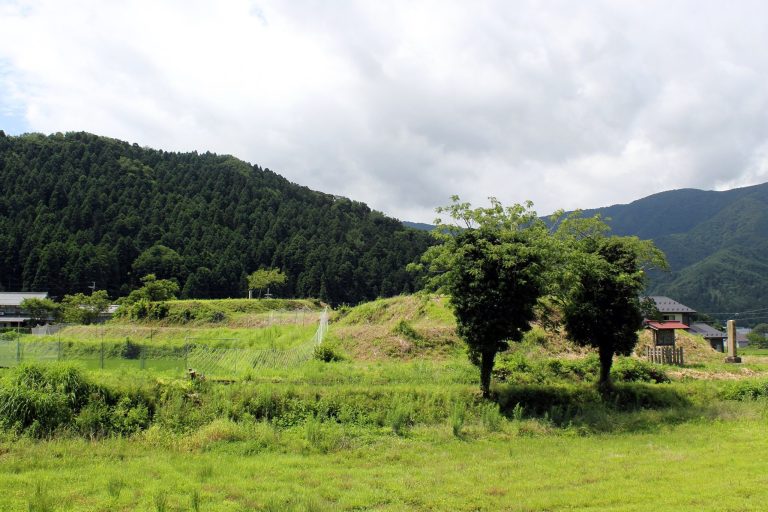
Hikida Castle survives as a mountain stronghold with the principal fortified enclosure, separately enclosed defensive areas, moats, and stone walls. Much of the surrounding area is now farmland, while the castle’s archaeological features remain on the elevated ground.
Castle enclosures and defenses
Principal enclosure
The honmaru, the castle’s principal fortified enclosure, occupies the central surviving area. A stairway approaches it from the southwest corner, where a monument identifies the honmaru site. A second historic-site monument stands on the southern side of the ruins.
Stone walls and moat
Stone walls and a moat remain visible on the eastern side of the castle ruins. Together with the honmaru and other enclosed defensive areas, these features preserve the arrangement of the mountain stronghold and its defensive construction.
Well and associated graves
Old well
A nearby old well is associated with the tradition of Torii Yoshichiro’s wife. According to the story, she ended her life there after the castle fell.
Commander’s burial site
One of the graves traditionally linked with commanders killed at Tonezaka lies below the mountain near the bridge at the meeting of the Goi and Shono rivers. The burial site is beside National Route 8, at the mountain foot near the river confluence.