Kiriyama Castle: A Kitabatake Mountain Stronghold in Japan


Site at a Glance
- Rating
- 4.4
- Popularity
- Very Low
- Country
- Japan
- Primary era
- Medieval
- Eras represented
- Medieval
- Civilizations
- Ashikaga shogunate
- Site type
- Military
- Remains
- Castle
On this page14 sections
History
Kiriyama Castle is a medieval Japanese mountain castle in Tsu, Japan, established by the Kitabatake clan in 1342 or 1343. Also known as Tage Castle and Kiriyama Gosho, it stood in Tage, in the historical province of Ise, and became the principal stronghold of a family that developed from Ise provincial governors into a regional warlord house.
Foundation and the Nanboku-chō Wars
After the Kitabatake clan’s lowland castles in southern Ise fell one after another, the 17-year-old Kitabatake Akiyoshi created a mountain stronghold at Tage. The position lay on the route connecting Ise and Yamato, and its mountain setting was suited to enduring a long military campaign. The castle and its associated settlement remained the Kitabatake base for approximately 240 years.
The period of the castle’s foundation was the Nanboku-chō era, the conflict between rival Northern and Southern imperial courts in Japan from 1336 to 1392. The Kitabatake initially supported the Southern Court, which was based at Yoshino for much of the war, before submitting to the Ashikaga shogunate after the two courts were reunited. Tage was an important transportation hub on the Ise Main Route. Mountain passes controlled its approaches, while the road connected the area with Yoshino, the Ise Grand Shrine, and Kyoto. These links supported military movements and the transport of rice and marine products to the Southern Court.
Most Kitabatake campaigns during the Nanboku-chō wars began from Kiriyama Castle, although Asaka Castle later became the forward base for expeditions. After the Southern Court’s defeat at the Battle of Shijōnawate in 1348, Ashikaga forces entered Yoshino. Akiyoshi advanced with 500 cavalry, and the Ashikaga army withdrew. Akiyoshi died at the Tage fortified residence in 1383, aged 58; the circumstances of his death remain disputed.
Political Refuge and Ashikaga Relations
The Northern and Southern Courts were reunited under the Meitoku Treaty in 1392. Its arrangement for alternating imperial lines was later violated after Emperor Shōkō came to the throne. In response, Kitabatake Mitsumasa raised troops at Asaka Castle in 1415. Prince Ogura, who had fled Kyoto in 1428, found shelter at Kiriyama Castle until early 1429 and then disappeared.
Relations between the Kitabatake family and the Ashikaga shogunate improved after Kitabatake Noritomo killed Akamatsu Noriyasu, who had been involved in the Kakitsu Incident. In April 1484, Ashikaga Yoshihisa, the ninth Ashikaga shogun, stopped at Kiriyama Castle while traveling to the Ise Grand Shrine. The castle was destroyed by fire in 1499 and rebuilt in 1506.
Kiriyama and its settlement also occupied a place in the literary culture of the period. The linked-verse poet Sōseki visited the castle town in July 1522, followed by another linked-verse poet, Sōchō, in October of that year. Renga was a form of collaborative poetry composed by several poets, and these visits connect the castle town with the cultural networks of sixteenth-century Japan.
Oda Nobunaga and the Fall of the Kitabatake
By the late 1560s, Oda Nobunaga’s invasion of northern Ise led the Kitabatake family to use Okawachi Castle, its second major stronghold, as a military base. Some interpretations treat this change as a transfer of the clan’s main seat, while others regard Okawachi as a wartime headquarters rather than a replacement for Kiriyama. Kitabatake Masanari remained at Kiriyama as its castellan.
In 1569, Kotsukuri Tomomasa, lord of Kotsukuri Castle, rebelled against the Kitabatake main house. Nobunaga entered Kotsukuri Castle that August, and fighting spread to Asaka Castle, its subsidiary fortifications, Funae Castle, and Okawachi Castle. The Battle of Okawachi Castle lasted about 50 days. It ended with an agreement under which Nobunaga’s son, Oda Nobukatsu, was adopted by Kitabatake Tomofusa.
Nobunaga forced Tomofusa to retire in 1575 and moved Nobukatsu from Okawachi Castle to Tamaru Castle. In November 1576, Nobukatsu ordered an attack on the Sanze fortified residence. Kitabatake Tomonori and 13 members of the Kitabatake family were killed, effectively ending the Kitabatake house. Soon afterward, forces led by Hashiba Hideyoshi, Kambe Nobutaka, and Seki Morinobu attacked Kiriyama Castle. Masanari defended it determinedly, but the castle and associated residences were burned and the stronghold fell. This destruction, associated with the Sanze Incident, ended the Kitabatake presence at Kiriyama after approximately 240 years.
Later History and Protection
The castle town disappeared after the fall of the castle in 1576, then revived during the Edo period as a post station for pilgrims traveling to Ise. By the beginning of the twenty-first century, the area had become a quiet mountain settlement with old houses.
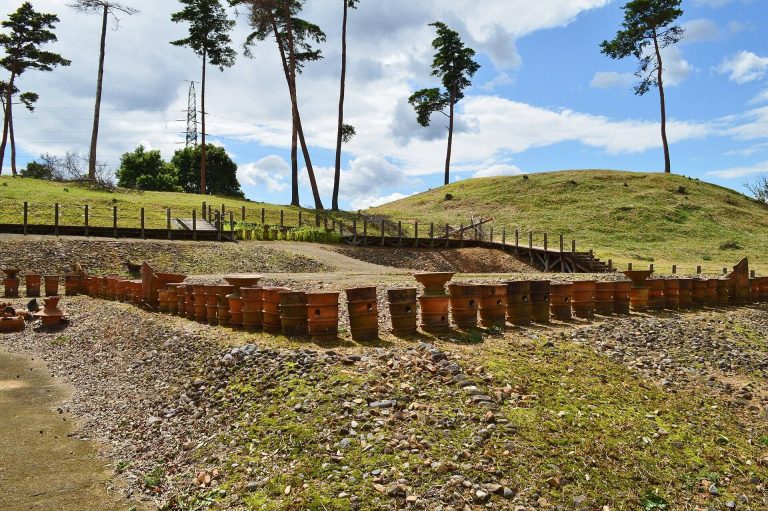
The castle ruins received National Historic Site designation in 1936. The protected area was later combined with the Tage Kitabatake fortified-residence ruins and garden remains. An expansion in 2006 established the official designation of the Tage Kitabatake Clan Fortified-Residence Sites, covering both the Kitabatake Residence Site and Kiriyama Castle Site. The integrated area measures 268,906.91 square metres, including 15,000 square metres for the castle site.
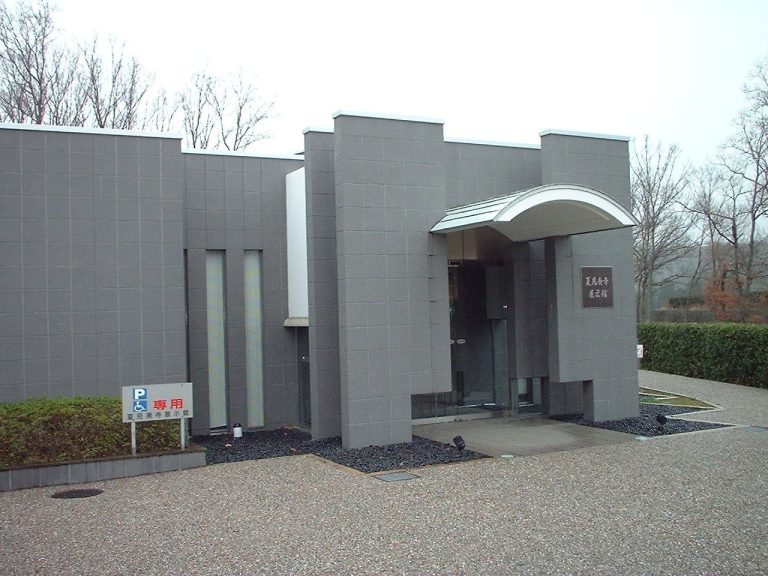
Investigations at the Kitabatake Residence Site took place from 1996 to 2005, followed by further examination of the castle and residence complex by the Tsu City Board of Education in 2006. Daily management of the remains is entrusted by Tsu City to the Kiriyama Castle Site Preservation Association.
Remains
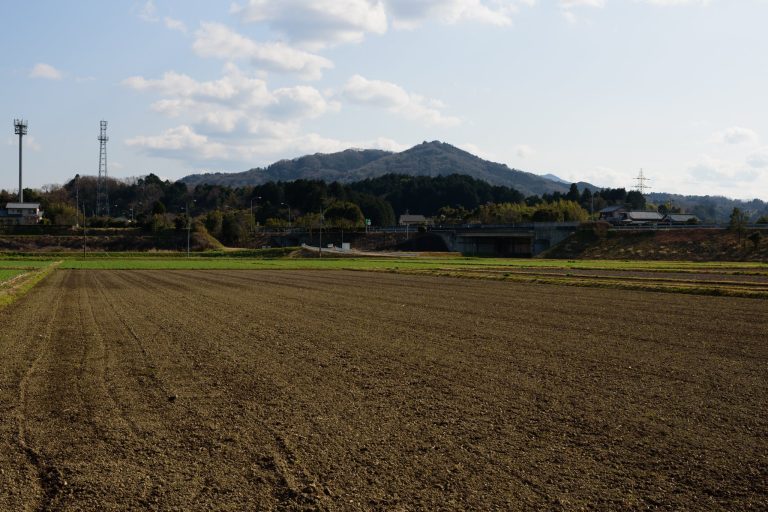
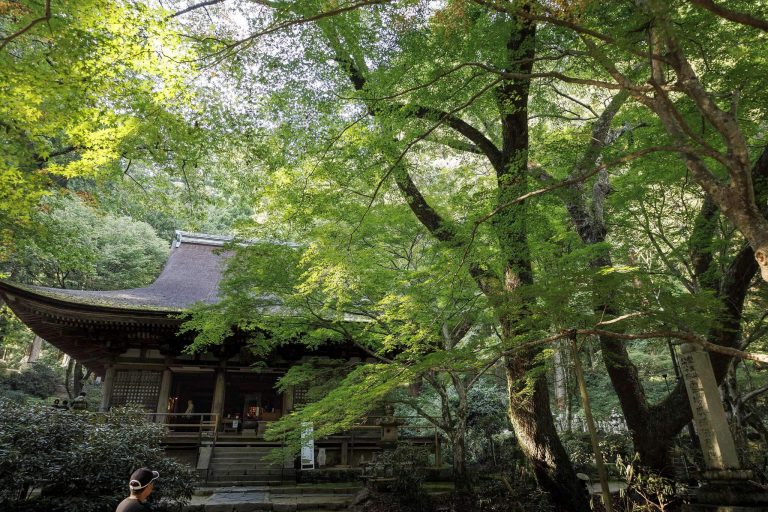
Kiriyama Castle is a yamashiro, a Japanese mountain castle that uses steep slopes, ridges, moats, and earthworks for defense. It occupies a summit west of the Tage Basin at an elevation of about 560 metres, approximately 240 metres above the surrounding plain. The former Tage fortified residence stood about 1.1 kilometres southeast at the mountain’s foot. Dry moats, earthworks, and enclosure traces preserve the basic defensive landscape of the medieval stronghold.
Summit Defenses
Principal Enclosures
Two dry moats were cut across a steep ridge. Inside an area about 120 metres long and 30 metres wide were two principal fortified enclosures. The northeastern enclosure had earthworks on three sides, while the higher southwestern enclosure was enclosed on all four sides. Its elevated position indicates that it probably formed the castle’s central core. Smaller enclosures surrounded these main areas, creating an extended group of defensive compounds.
Bell-Tower Site
A bell-tower installation stood near the principal enclosure. About 200 metres southeast of the main enclosure, a surviving irregular platform identified as the bell-tower site contains a dry moat and a low, short earthwork along its southwestern side. Together with the summit enclosures, these features show how the castle’s defensive compounds extended across the ridge.
Outer Defensive Works
The mountain approaches were controlled by additional fortifications. Works stood at the mouths of Sugi Pass and Shōji Pass, while barriers or checkpoint installations were placed at Hitsuzaka Pass and Kaizaka Pass. Observation posts guarded Shiraguchi Pass, Sakura Pass, Hitsu Pass, and Urushi Pass. Subsidiary castles surrounded Kiriyama, and an associated residence also served a protective function.
The steep setting made access difficult in the medieval period and remains difficult in the present. The Kitabatake family therefore normally lived at the Tage fortified residence and used Kiriyama as a final defensive stronghold. From the summit, the landscape opens toward the mountains of Iga and Nara Prefecture across the Unzue River to the west, toward the Tage settlement and Mount Tsubone to the east, and beyond them toward the Ise Plain.
Fortified Residence and Castle Town
Tage Fortified Residence
The lower Tage fortified residence formed the residential center associated with the mountain castle. It was surrounded by compounds belonging to retainers, with residences placed one chō to the south, five chō to the east, and ten chō to the north. The compound of a powerful retainer occupied a square area of half a chō, approximately 900 tsubo. Around 20 temples stood outside the eastern and northern residential areas, while comparatively few shrines were present.
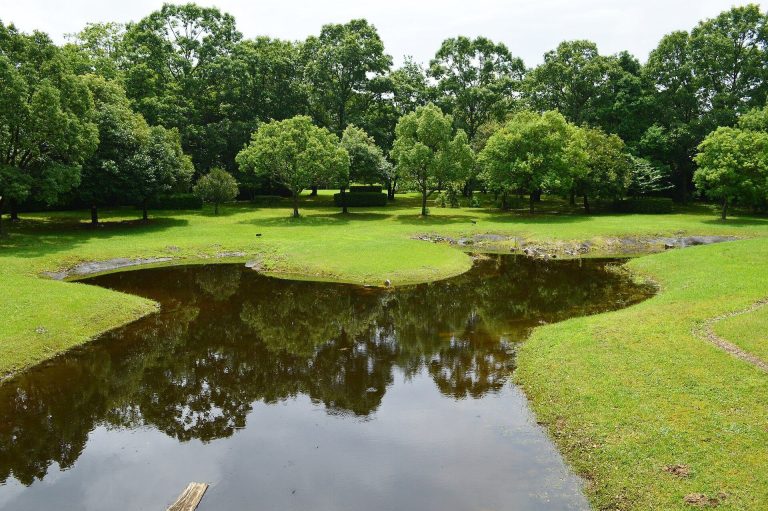
The former residence is now the site of Kitabatake Shrine. After the destruction of the Kitabatake family, the grounds became Shinzen-in and later served as the site of a Meiji-period elementary school. The school no longer exists, but the Kitabatake Residence Site Garden preserves a pond-and-stream strolling garden from the former residence landscape.
Residential and Service Buildings
About 200 buildings stood around two sides of the fortified residence. They included a horse-ground, an archery ground, a rice storehouse, and residences for senior retainers and household members. Markets and buildings used for government services occupied several parts of the settlement, alongside the premises of merchants and craftsmen. Warriors and commoners appear to have lived within the same town, although place-name evidence places commoners mainly to the south and east.
East Residence
Across the Hatamata River at Rokuda in Shimotaki lies the East Residence, also called the East Residence Kinjō Castle. Its remains include earthworks and a moat. Archaeological investigations have identified two building traditions, one from the first half of the fifteenth century and another dating around the end of the fifteenth to the beginning of the sixteenth century. The earlier complex contained stone walls considered among the older examples in Japanese history.