Iida Castle: A Japanese Hill-and-Slope Castle in Nagano


Site at a Glance
- Rating
- 3.4
- Popularity
- Very Low
- Country
- Japan
- Primary era
- Early Modern
- External website
- Open
- Eras represented
- Early Modern
- Civilizations
- Tokugawa
- Site type
- Military
- Remains
- Castle
On this page16 sections
History
Iida Castle is a Japanese hirayamajiro, a castle combining a fortified hill with its lower slopes, in Iida, Japan. Traditionally founded in the early thirteenth century by the Banzai clan, it developed through the age of the Takeda, Oda, and Tokugawa warlords before becoming the seat of Iida Domain during the Edo period.
Medieval origins
Iida Castle was also known as Nagahime Castle and Sanbonsugi Castle. Tradition attributes its foundation to the Banzai clan, which held local authority in Iida. The clan is said first to have lived near Matsubara-shuku, then to have built Atago Castle at Iizaka, and finally to have moved to Iida in search of a larger and more defensible position with better views. Another tradition holds that the land had been used as a training ground by mountain ascetics and was exchanged for the site of Atago Castle.
The Banzai clan’s origins and official status remain uncertain. They were described as local land stewards, but the Iida district was held by the Asonuma clan until the period of the Northern and Southern Courts, the fourteenth-century struggle between rival imperial courts. The Banzai’s relationship to the Banzai clan of Awa and their possible connection with the Ogasawara clan are also unresolved.
Takeda and Oda control
Takeda Shingen invaded southern Ina in 1554, and Iida remained under Takeda control for about three decades. The Takeda enlarged Iida, together with Takatō and Ōshima, as a base for operations toward southern Mikawa. Some elements of the castle’s later form reflect Takeda methods of fortification.
Akiyama Torashige, a military commander serving the Takeda clan, became lord of Iida Castle in 1562. When he took charge of Iwamura Castle in 1573, control of Iida passed to Banzai Oribe-no-suke. On February 14, 1582, during Oda Nobunaga and Tokugawa Ieyasu’s campaign against the Takeda, Oda Nobutada attacked the castle. Its commanders, including Hoshina Masatoshi, Banzai Oribe-no-suke, and Obata Inaba-no-kami, withdrew to Takatō Castle.
After the Takeda fell in 1582, the Oda retainer Mori Nagahide received the Ina district and governed it from Iida Castle. The Honnō-ji Incident, a coup in which Akechi Mitsuhide turned against Oda Nobunaga in Kyoto, then destabilized the former Takeda territories. In the resulting struggle among regional powers, a leader of the Shimojo family supported by Tokugawa Ieyasu took control, and Suganuma Sadatoshi later entered the castle as Ieyasu’s representative.
Early-modern castle and domain seat
Following the Tokugawa transfer to the Kantō region in 1590, Mori Hideyori returned to Iida. He enlarged the Third Bailey and the main gate while improving the castle town. His son-in-law, Kyōgoku Takatomo, later inherited the territory, and Iida Castle was developed into an early-modern castle.
Iida became the administrative seat of Iida Domain during the Edo period. Ogasawara Hidemasa became lord when the domain was established in 1601, but his transfer to Matsumoto in 1613 placed the territory under direct shogunal administration. The Wakisaka clan took control in 1617. In 1642, Hori Masachika entered from Karasuyama with a fief assessed at 20,000 koku, a measure of agricultural production used to express a domain’s fiscal scale. The Hori family remained based at Iida Castle until the Meiji Restoration.
After the Meiji Restoration
After the Meiji Restoration, the castle housed the Iida branch of Chikuma Prefecture. It was abandoned in 1871, and the castle buildings were subsequently demolished on a large scale. The former Main Bailey became the grounds of Osahime Shrine, founded in 1880. The former Second Bailey accommodated Iida Osahime High School from 1921 to 1982 and has housed the Iida City Museum since 1989. The former Sakura Bailey, where the domain lord’s residence stood, is now occupied by the Nagano Prefectural Iida Joint Government Office.
Surviving and relocated gates, including the Sakura Bailey Gate, Hachiken Gate, Yakui Gate, Sakura Bailey West Gate, and Wakisaka Gate, have been designated Iida municipal tangible cultural properties. These structures preserve elements of the castle after its transformation into administrative, educational, religious, and civic spaces.
Castle town and transport routes
Tanikawa Bridge divided the castle town into five wards to the north and thirteen to the south. The northern section served as a post station on the Sanshū Highway, with transport offices in Tenmachō and Sakuramachi alternating responsibility for relay horses. From the middle of the Edo period, Iida prospered as a relay point for the chūma packhorse transport network, which carried goods across inland routes and depended on stations such as Iida.
Remains
Terraced castle layout
Iida Castle occupied the end of a river terrace between the Matsukawa and Nosokogawa, tributaries of the Tenryū River. Natural cliffs flanked the site, while water moats and dry moats strengthened its defenses. The plan followed a largely linear sequence of linked baileys, or enclosed functional areas of a castle: Yamabushi-maru, the Main Bailey, Second Bailey, Demaru, Third Bailey, and Sakura Bailey. The Main Bailey lay toward the east, while the Second Bailey, Sakura Bailey, and Demaru extended west toward the cliffs.
The ground descended from the castle town toward the Main Bailey, and the side cliffs added protection to the approach. An attacker moving toward the Main Bailey had to capture the successive baileys individually. At the center, an approximately 100-meter square palace compound stood within earthen walls and contained seven buildings.
Earthworks and water defenses
Sections of stone rampart, dry moat, and earthen rampart survive in the former Main Bailey. In the former Sakura Bailey, a small section of the stonework belonging to the Sakura Bailey Water Gate remains. Together, these features preserve parts of the defensive system and indicate how the castle used both constructed barriers and the natural terrace edge.
Surviving and relocated gates
Sakura Bailey Gate
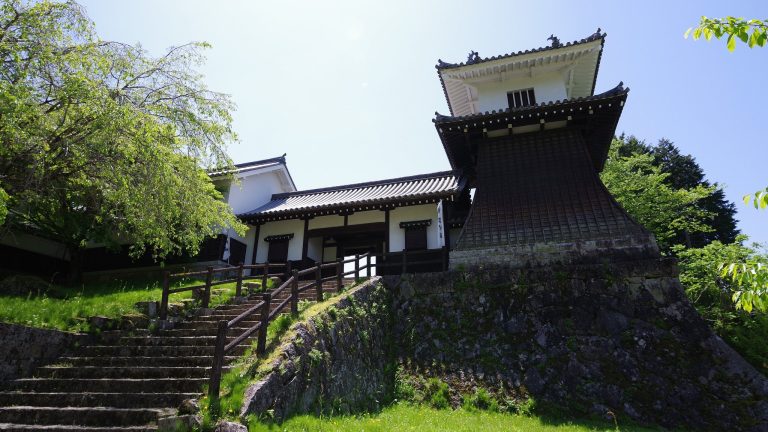
The Sakura Bailey Gate, known as the Red Gate for its finish in bengara, a red iron-oxide pigment traditionally used on wooden architecture, was the main entrance to the Sakura Bailey. Construction began in August 1753 and ended in 1754. The gate has a hipped-and-gabled roof, with latticework and carved wooden pendants in the gable decoration. Two hinged plank doors occupy the center, accompanied by a smaller wicket door on the left when viewed from the former Otemachi Elementary School.
A guard station projects beside the gate beneath a separate roof, an arrangement described as unique in Nagano Prefecture. The gate is the only Iida Castle building still standing on its original site and is one of four castle gates in Nagano Prefecture that remain in their original locations.
The Sakura Bailey Gate survived the large-scale demolition that followed the abolition of the domains. It later served as the main gate of the Iida Prefectural Office, the Iida office of Chikuma Prefecture, the Shimoina District Office, and the Shimoina Regional Office. After the Iida Joint Government Office was completed in 1971, the gate ceased to serve as a service entrance but was retained at the request of local residents. Major repairs in 1985 addressed its foundation and walls and included repainting. The gate became an Iida municipal tangible cultural property on November 20 of that year, and it reopened in March 1999 after fourteen years of closure.
Sakura Bailey Yakui Gate
The Sakura Bailey Yakui Gate was relocated to Kyōzōji Temple in Kamisato-Beppu, Iida. A Yakui-mon is a roofed gate with subsidiary roofed posts or wings, a form used at temples, residences, and castle compounds.
Sakura Bailey West Gate
The Sakura Bailey West Gate was relocated to Unsaiji Temple, preserving another entrance associated with the castle’s western enclosure.
Wakisaka Gate
The gate from the former Baba military training ground, known as the Wakisaka Gate, was relocated to an area of Babachō 3-chōme.
Hachiken Gate
The Hachiken Gate, reportedly built during the Bunroku era, survives after being relocated to a private residence in Matsuo Kui.
Cherry trees and road marker
The Married Couple Cherry Trees stand in the former Sakura Palace gardens, on the grounds of the Nagano Prefectural Iida Joint Government Office. One is a weeping cherry and the other is a non-weeping Edohigan cherry. Because their trunks and roots gradually fused after being planted unusually close together, the pair became known by this name. Their combined form appears to produce two kinds of blossoms from one tree, and the fusion of the two cherry varieties is considered highly unusual. In 2012, their estimated age was 400 years; together they reached 20 meters in height and had a trunk circumference of 10 meters at the base.
At the junction of Ōyokochō and Tonomachi stands a square granite road marker 37 centimeters high. First erected in 1596 and rebuilt in 1879, it carries inscriptions on its four faces directing travelers toward Imamiya and Hakusan, Zenkōji and Kōshū, Zenkōji, and Ōdaira, Kiso, and the Sanshū region. The marker preserves the route network that connected the castle town with surrounding destinations.