Aratakiyama Castle: A Sengoku-Period Mountain Fortress in Japan


Site at a Glance
- Rating
- 3.9
- Popularity
- Very Low
- Country
- Japan
- Primary era
- Early Modern
- External website
- Open
- Eras represented
- Early Modern
- Civilizations
- Unclassified
- Site type
- Military
- Remains
- Castle
On this page6 sections
History
Aratakiyama Castle, also called Arataki Castle, is a Japanese mountain castle in Ube, Yamaguchi Prefecture, Japan. Built during the Sengoku period, an era of prolonged political and military conflict from roughly the fifteenth to the late sixteenth century, its builder and exact construction date are unknown. One theory places its construction in the Tenbun era, around 1532–1555.
The Naito and Ouchi clans
Tradition identifies the castle as a residence of the Naito clan, senior retainers of the Ouchi clan. The Ouchi were a powerful western Japanese warrior house that controlled much of the surrounding region before losing its dominance during the sixteenth century. Naito Takaharu is said to have used Aratakiyama Castle as his residence.
The Naito clan held the office of deputy military governor of Nagato Province. This official administered a province on behalf of a military governor, giving the family an important political and military role. Aratakiyama Castle appears to have served mainly as a refuge during wartime, while the family’s peacetime residence is thought to have stood at Imaono, on the northeastern foothills of Aratakiyama.
Sixteenth-century occupation and abandonment
A record dated July 23, 1558, names a Naito retainer as the castle guard. By around 1600, Masuda Motoyoshi had become its lord. The castle was abandoned during the early Edo period, after which its summit was used as a beacon-fire station.
Excavations carried out through 2005 clarified the site’s history. Finds of Kyoto-style medieval Haji ware vessels and ceramics imported from China and Korea place activity at the castle from the mid-sixteenth to the late sixteenth century. They also point to close connections between the Naito clan and the Ouchi sphere. Kusu Town designated the ruins a historic site in 1994. Following the 2004 municipal merger, they became a Ube City historic site, and on January 11, 2008, the site received designation as a Yamaguchi Prefectural Historic Site. The prefectural designation recognized its well-preserved condition and the potential for archaeological investigation to help establish its date and illuminate regional history.
Remains
Aratakiyama Castle occupies the 459-meter-high Aratakiyama. Its remains extend for approximately 700 meters from east to west and 200 meters from north to south. The complex follows a linked-enclosure plan, in which several fortified areas are arranged in sequence along a ridge, and is centered on the main enclosure at the summit.
Ridge enclosures and defenses
The castle is divided into three principal enclosure groups: Senjoshiki, an outwork on the eastern ridge; the main enclosure at the summit; and an enclosure on the western ridge. Cut ditches, or trenches excavated across the ridges to obstruct movement, surround the enclosures and interrupt approaches along the high ground. The northern slopes contain a complex of ridge-and-gully dry moats, a defensive arrangement characteristic of late Sengoku-period mountain castles.
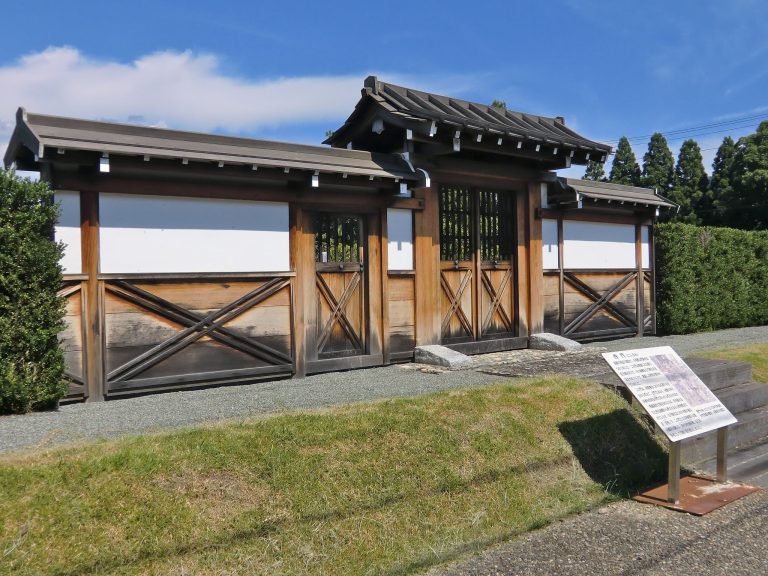
Surviving and excavated features include stone walls, moat traces, earthworks, an entrance area, and stone steps. The castle has no keep. From the summit, the site overlooks the Seto Inland Sea to the south and extends inland toward the Kibe Basin and the Mito and Shuho areas, reflecting the strategic position of the mountain site.
Excavated vessels and ceramics
Archaeological work recovered Kyoto-style medieval Haji ware, an unglazed earthenware tradition of premodern Japan. The finds include kawarake, small generally unglazed vessels used for drinking or serving, together with ceramics imported from China and Korea. Associated with the castle’s sixteenth-century occupation, these objects provide material evidence for the Naito clan’s regional connections and the site’s relationship with the Ouchi sphere.