Akihasan Hongū Akiha Shrine: Principal Shrine of Japan’s Akiha Fire-Protection Tradition


Site at a Glance
- Rating
- 4.5
- Popularity
- Medium
- Country
- Japan
- Primary era
- Early Modern
- External website
- Open
- Eras represented
- Classical, Early Modern, Modern
- Civilizations
- Japanese, Tokugawa, Yamato
- Site type
- Religious
- Remains
- Sanctuary
On this page12 sections
History
Akihasan Hongū Akiha Shrine is a Shinto shrine in Japan, near the summit of Mount Akiha in Hamamatsu, and is regarded as the origin of the nationwide Akiha faith. The mountain had been revered as a sacred place since ancient times. Tradition dates the first shrine buildings to 709, while another foundation tradition attributes the opening of an early Buddhist temple there to the monk Gyoki in 701.
Foundations and sacred traditions
The Buddhist temple later became known as Akiha-dera. Its name is traditionally linked to a poem attributed to Emperor Saga in the early ninth century, although other explanations for the name Akiha also circulated. A foundation legend tells that the mountain shook and burst into flame. Emperor Genmei then presented a poem honoring the fire-protecting deity, and shrine buildings were erected. Another local story says that a straw figure came to life and helped finish the construction before being released into a river, where it became associated with warnings of storms and floods.
Buddhism and Shugendo, an ascetic mountain religion combining Buddhist, Shinto, and other traditions, later became established on Mount Akiha. During the Heian period, the mountain was associated with the Shingon school of esoteric Buddhism. Tradition also places the Shugendo practitioner Sanjakubo on the mountain during the early Heian period. He was said to have trained at religious centers in Shinano and Echigo before making Akiha his principal base, although the details of his identity, travels, and relationship with Akiha Gongen remain uncertain.
Akiha Gongen was the syncretic guardian and fire-protecting deity worshipped at Mount Akiha before the separation of Buddhism and Shinto. Later traditions variously identified the figure with the mountain’s guardian or with Sanjakubo. Popular devotion generally brought these figures together under the name Akiha Daigongen, or simply Akiha-san. Before the Sengoku period, few written materials concerning Akiha Gongen have been identified.
The combined religious complex
Until the Edo period, Akiha Gongen Shrine and Akiha-dera occupied the same religious precinct under Shinbutsu shugo, the historical combination of Buddhist and Shinto beliefs, institutions, and practices in Japan. The temple’s principal image was Kannon Bosatsu, the Buddhist bodhisattva of compassion. By the Edo period, shrine priests, Soto Buddhist monks, and Tōzan-style Shugendo practitioners served on the mountain, while the Buddhist monks held the office of betto, or chief administrator.
The institution had close connections with Shingon Buddhism before the Sengoku period, a time of prolonged warfare among competing military powers. During the Tokugawa period, a monk associated with Tokugawa Ieyasu converted the war-damaged Akiha-dera into a Soto Zen administrative temple. The Tokugawa government then supported its recovery through land donations and other patronage.
Nationwide growth during the Edo period
Under Tokugawa Tsunayoshi, the fifth shogun of the Tokugawa government, Akiha Daigongen became widely revered as a power protecting against fire. The devotion combined Shinto, Buddhism, and Shugendo. Pilgrimage became especially prominent in Edo, a city that suffered repeated major fires, and Akiha confraternities and branch shrines spread across Japan.
In 1685, the government prohibited the traditional procession that carried the shrine’s mikoshi, or portable shrine, along the Tōkaidō toward Edo and Kyoto because of concerns about public disorder. The restriction encouraged a different form of expansion. Communities created numerous branch shrines, especially in central Japan, and Soto temples and monasteries often established small Akiha shrines within their grounds.
Pilgrims reached Mount Akiha by several routes known as Akiha roads or Akiha highways. Major approaches came from the Iida and Shinano region over Aokuzure Pass, from Mikawa through Toyokawa, Shinshiro, and Horai-ji, from Hamamatsu across the Tenryu River and through Futamata and Inui, and from Kakegawa through Mori and Inui. The Kakegawa route had earlier served as a salt route. Communities placed permanent night lanterns along these roads as devotional sites and markers of the Akiha tradition.
Fire protection remained the center of the shrine’s religious identity. People prayed for the safety of households and communities, protection during construction and house raising, and security for fireworks, metalworking, power-related work, and other industries involving fire. Prayers also concerned commercial prosperity, good catches, tea production, and martial success. Fire brigades and other communities threatened by fire visited the mountain, while fishing communities developed a particular devotion because fires could occur aboard boats and Mount Akiha could be seen from the Enshu Sea. In parts of Mikawa, people undertaking new construction or extensions traditionally received a ridge plaque for protection.
Dolls are burned in a memorial fire connected with the foundation legend and the cult of fire. The practice, together with prayers and protective talismans, continues the shrine’s association with people whose work involves fire.
Meiji reorganization and modern rebuilding
The Meiji government’s 1868 policy separating Buddhism and Shinto, followed by the abolition of Shugendo in 1872, forced the religious community on Mount Akiha to reorganize. Disputes arose over whether Akiha Gongen should be understood as a Buddhist or Shinto divinity. The government ultimately treated Akiha Gongen as a guardian deity distinct from Sanjakubo. The shrine was renamed Akiha Shrine, and its enshrined deity was designated Hinokagutsuchi-no-Okami, a Shinto kami associated with fire.
Akiha-dera was abolished in 1873 because it had no resident priest or parishioners under the regulations then governing temples and shrines. Sanjakubo and the temple’s religious objects were transferred to Kasuisai in Fukuroi, while the shrine became a prefectural shrine. Strong local requests led to the re-establishment of Akiha-dera as a Kannon temple in 1880. The post-Meiji shrine and the restored temple therefore continued separate parts of the former combined complex.
In 1943, during the Second World War, a wildfire that rose from the lower mountain reached the summit and destroyed every building except the gate east of the main sanctuary. Wartime and postwar conditions made reconstruction difficult, so worship continued through a newly established lower shrine. The summit buildings were reconstructed in 1986, reviving the institution as Akihasan Hongū Akiha Shrine. The use of Hongū, meaning principal shrine, emphasized its position as the main shrine in the nationwide Akiha network after the shrine-ranking system had ended. A western gate was added in 2009 to commemorate 1,300 years of the traditional foundation.
The principal annual festival is held in December, with December 16 recorded as the regular festival date. The modern observance lasts three nights and includes ceremonies involving large flares and other fireworks, maintaining the shrine’s fire-centered identity. Firefighters, power-generation workers, cooks, and others in fire-related occupations continue to visit for protective talismans and prayers.
Remains
Akihasan Hongū Akiha Shrine is arranged in two principal sections, an upper shrine near the 866-metre summit of Mount Akiha and a lower shrine beside the Keta River at the foot of the mountain. Mount Akiha stands at the southern end of the Akaishi Mountains. A traditional pilgrimage path links the two sections, climbing about 750 metres and taking approximately one and a half to two hours on foot. Another approach follows the Tokai Nature Trail.
Summit precinct
Main sanctuary and gates
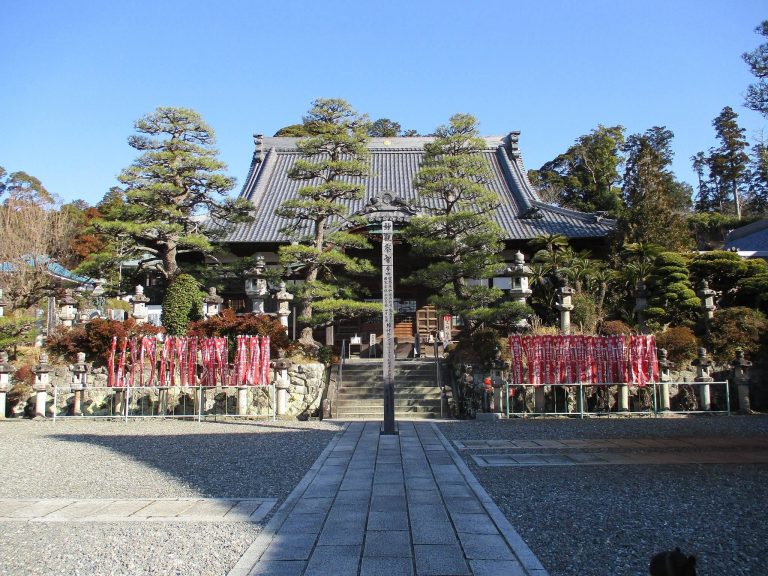
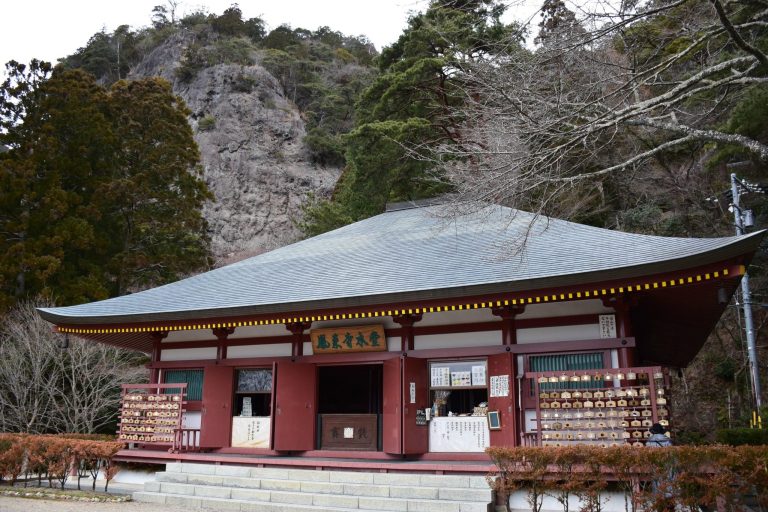
The upper shrine’s summit complex contains the main sanctuary and an associated Kannon hall. The buildings were reconstructed in 1986 after the wartime wildfire. The eastern gate beside the main sanctuary survived the fire, while a western gate was built in 2009. A gold-painted torii, the gateway marking the approach to a Shinto sacred precinct, stands before the main sanctuary. It is known as the Torii of Happiness because it was erected with a wish for human happiness.
Historic buildings and pilgrimage features
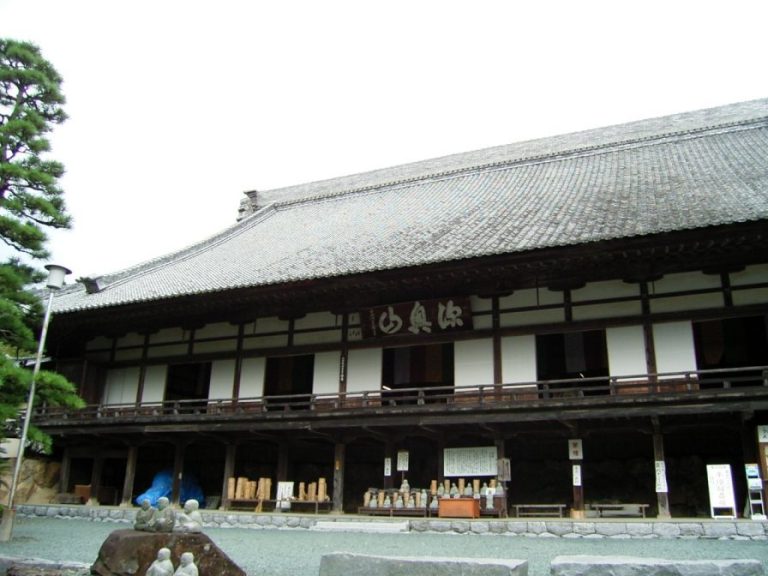
The summit precinct also preserves the former main clerical residence, a pagoda, and other buildings associated with the Edo-period complex. Seventeen Shugendo lodges were traditionally linked with the mountain, although the number varied and was said in some periods to have reached thirty-six. A mountain gate, permanent lanterns, and the remains of tea houses provide physical evidence of the summit’s prosperity during the Edo-period pilgrimage era. Work associated with the Tachikawa school of shrine carpenters appears among the gate and lanterns.
The shrine’s divine crest is a seven-leaf maple, while its institutional crest is a sword-flower rhombus. Shrine tradition attributes the latter to a donation by Takeda Shingen. The summit also contains subsidiary shrines dedicated to Amaterasu, Toyouke, the purification deities, water, heavenly deities, Oguni, the mountain lord, wind, Yamanba, Hakusan, and the mountain itself. The Yamanba Shrine is associated with the Weaving Well, where a mountain woman was said to have lived and woven cloth.
Branch worship and material heritage
Lanterns and wayside worship
Special permanent lanterns known as dragon lanterns served both as small shrines and as community places of worship. Communities traditionally received talismans from Akiha and enshrined them in these lanterns. The Kakegawa Wayside Worship Place is a subsidiary shrine connected with a former first torii in Kakegawa’s Torii district. Utagawa Hiroshige depicted that gateway in his series Fifty-three Stations of the Tōkaidō, and the subsidiary shrine now represents it institutionally.
Museum objects
A small museum at the shrine displays surviving historical artifacts, including swords offered by Imagawa Nakaaki, Takeda Shingen, Toyotomi Hideyoshi, and Kato Kiyomasa. These objects preserve material links with military and religious patronage associated with the Akiha tradition.