Manshu-in Temple: An Imperial Tendai Monzeki Temple in Kyoto


Site at a Glance
- Rating
- 4.2
- Popularity
- Medium
- Country
- Japan
- Primary era
- Early Modern
- External website
- Open
- Eras represented
- Early Modern
- Civilizations
- Tokugawa
- Site type
- Religious
- Remains
- Monastery
On this page17 sections
History
Manshu-in Temple is a Tendai Buddhist monastery in Kyoto, Japan, whose present complex dates mainly from the early Edo period after its relocation in 1656. Tendai is a major Japanese Buddhist school associated with Mount Hiei. The temple is traditionally linked to Saicho, the monk who founded the school in Japan, and it became an imperial monzeki institution, a monastery traditionally headed by members of the imperial family or aristocracy. Its principal image is Amitabha Buddha, and its traditional founder is Zesan.
Origins on Mount Hiei
Temple tradition traces Manshu-in to a small establishment founded by Saicho on Mount Hiei during the eighth century. After the tenure of later Buddhist leaders, the community moved between 947 and 957 to the northern valley of the Western Pagoda area of Mount Hiei. There it was known as Tobibo.
From the Heian period until the late early-modern period, the monastery maintained a close relationship with Kitano Shrine, now called Kitano Tenmangu. Its abbots also served as administrative superintendents of the shrine. Zesan, a monk from the Sugawara family, is traditionally regarded as the first superintendent. His appointment is placed either at the shrine’s foundation in 947 or in 1004, when Emperor Ichijo visited it. The earlier date is problematic because Zesan is recorded as having died in 1018.
The Kitayama Branch and Shrine Administration
During the tenure of the eighth abbot after Zesan, a branch establishment was built at Kitayama near Kitano Shrine around 1108 to 1110. The institution then adopted the name Manshu-in. For a time, the Kitayama branch and the original headquarters on Mount Hiei coexisted, but the branch gradually became the principal center. Its creation appears to have facilitated the administration of Kitano Shrine.
Medieval records do not consistently align the succession of Manshu-in abbots with that of the shrine’s superintendents. The relationship became clearly aligned again after a late-Kamakura-period abbot secured the superintendent’s office through litigation in 1301. He and his successor, who was also his nephew and disciple, are regarded as having established Manshu-in as a monzeki institution.
Imperial Connections and Relocation
The later of these two abbots maintained close relations with both major imperial lines. After entering religious life, he taught Emperor Hanazono and Emperor Kogon. During the Genko Incident, a conflict connected with Emperor Go-Daigo, he was temporarily detained by the Rokuhara Tandai because of his association with the emperor. During the reunification of the Northern and Southern Courts, he was appointed head of the Tendai school. After his death, his nephew became abbot, reinforcing Manshu-in’s ties with the Northern Court and the Muromachi shogunate.
The Kitayama establishment was forced to move as Ashikaga Yoshimitsu developed his Kitayama residence, later known as Kinkaku-ji. Between 1379 and 1381, Manshu-in relocated to an area south of Shokoku-ji, within the aristocratic district near the imperial palace.
Around 1495, an imperial prince entered the monastery as its twenty-sixth abbot. From then on, members of the imperial family customarily served as abbots, establishing Manshu-in’s status as an imperial monzeki temple. It is also known as Takenouchi Monzeki and is counted among Kyoto’s five major Tendai monzeki institutions.
The Present Temple and Its Cultural Role
In 1656, Prince Ryosho, the twenty-ninth abbot, moved Manshu-in to its present site on the western foothills of Mount Hiei in Ichijoji, northeastern Kyoto. The location had previously held a small Hiei-associated temple where scholarly religious gatherings had taken place before the site fell into disuse. Prince Ryosho reorganized the complex after the move.
Ryosho was the second son of Prince Toshihito, associated with the construction of Katsura Imperial Villa, and an adopted son of Emperor Go-Mizunoo. He was a Tendai leader and head of the school, as well as an accomplished practitioner of tea, flower arrangement, incense, poetry, calligraphy, and garden design. These interests shaped the cultural character of the rebuilt Manshu-in.
Manshu-in’s authority in relation to Kitano Shrine was protected under both the Toyotomi regime and the Edo shogunate. The Toyotomi government granted it the office of shrine superintendent, while the shogunate assigned it responsibility for temple administration. In 1689, despite opposition from shrine priests, Manshu-in pardoned hereditary workers affiliated with the shrine who had been expelled after a fifteenth-century dispute concerning rice-koji production. In 1735, the temple succeeded in removing the right to submit shrine petitions from the court-appointed intermediary associated with the Sugawara family.
The relationship with Kitano Shrine ended during the Meiji period through the separation of Buddhism and Shinto. In 1872, Manshu-in sold its ceremonial hall and donated the proceeds to support construction of a medical hospital, now Kyoto Prefectural University of Medicine Hospital. The temple lacked the building for many years before it was reconstructed in 2022. Torrential rain on July 12, 1972, also caused about 10 meters of the earthen wall around the shoin buildings to collapse.
Manshu-in remains affiliated with the Tendai school and is recognized as one of its five principal monzeki temples. It is also associated with the Kinki Thirty-Six Fudo pilgrimage and with a pilgrimage route linking Buddhist and Shinto sacred sites. Nationally designated cultural properties connected with the temple include the Yellow Fudo painting and the Manshu-in manuscript of the Kokinshu anthology, while the garden is designated nationally as a Place of Scenic Beauty.
Remains
Entrance and Shoin Buildings
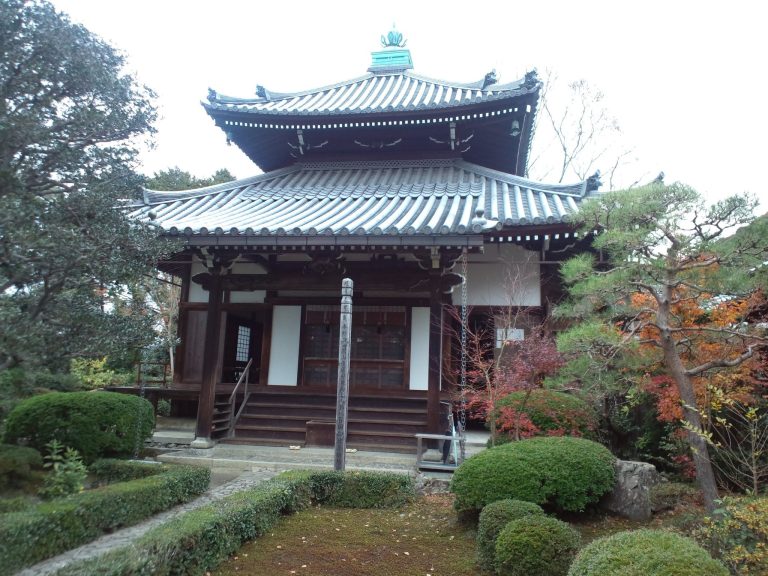
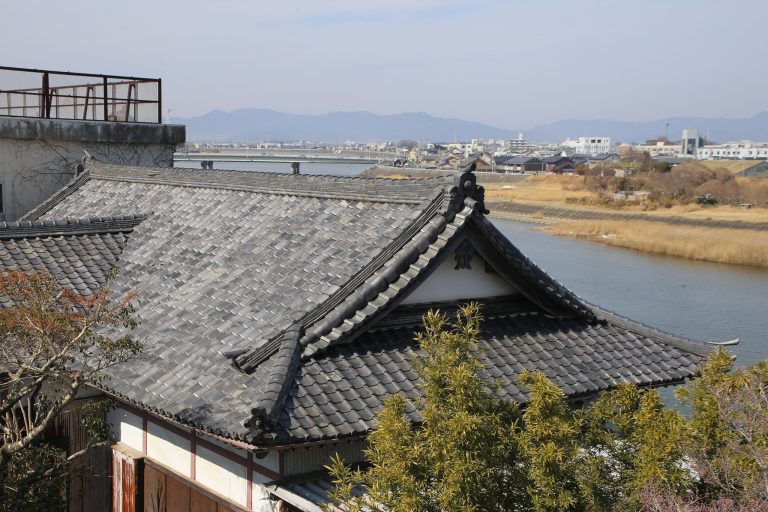
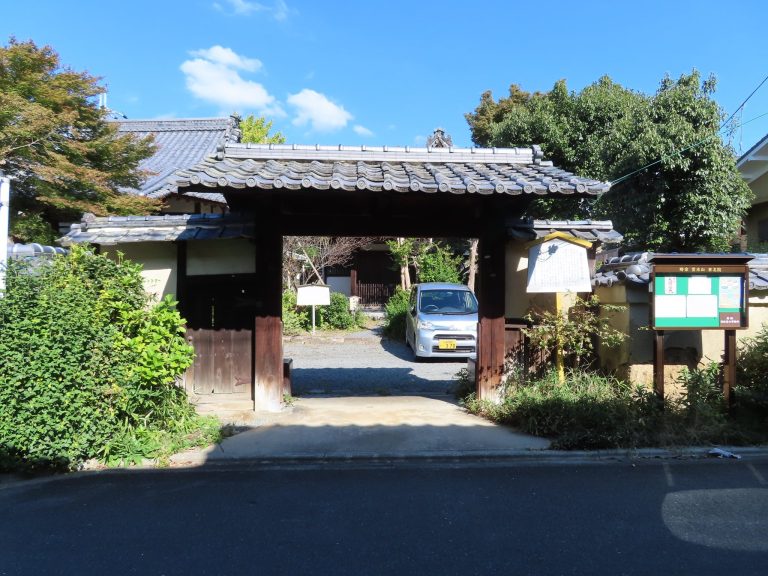
The temple’s surviving complex is organized around buildings dating mainly from the 1656 relocation. Its formal entrance is the Imperial Envoy Gate. The earthen walls on either side carry five horizontal bands, a treatment expressing the high rank associated with an imperial monzeki temple. Near Shugakuin Imperial Villa, the buildings occupy the western foothills of Mount Hiei in Ichijoji.
The Entry Building
The entry building contains a Tiger Room with paintings attributed to Kano Eitoku, a prominent painter of the Kano school. Its Bamboo Room is decorated with Edo-period woodblock prints, while the Peacock Room contains paintings attributed to Ganku, an artist associated with the later development of naturalistic painting.
The Great Shoin
The Great Shoin, the main hall and principal temple building, contains a Waterfall Room with sliding-panel paintings attributed to Kano Tanyu and a Snowy Scenes Room with screen paintings by the same artist. Its shelving closely resembles the shelving at Katsura Imperial Villa, reflecting a shared design tradition.
The Small Shoin
The Small Shoin contains a Mount Fuji Room with images by Kano Tanyu on its sliding doors, a Twilight Room with a royal throne and further Kano paintings, and a tea room. Decorative metal fittings, door pulls, and transoms throughout the shoin buildings share designs with those at Katsura Imperial Villa and are regarded as products of the same workshop tradition. This resemblance has led to Manshu-in being called a “small Katsura Imperial Villa.”
Gardens
The Dry Landscape Garden
The principal garden is a karesansui, or dry landscape garden that represents natural scenery through arranged rocks, sand or gravel, and selected vegetation rather than flowing water. A Japanese white pine, approximately 400 years old, stands on an island-like setting within a stream of white sand.
The Inner Garden
A smaller inner garden contains a stone basin and an old well, forming a more enclosed garden space within the temple complex.
Paintings, Calligraphy, and Sculpture
The Yellow Fudo
The Yellow Fudo is a polychrome painting on silk, probably produced around the twelfth century. It belongs to a group of images based on the early-Heian Yellow Fudo preserved at Onjo-ji in Shiga Prefecture. The image represents Fudo Myoo, a Buddhist guardian deity associated with immovable resolve and the destruction of spiritual obstacles. The painting is deposited at the Kyoto National Museum. It was restored over two years beginning in 2013 and is now treated as a hidden image. A copy made over four years at Aichi University of the Arts was dedicated at Manshu-in during the restoration period.
The Manshu-in Manuscript of the Kokinshu
The Manshu-in manuscript of the Kokinshu, an early tenth-century imperial anthology of Japanese poetry, is a single-volume copy written on alternately colored dyed paper. Its elegant Japanese kana calligraphy makes it an important example of Heian-period writing. The manuscript is deposited at the Kyoto National Museum.
Statue of Jikei Daishi
A seated wooden statue of Jikei Daishi is among Manshu-in’s important cultural properties, adding a sculptural work to the temple’s surviving religious and artistic heritage.
Nearby sites