Kyzyl-Kala: An Ancient Fortress in Uzbekistan


Site at a Glance
- Rating
- 4.5
- Popularity
- Low
- Country
- Uzbekistan
- Primary era
- Classical
- Eras represented
- Classical
- Civilizations
- Parthian, Sassanid
- Site type
- Military
- Remains
- Fort
On this page8 sections
History
Ancient Chorasmian fortress
Kyzyl-Kala is an ancient fortress in Uzbekistan, built in the historical region of Chorasmia during the 1st to 4th centuries CE. Chorasmia, also called Khwarazm, was an oasis civilization centered on the irrigated lands around the lower Amu Darya, where settled agriculture met the steppe. Kyzyl-Kala is associated with the Parthian and Sasanian periods and probably served as an advanced defensive post for nearby Toprak-Kala rather than as an independent stronghold.
The fortress remained in use until the 4th century and was then abandoned. Its position near Toprak-Kala formed part of a fortified landscape in ancient Chorasmia. Local tradition later imagined the two fortresses connected by a long underground passage inhabited by spirits and ancestral souls, with hidden treasure concealed along the route.
Khwarazmian restoration and destruction
Kyzyl-Kala was restored during the Khwarazmian period in the 12th century. The Khwarazmian Empire was a major medieval state in Central Asia and Iran, ruled at this stage by Ala ad-Din Muhammad II. The shah occupied the fortress before it suffered its final destruction during the Mongol conquest of the Khwarazmian Empire in the early 13th century.
Medieval occupation from the 12th and 13th centuries remains visible at the site. A separate local tradition concerns the choice of building sites in the desert. It held that a wild animal should be killed near a proposed site and that construction should not begin if the animal appeared diseased, a belief probably connected with the difficult desert environment surrounding the ruins.
Archaeological investigation and preservation
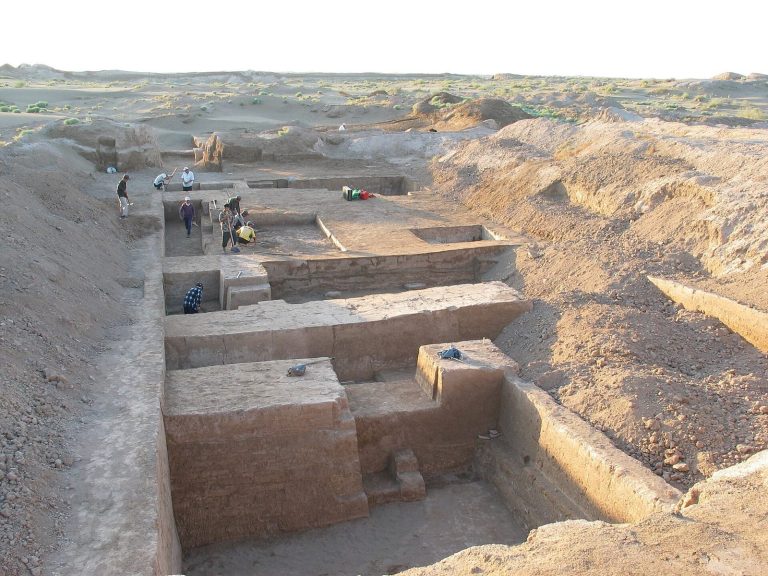
The historian and archaeologist S. P. Tolstov first scientifically described Kyzyl-Kala in 1938 during an expedition to the lower Syr Darya region. His archaeological work helped establish the developmental history of ancient Chorasmia. Modern renovation and reconstruction have sought to convey the fortress’s presumed original appearance, while preserving surviving ancient remains. Kyzyl-Kala is protected by the state and forms part of Uzbekistan’s “Fifty Fortresses Oasis.”
Remains
Setting and defensive walls
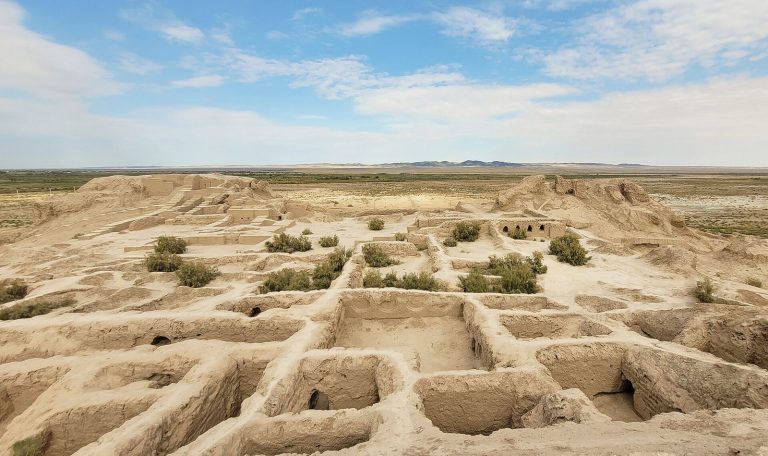
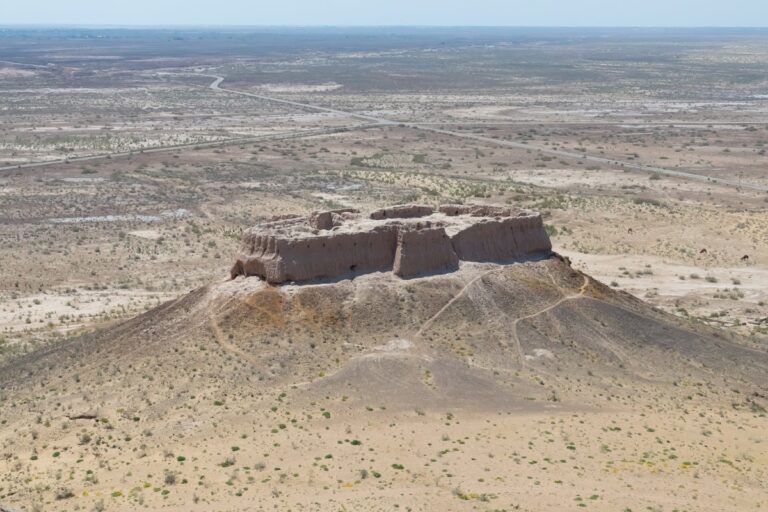
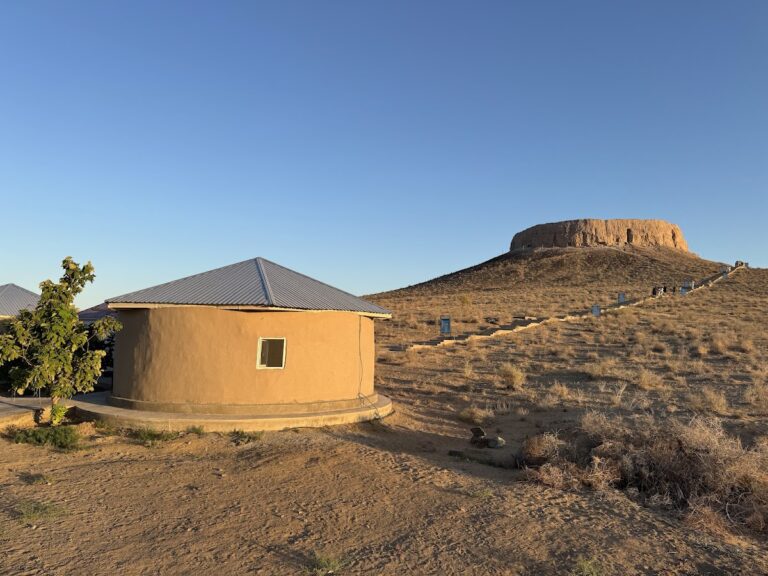
Kyzyl-Kala stands on a slightly raised platform across a flat plain south of the Sultan Uvays Dag mountains. Toprak-Kala lies to the east, approximately 1 to 3 kilometres away. The fortress was built from large-format mud bricks, unfired bricks made from earth or clay. The building material consisted of river sand mixed with riverbed silt, a combination described as resistant to damp and able to absorb the effects of earthquakes.
Two large rectangular towers project from the middle sections of the northwestern and southwestern walls. The central section of the southern wall contains an entrance tower with an outer gate structure and a ramp leading into the fortress. On either side, the upper tier of the outer wall has rectangular pilasters, shallow projections attached to the wall, containing two rows of arrow slits. These narrow openings were designed for projecting missiles from the fortification.
Interior spaces and archaeological finds
The interior is arranged on two levels. The lower level has been only minimally excavated and contains vaulted roofing, probably associated with interconnected corridors that preserve ancient architectural layers. Rooms were found within the fortress, and traces of the later medieval occupation remain on the surface.
Excavations recovered ordinary pottery, glass, bronze fragments, jewelry, and remains of colored wall frescoes, which are paintings applied to walls or plaster. The frescoes and the character of the finds suggest that a wealthy dignitary and his retinue may have lived at Kyzyl-Kala. Objects from the rooms included twelve stacked glazed mina’i-type plates, Chinese-origin chandeliers, part of a richly decorated bronze lamp, domestic pottery, rings, and beads.
Ancient water supply and present condition
Ceramic water pipes from the ancient period were found outside the southern wall at a depth of approximately 1.5 metres. They probably carried water from a branch of the ancient Gaukhare Canal, whose channel ran about 5 kilometres from Kyzyl-Kala. The pipes provide physical evidence for the systems that supported the fortress beyond its walls.
The surviving site combines ancient ruins with wall sections that have been restored or reconstructed through modern work. Kyzyl-Kala remains in a ruined condition, while its defensive layout, interior layers, excavated objects, and water-supply evidence preserve aspects of its long use from ancient Chorasmia through the Khwarazmian period.