Hodegetria Monastery: A Fortified Eastern Orthodox Monastery on Crete


Site at a Glance
- Rating
- 4.7
- Popularity
- Medium
- Country
- Greece
- Primary era
- Medieval
- External website
- Open
- Eras represented
- Medieval, Early Modern, Modern
- Civilizations
- Ottoman, Venetian
- Site type
- Religious
- Remains
- Fortified Monastery
On this page11 sections
History
Hodegetria Monastery is an Eastern Orthodox male monastery in Greece, on Crete. Its construction dates to the fourteenth century, and its oldest surviving church paintings belong to the same period. Hodegetria is a title of the Virgin Mary meaning “Guide” or “She Who Shows the Way,” and the monastery became closely associated with Cretan religious life and resistance.
Foundation and Early Development
The monastery was established in the fourteenth century and was formerly a stavropegic institution, meaning that it stood directly under a senior ecclesiastical authority rather than the ordinary jurisdiction of the local bishop. It was also previously a mixed male-and-female monastery. The earliest recorded references to Hodegetria and its earliest other buildings date from the sixteenth century.
Its position on the western edge of the Asterousia Mountains gave the monastery a defensive role. The fortified complex served as a refuge for Cretan rebels. During the uprisings of the nineteenth century, this protected setting allowed people connected with the resistance to shelter there. In 1866, the rebel fighter Michael Korakas concealed three of his children at the monastery, where they passed unnoticed by Turkish forces.
Xopatéras and the Rebellions
Hodegetria is especially associated with the monk and freedom fighter Xopatéras, who was born in 1788 at the settlement of Manousanas. His secular name was John Markakis. After he was ordained at the monastery, he took the name Ioasaf.
Ioasaf was forced to leave the monastery after killing a janissary who had insulted his family’s honor. Janissaries were elite infantrymen of the Ottoman military and administration. The metropolitan defrocked him, and he became known as Xopatéras, Xepatéras, or Xopapas. Another tradition holds that his defrocking followed the birth of a child outside marriage with a woman with whom he lived.
Xopatéras later became an ally and fellow combatant of Dimitrios Kourmoulis of Kouses. With the monastery as a refuge, he and other fighters posed a major threat to the janissaries. During Turkish clearance operations in the Asterousia Mountains near the end of the Greek War of Independence, Xopatéras chose to remain in the monastery rather than retreat with the other rebels. In May 1828, he barricaded himself in its tower with his wife, other relatives, and a child.
Turkish forces besieged the tower for three days and killed the other fighters inside. Xopatéras opened the door so that his wife and the child could escape, but the attackers killed them. He then remained in the tower with his sister until their ammunition ran out. When he attempted to break through the besieging force with his sword, he killed several attackers before being killed himself. The Turkish forces beheaded him and compelled his sister to carry his head to Mustafa Pasha, a high-ranking Ottoman administrative or military official.
Destruction and Re-establishment
The monastery was destroyed in connection with the rebellions in 1828 and 1866 and was later re-established. The life and death of Xopatéras continued to be commemorated in mourning songs from the Cretan folk tradition, preserving his association with the monastery in local historical memory.
Remains
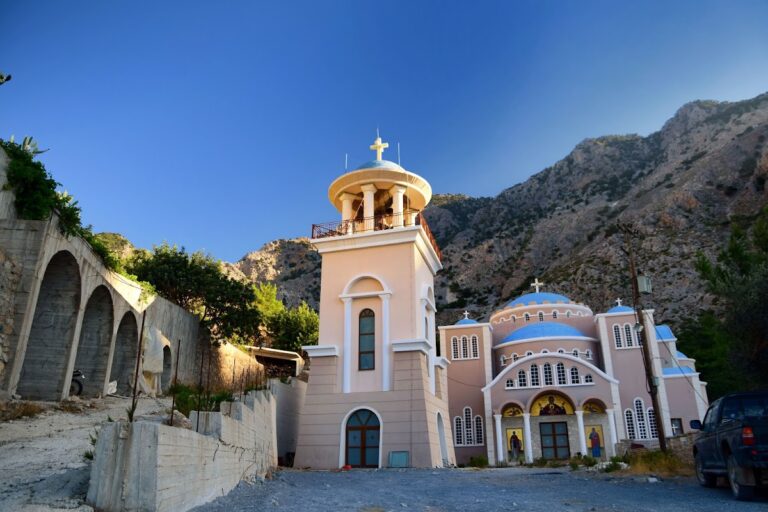
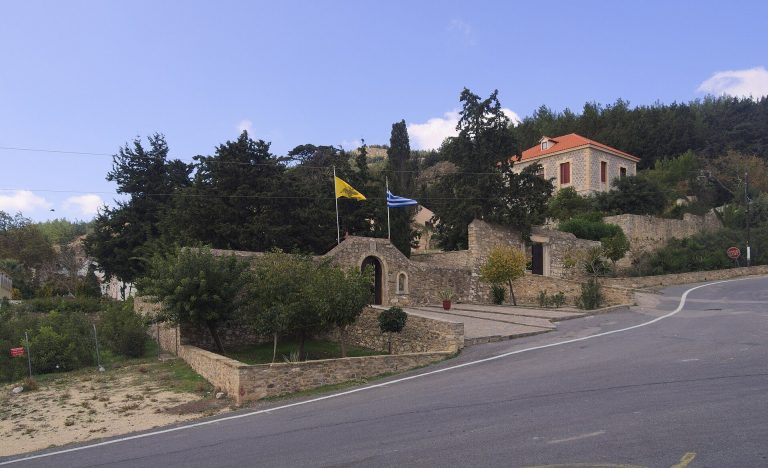
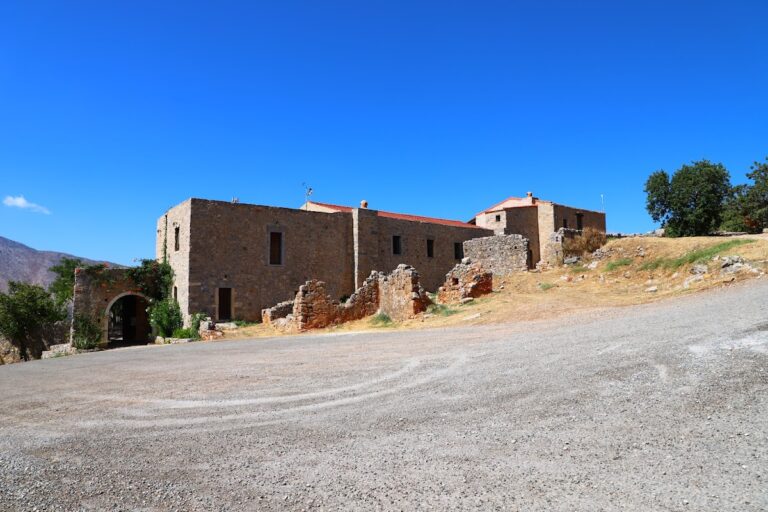
Hodegetria Monastery occupies a fortified position at about 250 metres above sea level on the western edge of the Asterousia Mountains. The surviving group of buildings has a fortress-like character. A surrounding wall once enclosed the complex, and surviving sections include the northern gate, which bears the date 1568.
Fortifications and Tower
Northern Gate and Enclosure Wall
The enclosure wall formed the monastery’s defensive boundary. Parts of it remain, including the northern entrance marked with the date 1568. Together with the grouped buildings, the wall gives the monastery its fortified appearance.
Xopatéras Tower
The tall Xopatéras Tower belongs to the monastery complex. Its historical importance comes from the siege of May 1828, when Xopatéras and those with him defended themselves there for three days. The tower is therefore both a surviving architectural element and the setting of the final episode in his life.
Monastery Church
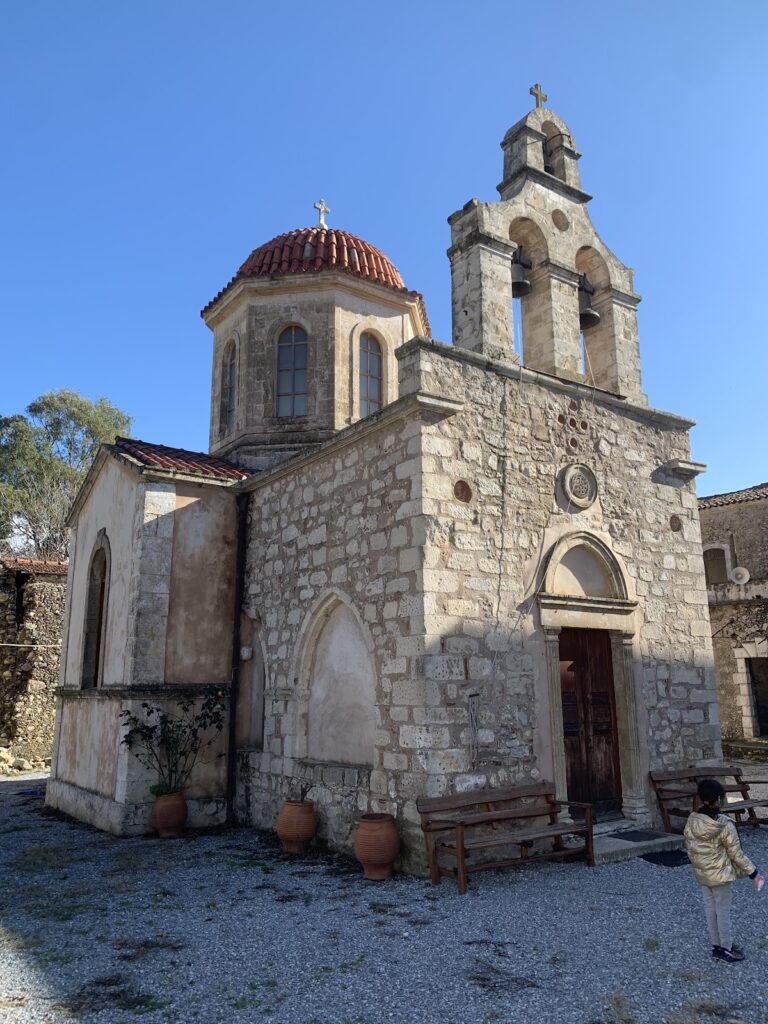
The monastery church stands at the centre of the enclosure and has two aisles. Its dedications are associated with the Nativity of the Theotokos, a Christian title for Mary meaning “Bearer of God,” and the Apostles. A more specific identification assigns the central nave to the Dormition of the Virgin and the northern nave to the Apostles Peter and Paul.
The church and its narthex, or entrance hall, contain wall paintings and icons of the Cretan School. This was a major tradition of post-Byzantine religious painting that developed in Crete and combined Byzantine iconography with later artistic influences. Sacred vestments, an icon screen, and other ecclesiastical furnishings are also preserved in the church.
Surrounding Churches and Working Buildings
The area around the monastery contains the fully painted Church of Saint Eutychianos, which also has traces of wall paintings, and the painted Church of Saint John. The Church of Saint Andrew stood in an old settlement and retains its wall paintings.
The monastery’s olive press retains its seventeenth- to eighteenth-century form. Most of the other monastery buildings date from the eighteenth and nineteenth centuries, adding later phases of construction to the medieval foundation.
Earlier Archaeological Evidence
Minoan-period tombs have been found near the monastery. The Minoan period refers to Crete’s Bronze Age civilization, conventionally dated from the third to the second millennium BC. These tombs place earlier archaeological activity in the landscape surrounding the later monastery.