Basilica of St. Achillios: The Early Byzantine Cathedral of Larissa


Site at a Glance
- Rating
- 4.7
- Popularity
- Very Low
- Country
- Greece
- Primary era
- Medieval
- External website
- Open
- Eras represented
- Medieval
- Civilizations
- Byzantine
- Site type
- Religious
- Remains
- Cathedral
On this page11 sections
History
The Basilica of St. Achillios is an early Byzantine church in Larissa, Greece, built in the mid-sixth century on the acropolis of ancient Larissa. Dedicated to St. Achilleios, the city’s patron saint, it served as the cathedral of the Metropolis of Larissa, a major ecclesiastical jurisdiction headed by a metropolitan bishop, within the Eastern Orthodox tradition under the Ecumenical Patriarchate.
Foundation and Ecclesiastical Role
Surviving inscriptions identify the church’s dedication to St. Achilleios, a fourth-century metropolitan bishop of Larissa who served for 35 years and later became the city’s patron saint. The basilica therefore combined the functions of a cathedral and a place associated with the memory of the city’s principal saint.
Middle Byzantine Development
During the Middle Byzantine period, the central phase of Byzantine history from approximately the eighth to the twelfth century, the cathedral was repaired. This period also saw the growth of a large cemetery east of the church and the construction of associated buildings, probably including storehouses, baths, charitable institutions, and other supporting facilities.
Later History and Excavation
The church remained in existence until the middle of the fourteenth century. It was probably demolished in the late fifteenth century, when the Ottomans built the Larissa Bedesten, a covered market used for valuable goods. Its ruins were probably reused as building material for the later structure.
The basilica was discovered and excavated in 1978 during works connected with the local open-air market. The excavations brought the church foundations, burial areas, and Middle Byzantine associated buildings into view, preserving evidence of the cathedral’s long religious and funerary use.
Remains
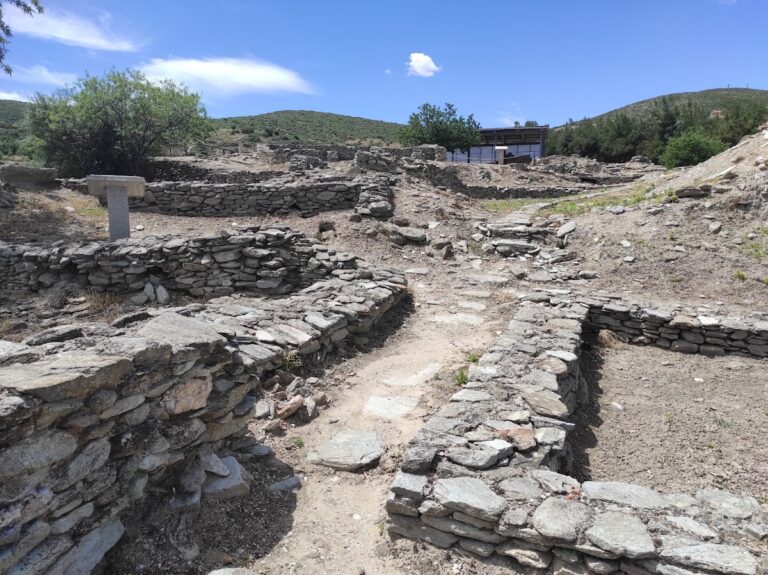
The remains occupy the summit of Frourio Hill, the acropolis of Larissa, between the First Ancient Theatre and the later Ottoman-era Bedesten. The ruined church follows the plan of a typical three-aisled basilica, with a long central nave flanked by aisles, an entrance hall called a narthex, and an additional outer vestibule known as an exonarthex. Its original roof was made of wood, and the surviving structure is a non-functioning church.
Church and Burials
Basilica Foundations
Excavation exposed the foundations of the three-aisled church, including the central nave, side aisles, narthex, and exonarthex. These remains define the principal arrangement of the cathedral and preserve its early Byzantine form at the summit of the hill.
Vaulted Tombs and Graves
Graves lay inside and around the building, including three vaulted tombs and numerous box-like graves. A vaulted tomb at the eastern end of the northern aisle carries cross decoration and may have been the burial place of St. Achilleios, linking the physical remains to the church’s dedication and commemorative role.
Middle Byzantine Complex
Auxiliary Buildings
Foundations of buildings associated with the cathedral belong to the Middle Byzantine period. They probably served practical and charitable purposes, including storage, bathing, and institutional support for the ecclesiastical center.
Eastern Cemetery
A large cemetery extended eastward from the church. Its graves formed part of the wider funerary area that developed around the repaired cathedral, adding an important archaeological dimension to the surviving complex.