Moni Keras: A Greek Orthodox Nunnery in Crete


Site at a Glance
- Rating
- 4.6
- Popularity
- Medium
- Country
- Greece
- Primary era
- Medieval
- Eras represented
- Medieval
- Civilizations
- Venetian
- Site type
- Religious
- Remains
- Fortified Monastery
On this page7 sections
History
Moni Keras is a Greek Orthodox nunnery in Greece, a Byzantine-style monastery dedicated to the Virgin Mary. Its exact foundation date is unknown, but manuscripts mention the monastery in the early fourteenth century, probably in 1333. Another tradition places its establishment broadly between 961 and 1204. The monastery is associated with the Church of Crete and the Ecumenical Patriarchate of Constantinople.
The monastery and the Virgin Mary icon
Moni Keras has long been linked with an old icon of the Virgin Mary traditionally regarded as miraculous. The icon was associated with an eighth-century image and, during Iconoclasm, the Byzantine controversy over the religious use and veneration of sacred images, was taken to Constantinople. Tradition holds that it later returned to Crete by miraculous means.
In 1498, during Venetian rule, a Cretan wine merchant stole the original icon and carried it to Rome. It was eventually placed in the Church of St. Alphonsus near the Esquiline Hill, where it remains permanently enshrined. The church is named for Alphonsus Liguori, an eighteenth-century Catholic bishop and founder.
A replacement icon, known as the Kardiotissa or “Heart-Bearing” Virgin, was brought to Moni Keras in 1735. It too became associated with miracles, including cures for infertility, and remains central to the monastery’s religious identity.
Venetian patronage and later expansion
The Manganaris family acted as the monastery’s patrons for many generations. In 1429, the Venetian governor of Crete transferred Moni Keras to the priest Paul Manganaris. Paul restored it at his own expense and repopulated it with Orthodox monks. A document from 1443 records the transfer and restoration.
In the middle of the seventeenth century, Paul, Alexander, and Theodosius Manganaris, together with their sister Maria, restored the main church. Their nephew Theophilos became abbot, and members of the Manganaris family continued to be chosen as abbots until the beginning of the twentieth century.
During the seventeenth and first half of the eighteenth centuries, the monastery held extensive landed property. In 1720 it became stauropegic, meaning that it came under the direct authority of the patriarchate rather than the ordinary jurisdiction of the local bishop. In 1755, the bishop of Siteia used Moni Keras as one of his residences, while about sixty monks lived there.
Ottoman occupation and continuing religious life
Ottoman forces conquered Crete in 1648. During the occupation, Moni Keras was attacked and destroyed several times, including in 1822 and 1842. The monastery was repaired soon after the destruction of 1822. Its sheltered location also allowed it to serve as a local revolutionary center and, during the Cretan uprising of 1866–1867, as one of the uprising’s bases.
Moni Keras remains an active nunnery. Its principal feast is celebrated on September 8, the Nativity of the Virgin Mary. Twenty-six residents were recorded there in 2011.
Remains
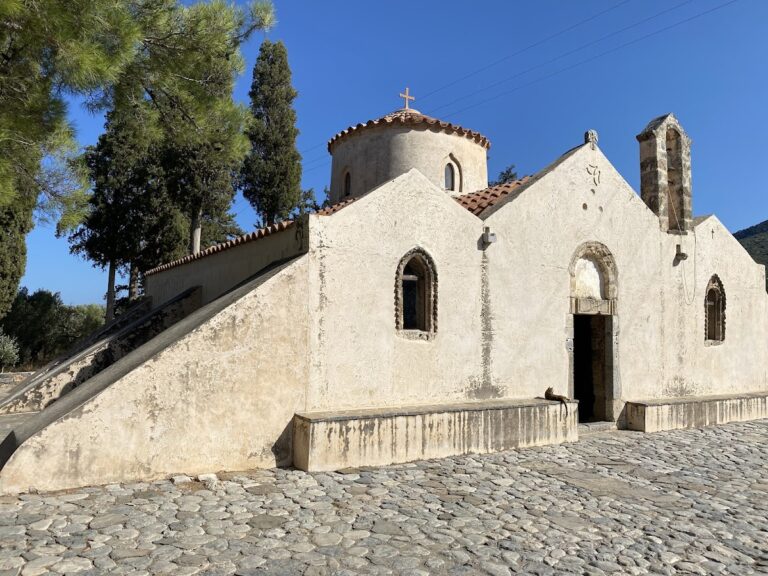
Moni Keras stands near the village of Kera on the northern slopes of Mount Dikti in Crete, beside the road to the Lasithi Plateau. Its elevation is given as approximately 630–650 metres above sea level, and its Byzantine-style complex is enclosed by fortified walls. A small religious museum is also present.
The katholikon and associated spaces
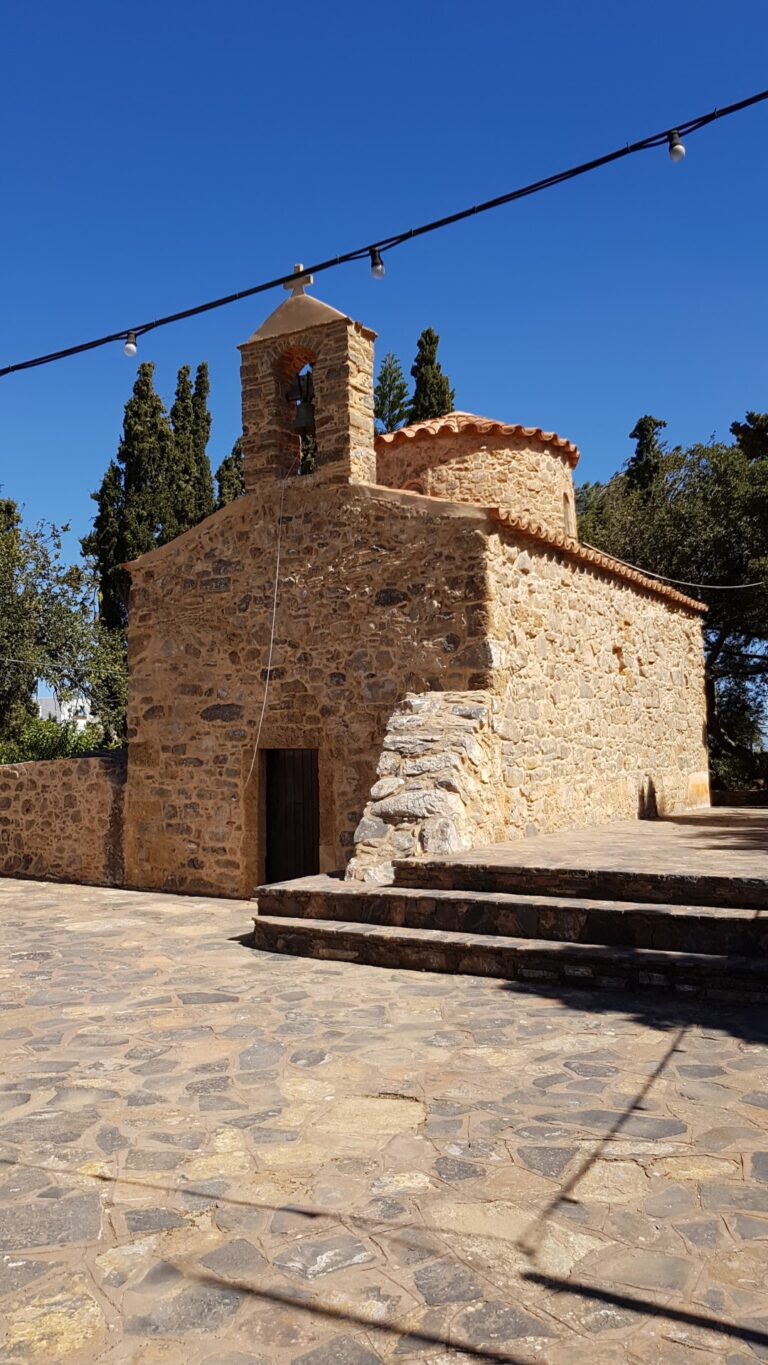
The katholikon, the principal church of an Orthodox monastery, is dedicated to the Nativity of the Virgin Mary. It began as a single-nave, arch-covered building and was enlarged through four successive building phases. The later additions include a northern barrel-vaulted chapel dedicated to the Hieromartyr Charalambos, a smaller chapel, two narthexes, and three parallel spaces on the western side. A large transverse narthex brought these additions into a unified arrangement.
The sides of the large narthex display a Byzantine design with blind brick arcades and ceramic decoration. Byzantine-period wall paintings from the fourteenth and fifteenth centuries survive in the katholikon. The eastern wall of the central nave in the western narthex depicts the Dormition of the Virgin, while the vaulted ceiling presents scenes from the life of Jesus, including the Nativity, Joseph’s Dream, the Flight into Egypt, the Betrayal of Judas, the Raising of Lazarus, and the Harrowing of Hell. The western wall shows the Last Supper.
Icon, relics, and associated features
The Kardiotissa icon is kept inside the church to the left of the iconostasis. Chains associated with the icon are preserved beside it, while a marble pillar linked with the icon stands outside the church. These objects belong to the tradition that the Virgin Mary icon was miraculously transferred from Constantinople to the monastery.
The monastery also preserves fragments of relics associated with Saint George the Victorious, Saint John Chrysostom, and Saint Paraskeva.