Aghperig Monastery: A Medieval Armenian Monastic Complex in Turkey


Site at a Glance
- Rating
- 5
- Popularity
- Very Low
- Country
- Turkey
- Primary era
- Medieval
- Eras represented
- Classical, Medieval, Early Modern
- Civilizations
- Armenian
- Site type
- Religious
- Remains
- Fortified Monastery
On this page13 sections
History
Aghperig Monastery is a medieval Armenian monastic complex in Turkey, located in the historic Sasun region of the northern Sasun Mountains. Affiliated with the Armenian Apostolic Church, an ancient independent Christian church rooted in Armenia and its surrounding historical regions, the monastery stands approximately 20 kilometres southeast of Mush and 56 kilometres west of Lake Van. Its origins are associated with the beginnings of Armenian Christianity, around the fourth century, although its exact foundation date is unknown.
Origins and religious traditions
Local tradition connects the main church with Saint Thaddeus, an apostle traditionally associated with the early Christian mission in Armenia, and places the construction of the adjacent church under Gregory the Illuminator around AD 300. Gregory was the missionary traditionally credited with converting Armenia to Christianity and becoming its first chief bishop. The surviving buildings belong to several later phases, including substantial rebuilding and additions over many centuries.
The monastery is known by several names, including Beyaz Kilise, Aghperga, Aghperka(vank), and Vantir Monastery. It is also commonly called Saint Aghperig, meaning “Holy Spring.” The name refers to the natural spring beneath or near the complex and to other springs in the surrounding area. A tradition holds that Saint Thaddeus dipped one of the nails used in Christ’s crucifixion into the spring, giving its water miraculous and healing qualities. Local residents therefore called it holy water.
Violence and abandonment
During the Hamidian massacres, mass killings of Armenians in the Ottoman Empire during the reign of Sultan Abdul Hamid II, especially in 1894–1896, Aghperig Monastery sheltered refugees and wounded people in 1895. The complex later suffered attacks in 1899 and 1908. Father Ghazar, one of its abbots, was killed in 1899, and his successor, Father Zacharia Avdalyan, was killed in 1908.
Father Khachadur was abbot in 1914. He, the pupils of the monastery school, and other members of the order were killed during the Armenian genocide. The monastic community left the site around 1915, after which the buildings stood unoccupied and gradually fell into ruin. Numerous pits were dug around the complex because local people believed that Armenians departing from the monastery had buried gold there.
Modern recognition
In 2015, the Gomidas Institute visited Aghperig with academics and journalists. Working with local Kurdish civil society and a local municipality, the London-based institute campaigned for protection of the complex, which stands on state-owned land. The journey was recorded in the 2016 documentary 100 Years Later, which concerned the work of historian Ara Sarafian, the institute’s founder.
Remains
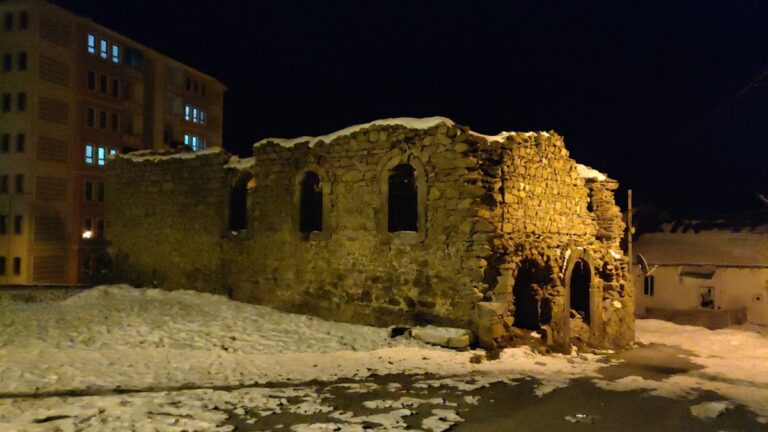
Aghperig Monastery was built in a gorge on a mountainside at approximately 1,950 metres above sea level, above a natural spring. A steep mountain encloses the complex on three sides. On its southern side, the site overlooks Prnashen and a small field called Tavta. The buildings form a connected group of churches, entrance halls, and later structures, with defensive walls added around the complex during the late medieval period. The site is now in ruins, and the buildings have remained unoccupied since the monastic community departed around 1915.
Churches and connected entrance halls
Church of Saint Thaddeus
The Church of Saint Thaddeus is a three-apsed, single-nave building measuring 11.7 by 8.9 metres. Probably built before the tenth century and later rebuilt, it contains niches beneath the arches, a pointed barrel vault strengthened by transverse arches, and two lateral chambers. Its western wall is joined by the narthex of Saint Stephen, an entrance hall or vestibule attached to a church.
Narthex of Saint Stephen
The narthex of Saint Stephen stands against the western wall of the Church of Saint Thaddeus and measures approximately 15 by 12 metres. Built at an uncertain date and subsequently rebuilt, it has a pointed cylindrical vault, niches beneath the arches, and transverse arches resting on imposts. An impost is a projecting block or ledge from which an arch begins.
Church of the Holy Savior
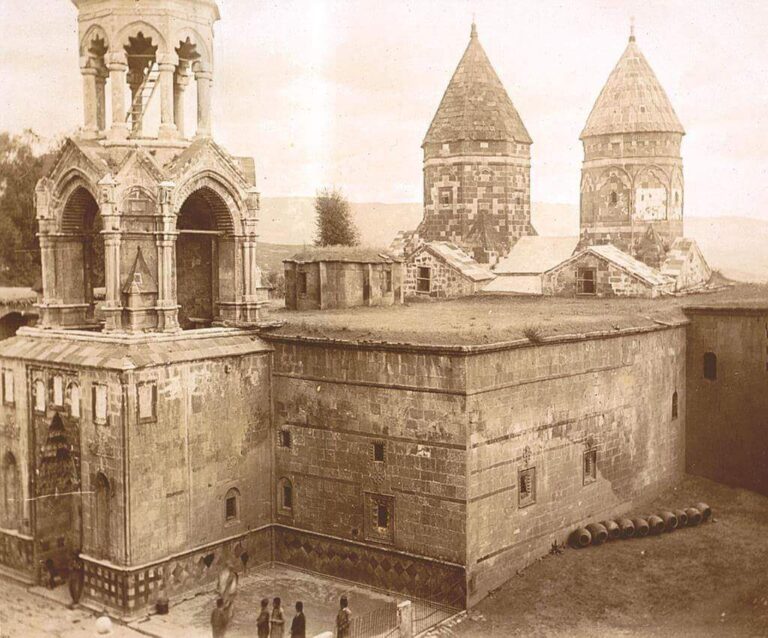
North of the Church of Saint Thaddeus stands the Church of the Holy Savior, also called the Church of the Holy Forerunner. A covered passage with cross-vaults connects it to Saint Thaddeus. One altar is dedicated to Saint John the Baptist, which explains the church’s alternative name. Prince Viken Mamikonian built it around the middle of the tenth century, following the model of the Church of Saint Thaddeus. It has a cross-shaped plan measuring 14.1 by 10.6 metres, two-faceted columns, and a dome carried on a polygonal drum.
Narthex of the Illuminator
The narthex of the Illuminator extends directly west from the Church of the Holy Savior. Measuring 12.6 by 9.5 metres, it contains four central columns and eight engaged columns, which divide the interior into nine unequal compartments. Each compartment is covered with a calotte, a shallow dome or domed vault. The narthex probably dates from the sixteenth century or later. Its western wall aligns with the wall of the narthex of Saint Stephen, and the two structures connect and overlap.
Later additions and defenses
Bell tower
A bell tower was built later in front of the narthex of the Illuminator. Its base measures approximately 11.3 by 5.6 metres, placing it among the later additions to the monastic complex.
Defensive walls
Walls were constructed around Aghperig during the late medieval period, enclosing the group of religious buildings on the mountain site. They form part of the surviving physical organization of the complex, whose churches and halls now stand in a ruined condition above the spring.