Sanctuary of Kato Symi: A Minoan and Greek Cult Site in Crete
Site at a Glance
- Popularity
- Very Low
- Country
- Greece
- Primary era
- Bronze Age
- Eras represented
- Bronze Age, Iron Age, Classical
- Civilizations
- Ancient Greek, Minoan, Roman
- Site type
- Religious
- Remains
- Sanctuary
On this page23 sections
History
The Sanctuary of Kato Symi is an ancient cult site in Viannos, Greece, on the island of Crete. Worship began around 2100–2000 BC, and the oldest surviving construction dates to about 1800–1700 BC, during the Minoan Bronze Age. The sanctuary continued in use well beyond the end of Minoan civilization, making it important for understanding how an ancient sacred place endured into the Iron Age. Its ancient name is unknown. Kato Symi refers to a nearby modern village, while Sanctuary of Hermes and Aphrodite describes the site’s later cult.
Minoan origins
Activity grew more substantial during the Early Palatial period, a phase associated with Minoan palace culture, around 1900–1800 BC. The sanctuary was rebuilt in the Late Palatial period, about 1750–1450 BC, perhaps following an earthquake. Buildings associated with Middle Minoan III, another phase of Minoan Crete, were later altered and expanded.
The identity of the Minoan deity remains uncertain. Objects dedicated to a god suggest that worship may have focused on a male divinity, although a mother goddess has also been proposed. Ritual life included burning animal offerings, shared meals, and pouring liquids in open-air spaces. Spring water had an important place in these practices.
Renewal and historical-period worship
The sanctuary remained active after the Minoan period. Its position away from a palace center may have helped sustain its use. During the Subminoan period, the final phase of Minoan culture and its transition toward the Iron Age, terraces and a pit for burnt offerings were established in the southern precinct. The sanctuary was renewed in the Protogeometric period, with a new altar at its center.
From the Subminoan or Protogeometric period, the sanctuary appears to have drawn worshippers from beyond its immediate surroundings. The first indications of worship there of Hermes, a god associated with travel, communication, and boundaries, and a goddess date to around 900 BC. Inscriptions identify Hermes by name from the fifth century BC, and the goddess was identified as Aphrodite, the goddess of love and sexual desire, by the Hellenistic period. These deities have sometimes been interpreted as successors to a Minoan vegetation goddess and her divine companion.
Inscriptions on roof tiles name worshippers from the Cretan city-states of Lyttos, Priansos, Hierapytna, and Arkades. A reference to a civic tribe of Lyttos, called a phyle, suggests that Lyttos may have overseen the sanctuary’s cult and administration. Its political jurisdiction is uncertain, however. Although the sanctuary lay near Biannos, the sacred territory may have bordered the lands of several neighboring city-states.
The sanctuary’s regional influence seems to have eased during the Archaic and Classical periods, though substantial activity continued. Ceramic finds became less varied in the fourth century BC, perhaps because one city had gained control of the site. A broader range of influences is apparent again during the Hellenistic period.
Ritual life and possible initiation rites
The sanctuary may have played a part in rites of passage for young Cretan men. Strabo, an ancient Greek geographer and historian, drew on the historian Ephorus of Cyme to describe a Cretan custom in which an older man selected and took away a younger partner. They hunted and ate together outside the city for two months, and the younger man learned about a warrior’s life in the mountains. On their return, he received a drinking cup, a garment, and a bull to sacrifice to Zeus. Their relationship was said to continue as military companionship. The sanctuary’s position in a mountainous border area may have suited such rites, but its role in them remains a possibility rather than a certainty.
Roman decline and later use
The sanctuary declined markedly under Roman rule and had become a local place of worship by the first century AD. Its precise end as an active religious site is unknown, but the cult had ceased by the Christianization of the Roman Empire. Later Christian use of part of the site is reflected in church remains and a nearby grave.
Road construction exposed the sanctuary by chance in September 1972. Archaeologist Angeliki Lebessi directed excavations from 1972 to 2003. Roadwork and water moving down the slope disturbed the archaeological layers. Shallow deposits, mixed remains from different periods, farming and land reclamation, rain, and streams also complicated excavation; some objects could be dated only by their style.
Remains
Setting and sanctuary layout
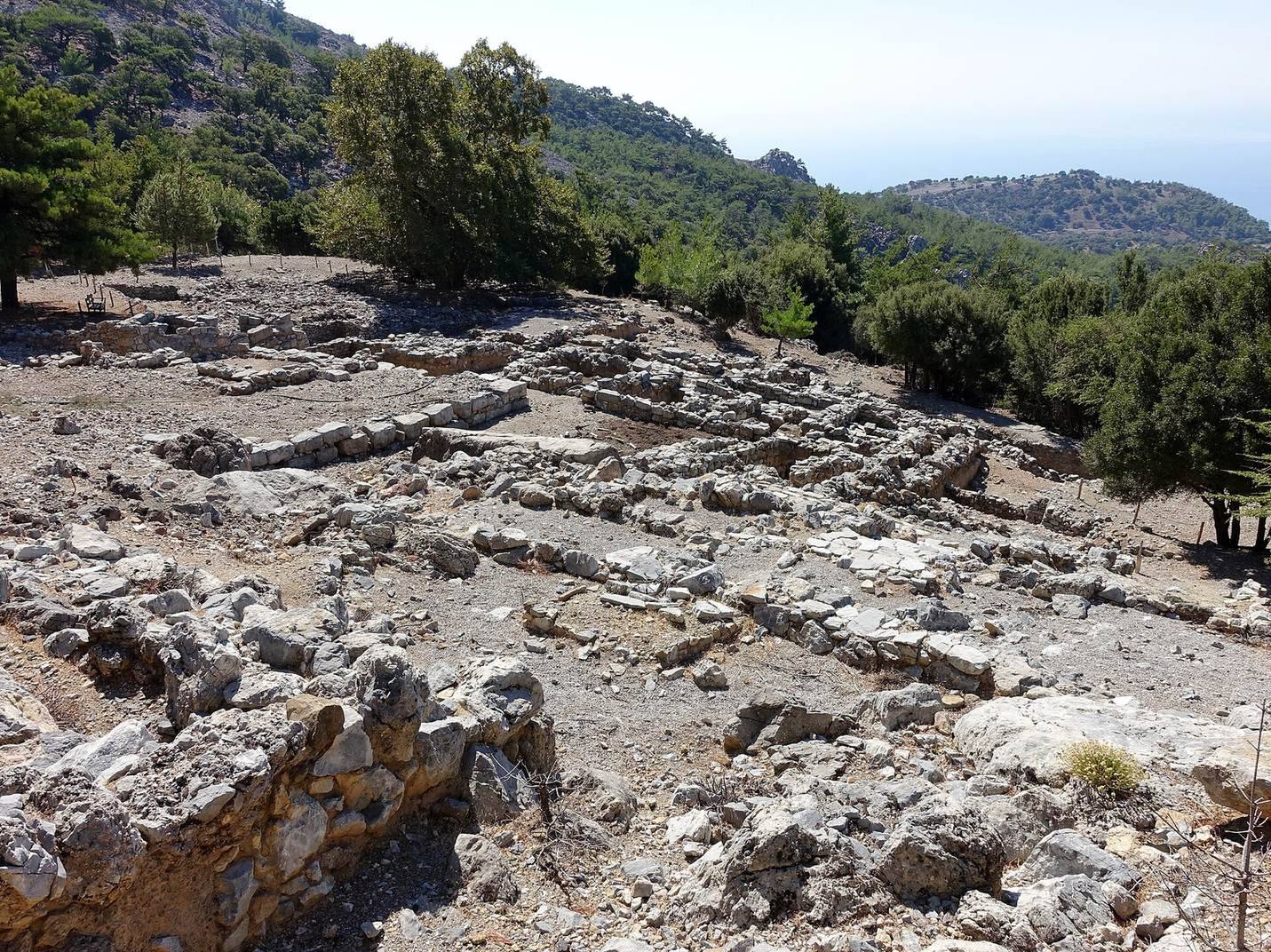
The sanctuary occupies a wooded plateau that slopes south at about 1,130 metres above sea level, on the southern side of the Pratolitsa range in the Dikti Mountains. Pines and oaks grow among the remains, and a small stream crosses the site. The sanctuary covers an estimated 9,350 square metres, of which about 1,250 have been excavated. A spring near the site, in an area now called Krya Vrysi, or Cold Spring, may have influenced its location. Unlike the typical Minoan mountain-top sanctuary, it stood on a slope. Its layout included enclosed precincts in the north and west, ritual terraces to the south, and buildings from several periods.
Enclosures and raised platform
A Neopalatial enclosure of about 530 square metres lay west of the sacred spring in the northern part of the site. At its center was a square raised platform. A rectangular boundary wall also enclosed the Late Palatial sanctuary, with a passage leading to its entrance.
Southern terraces
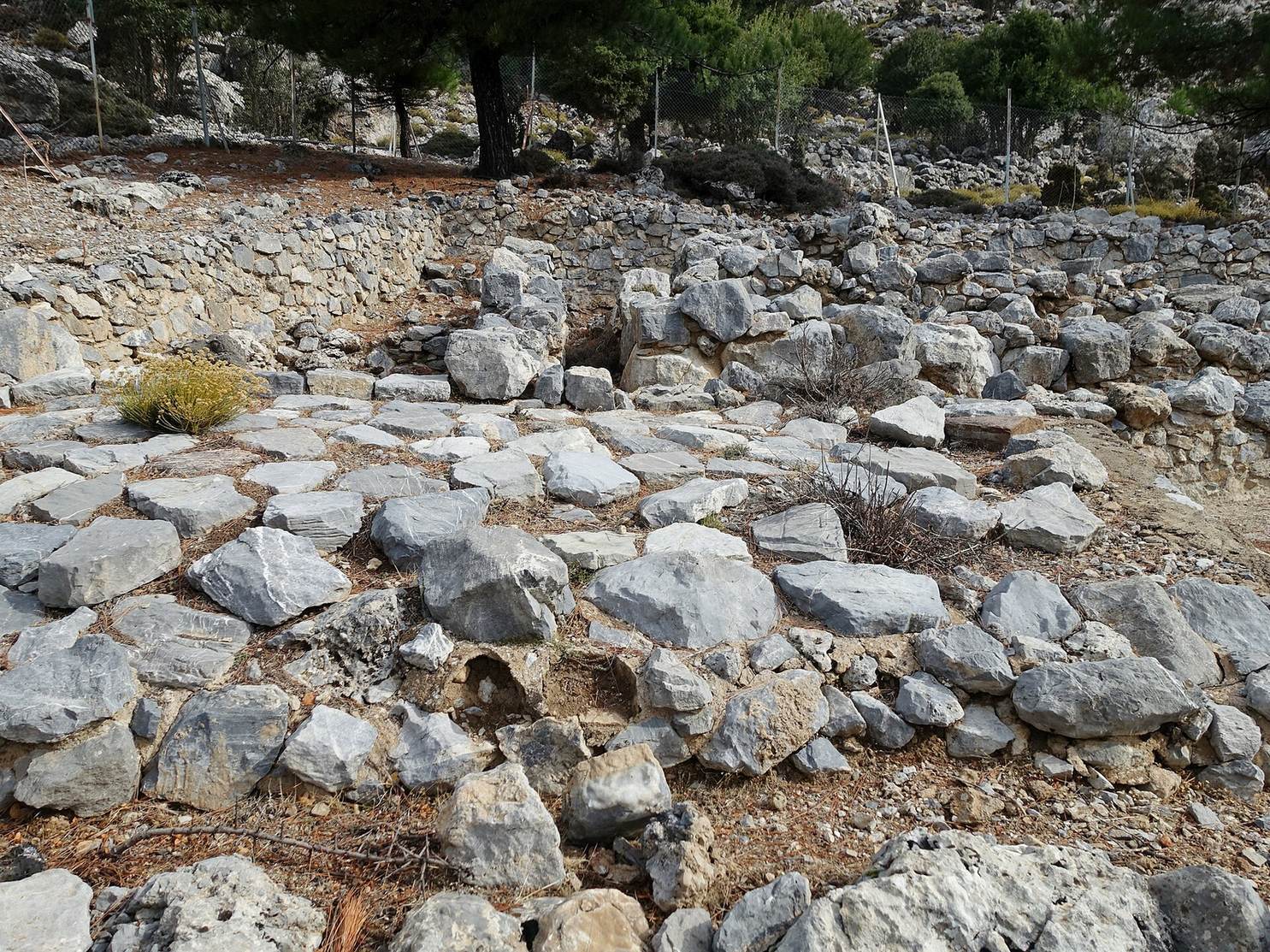
Stepped terraces in the southern area provided open-air space for rituals. Early buildings there served as accommodation for priests and worshippers. A pit used for burnt offerings lay above the terraces.
Minoan buildings
Two-room shrine
The walls of a Middle Minoan III B shrine survive to a height of up to 30 centimetres. A doorway between its two rooms was later blocked, and both rooms had plaster floors. In the western room, a low stone bench altar held offering vessels, including two with Linear A signs. Linear A was a Minoan script that remains undeciphered. Terracotta vessels for cult use, tubes for pouring liquid offerings, and conical cups were found in both rooms.
Three-room building
Southeast of the altar, a three-room building dates to Middle Minoan III B–Late Minoan I A. Its plastered walls survive to about one metre high. Clay vessels, some shaped like chalices, and stone vessels were found near a triangular platform. Rooms immediately to the south and an open paved area probably formed part of the same building. A thick burnt layer covered them.
Building west of the altar
A building of the same broad date stood west of the altar. It contained many stone offering vessels, including one broken piece marked with three Linear A signs.
Later ritual and religious buildings
Central altar
An altar measuring about 2.7 by 2.2 metres stood at the sanctuary’s center during the first millennium BC. Buildings from different periods surrounded it, some roofed and some open. Numerous remains of sacrifices were associated with the altar.
Hellenistic shrine and Roman building
A single-room shrine was built in the second half of the second century BC at the southeastern corner of the earlier raised platform. A Roman building measuring 2.65 by 2.85 metres was later constructed over the shrine.
Christian churches and grave
A chapel built sometime between the fourth and seventh centuries AD stood in the northwestern part of the excavated area. A second church later replaced it. A grave near that church contained pottery dating from the ninth to eleventh centuries. A Middle Byzantine pottery fragment and three Venetian coins may reflect occasional medieval visits rather than regular activity.
Offerings, figures, and inscriptions
Minoan objects
Finds from the southeastern building include bronze figures of worshippers and terracotta animals from the Late Minoan III period, a Neopalatial seal showing two fish, and a small bronze double axe dedicated to a deity. A seal from the western building shows a running goat beside a two-bodied demon in a kneeling-running pose. Other objects found among later layers include two male bronze figures from the Late Minoan I period, Neopalatial seals, and three Cretan-Mycenaean bronze swords. Their presence suggests that earlier offerings were reused. Terracotta and bronze animal figures, familiar as Minoan offerings, were found in a burnt layer beneath the altar.
Subminoan and Geometric offerings
Objects from the Subminoan and Geometric periods include half of a double vase shaped like a man’s head and numerous female figures from the Protogeometric period. A female bronze figure from the Early Geometric period combines Minoan features with elements from elsewhere. A later Geometric group comprises two figures with erect phalluses, while a headless clay female figure dates to the end of the period.
Bronze figures and tripod
Bronze figures from the seventh century BC depict gods or worshippers. An early Orientalizing-period figure, from a phase of early Greek art shaped by outside influences, shows a man in a kilt holding a four-string lyre and may represent Hermes. A complete statue of a youth, or kouros, from the middle of that period wears a kilt and raises his arms in a gesture of worship. Another male figure has a head shape and hairstyle suggesting Egyptian influence. A small archer and a youth figure belong to later parts of the Orientalizing period, while a centaur from its final phase reflects Corinthian influence.
Fragments of a tripod show repeated pairs of griffins facing a sacred tree. The object relates to examples from Cyprus, but its differences suggest that it was made on Crete using Cypriot models.
Bronze plaques and ritual imagery
Engraved or cut-out bronze plaques, dating from the seventh to the middle of the fifth century BC, appear to have been offered individually rather than attached to a larger object. Some depict male worshippers sacrificing an animal or part of one; others may represent Hermes. Several show armed figures with bows and quivers. Plaques linked with possible initiation rites depict long-haired, beardless youths hunting wild goats with bows and arrows. Visitors hung these plaques on trees. The animals may represent those later sacrificed at the sanctuary, with the meat shared between the god and the youths’ companions. Similar details on the plaques and the centaur figure suggest that they may have come from the same workshop. A separate bronze plaque from the fifth century BC depicts Hermes.
Hellenistic and Roman-period finds
Late Hellenistic objects found in the upper layers disturbed by road construction include the lower part of a clay figure of Aphrodite, another of Hermes, and a bronze Hermes wearing a short belted tunic, a cloak, a broad-brimmed hat, and winged sandals. A graffito on a Hellenistic water jar preserves part of a dedication to Aphrodite and may once have named both her and Hermes. A dedication found near the surface in 1973 dates to the third century AD and names Hermes Kedrites, meaning Hermes of the Cedars.
Other finds include many bronze and clay animal figures, miniature bronze shields dedicated to a deity, jewellery, and additional objects. The excavated finds are now held at the Heraklion Archaeological Museum.