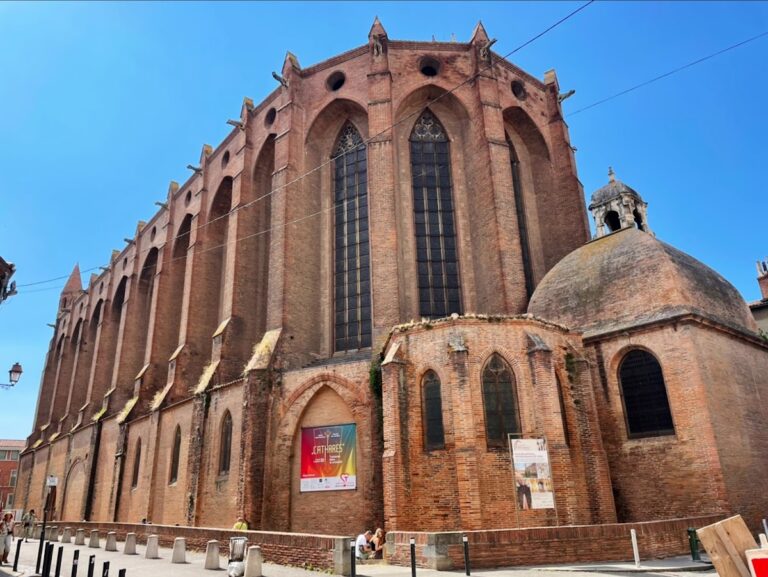
Maison Seilhan: The Traditional Birthplace of the Dominican Order in Toulouse


Site at a Glance
- Rating
- 4.2
- Popularity
- Very Low
- Country
- France
- Primary era
- Early Modern
- External website
- Open
- Eras represented
- Classical, Early Modern, Modern
- Civilizations
- French, Roman
- Site type
- Domestic
- Remains
- House
On this page10 sections
History
Maison Seilhan is a historic residence in Toulouse, France, associated with the foundation of the Dominican Order in 1215. On 25 April that year, the house was given to Dominic de Guzmán, the Castilian preacher later known as Saint Dominic, during the division of Bernard Seilhan’s inheritance. Bernard had been a local magistrate serving the Count of Toulouse, and the deed recording the transfer is preserved in the French National Archives.
The first Dominican community
In 1215, Dominic settled in the family home of Pierre Seilhan with several companions. Pierre’s share of the inheritance had been assigned to Dominic after Pierre entered religious life, and Dominic formally accepted ownership as head of the emerging community. Because he gathered his first brothers at Maison Seilhan, the house is traditionally regarded as the place where the Order of Preachers was founded. The order is a Catholic religious community whose members are commonly called Dominicans.
The friars moved to Saint-Romain Priory in July 1216 and began transferring gradually to the Jacobins convent from 1234. Maison Seilhan nevertheless remained in Dominican possession and use until the end of the eighteenth century. Friars assigned to serve the Inquisition also lived there. The Inquisition was a church institution that investigated and judged alleged heresy, and Dominican friars often served as its inquisitors during the medieval period. This association gave the house the later name “House of the Inquisition.”
Later ownership and restoration
In 1989, the Toulouse Association of Saint Dominic purchased Maison Seilhan on behalf of the Dominican Order. The Catholic Institute of Toulouse acquired the remaining buildings, including the former chapel. That chapel had been converted during the seventeenth century and was later adapted as an amphitheatre and lecture hall. The chapel of the Sisters of the Society of Mary Reparatrix, who were the last owners before the Institute, became the Bruno de Solages Amphitheatre.
Renovation of the amphitheatre uncovered a painted ceiling created between 1648 and 1650 by Balthasar-Thomas Moncornet, a Dominican novice. Four wall paintings that had originally accompanied the ceiling scenes have been lost. The house also contains works representing Dominican saints and memorabilia connected with Henri-Dominique Lacordaire, the nineteenth-century French Dominican priest who helped restore the order in France.
Remains
Maison Seilhan forms a historic residence with a façade on Place du Parlement. The complex, including the Bruno de Solages Amphitheatre, adjoins surviving remains of Toulouse’s Roman wall. Its architectural elements and religious interiors preserve several layers of the building’s history, from the medieval association with Dominic to later Dominican decoration and reuse.
Maison Seilhan
Portal and historic fabric
The house is entered through a white-stone portal carved and installed in the sixteenth century by Laurent Clary, a master mason of Toulouse. The building’s position beside the Roman enclosure is especially clear in the room traditionally identified as Saint Dominic’s room, where remains of the former Gallo-Roman boundary survive.
Saint Dominic’s room
Tradition identifies this room as the place where Dominic and his first companions slept and prayed. It is preserved as an oratory and contains an old painted ceiling, a contemporary stained-glass window by the Dominican artist Kim En Joong, and an altar sculpted in 2014 by Dominique Kaeppelin.
Former chapel and amphitheatre
Painted coffered ceiling
The former chapel, now the Bruno de Solages Amphitheatre, retains a seventeenth-century painted coffered ceiling. A coffered ceiling is divided into framed or recessed panels. Here, fifteen panels are arranged in five rows of three and depict episodes from Saint Dominic’s life. Moncornet painted the cycle between 1648 and 1650.
The scenes include Dominic’s baptism, a sign of his vocation, his mercy, the return to the Gospel, the prayer of the Rosary, the establishment of the Order of Preachers, and his apostolic vocation. Other panels show protection by the Virgin Mary, Catherine, and Cecilia, a miraculous intervention, Dominic at prayer, a healing, a healing in Rome, his purity, his approaching death, and his death.
Several images use symbolic rather than strictly chronological themes. One panel shows Mary offering the Rosary to Dominic, although the Rosary had not yet come into existence during his lifetime. Another depicts Saints Peter and Paul presenting him with a pilgrim’s staff and the Book of Scripture. A further scene shows a dog carrying a flaming torch beside a globe. This emblem refers to the Latin wordplay Domini canes, meaning “the Lord’s dogs,” a reference associated with the Dominican Order.
Paintings from Trier
The upper floor contains six paintings dated 1754 and devoted to episodes from Saint Dominic’s life. Their subjects are the Resurrection of the Widow’s Son at Saint-Sixtus, the Miracle of the Meal at Saint-Sixtus, Saint Dominic Overcomes the Demon at Saint-Sixtus, the Approval of the Constitutions by Honorius III, the Conversion of Cathar Women who Founded Notre Dame de Prouilhe, and the Death of Saint Dominic in Bologna.
Verotius created the paintings for the Dominican convent in Trier, Germany. They were incorporated into Maison Seilhan on 1 February 1861. One scene refers to Honorius III, pope from 1216 to 1227, whose approval was central to the formal establishment of the Order of Preachers. Another concerns Cathar women, members of a medieval Christian movement considered heretical by the Catholic Church, whose communities were particularly influential in southern France.