Church of Saint Stephen in Kouřim: A Medieval Parish and Archdean Church


Site at a Glance
- Rating
- 4.8
- Popularity
- Low
- Country
- Czechia
- Primary era
- Medieval
- External website
- Open
- Eras represented
- Medieval, Early Modern, Modern
- Civilizations
- Holy Roman Empire, Kingdom of Bohemia
- Site type
- Religious
- Remains
- Church
On this page13 sections
History
The Church of Saint Stephen is a Roman Catholic church in Kouřim, Czechia, built alongside the town in the 1260s as a three-nave basilica in the Burgundian style. Dedicated to Saint Stephen, an early Christian martyr traditionally regarded as Christianity’s first deacon, it serves as an archdean and filial church within the Prague Archdiocese, the Kolín Vicariate, and the parish of Kostelec nad Černými lesy. The building probably occupies the site of an older Romanesque sanctuary that existed before Kouřim was founded.
Medieval foundation and religious life
The church became associated with important religious and administrative figures during the Middle Ages. Jakub served there as chaplain to King Wenceslaus II from 1268 to 1299. Konrád of Písek was connected with the church from 1374 to 1395 while serving as a scribe to Empress Elizabeth of Pomerania. The scholars Křišťan of Prachatice and Štěpán of Páleč served there in 1395–1407 and 1407–1410 respectively, while Jan Vinkler worked as a scribe to Sigismund of Luxembourg.
The church’s literary brotherhood, a lay religious association that helped maintain and perform liturgical music, was associated with two important books. These were a late-Gothic gradual from 1470, containing chants for the Mass, and a Renaissance Advent hymnal from 1581, containing religious songs.
Hussite and Catholic periods
In April 1421, Prague Hussite forces occupied Kouřim and compelled its inhabitants to accept the Prague Articles, a program of religious demands formulated by the Hussite movement in Prague. The church consequently became Utraquist for almost 200 years. Utraquism was the Hussite church tradition that emphasized giving both bread and wine to the laity during communion.
The theologian Jiří Tesák Mošovský preached at Saint Stephen’s from 1608 to 1610. After 1622, the church returned to Catholic use. Dean Šimon Eustach Kapihorský initiated several inquisitorial proceedings in the town and, with military assistance, completed its re-Catholicization.
Fires, rebuilding, and restoration
A fire damaged the church in 1334, and further fires followed in 1567, 1641, 1643, 1659, and 1665. The most destructive blaze came in 1670. It brought down the main-nave vault, burned the towers and the covered bridge that linked their upper levels, destroyed the roofs over the whole church, and consumed most of the Gothic furnishings. Fires in 1687 and 1690 added to the damage.
Kouřim had already suffered severe destruction during the Thirty Years’ War, a major seventeenth-century European conflict, and had too few resources to rebuild the church immediately. It remained unrestored for 17 years. Baroque repairs continued until 1740, when the lowered towers received their present roof structures. Around 1850, the church and its clerical administration were incorporated into the Kolín Vicariate. Dean Antonín Ladislav Dlask then began restoring the neglected building, with repairs directed by the architect Josef Schulz. The church and its adjacent bell tower are listed as cultural monuments.
Remains
Layout and architectural character
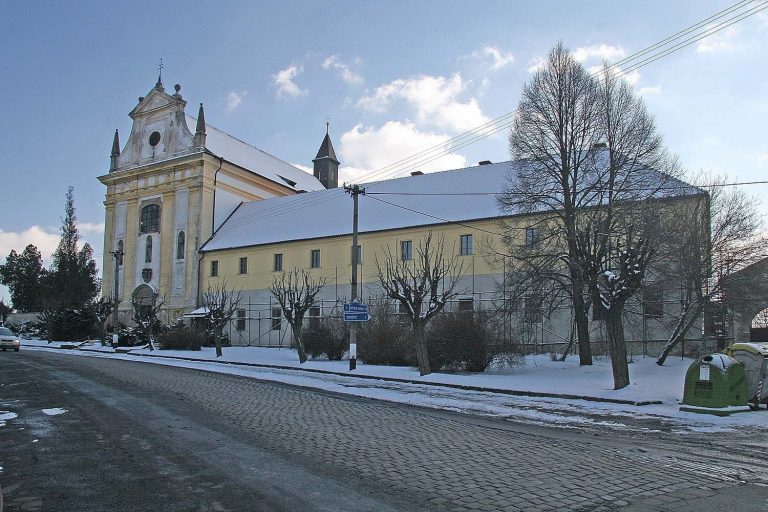
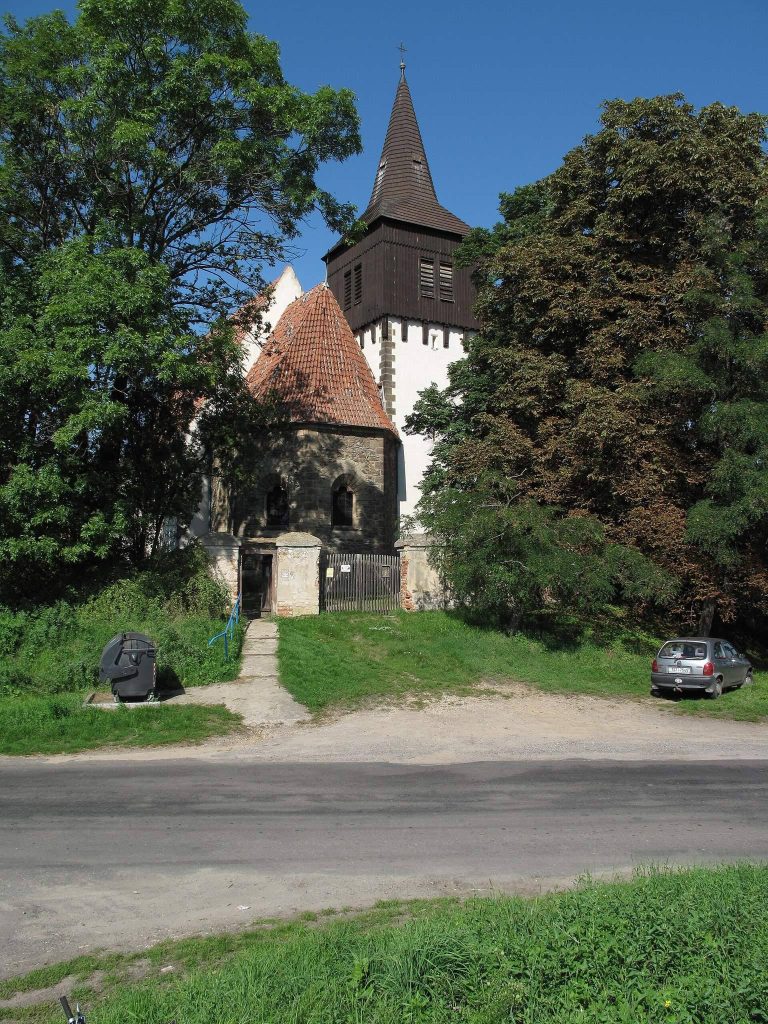
The church survives almost in its original form and forms the principal architectural landmark of Kouřim’s square and the town as a whole. Its character combines Romanesque, late-Gothic, Renaissance, Baroque, and historicist elements. The building has three naves, each ending in a five-sided termination. Two massive towers rise above it. They were once taller, and their upper levels were joined by a covered bridge, which burned in the fire of 1670.
Facade and burial evidence
The western entrance passes through a strongly neo-Gothic remodeled facade with a large window. Extensive neo-Gothic changes intended to restore the church’s original appearance were later considered harmful to the building as a whole. Fifteen Renaissance tombstones from the turn of the sixteenth and seventeenth centuries form a gallery on the interior walls. Made of marble and red sandstone, they are joined by further tombstones built into the northern and southern exterior walls.
A stone block beside the eastern wall of the presbytery, the part of the church reserved for the clergy and altar, commemorates a mass grave for those killed in the Battle of Kolín in 1757.
Crypt and Romanesque sculpture
Crypt of Saint Catherine
Below the presbytery lies the Early Gothic Crypt of Saint Catherine, a chamber beneath the church used for religious commemoration. Its star-shaped, octagonal vault carries Gothic paintings of the martyrdom of Saint Catherine of Alexandria, an early Christian martyr and saint, together with scenes of the Passion of Christ and angels playing contemporary musical instruments. A central column represents Christ as the Tree of Life. The crypt is described as the oldest space of its kind in continental Europe.
The Kouřim Lions
The Romanesque sculptural group known as the Kouřim Lions was probably made around 1200. It shows a monster standing on two lions and may have served as a pulpit or as the pedestal of a baptismal font. The original is held in the Lapidarium of the National Museum, a collection devoted mainly to stone sculpture and architectural fragments, while a copy is held by the Museum of Kouřimsko.
Bell tower and former cemetery
Renaissance bell tower
A detached Renaissance bell tower stands beside the church. Its bells use an unusual upper-turning mounting. At rest, their clappers point upward and their heads downward, while the mechanism is operated with foot pedals. This traditional arrangement has survived in the Czech Republic only here and at Rovensko pod Troskami.
Former cemetery
The cemetery beside the church was used until 1591. Part of its enclosing wall survives, along with three sixteenth-century tombstones mounted on a brick pillar. The cemetery was completely abolished in 1836.