Țipova Monastery: A Rock-Cut Orthodox Monastery in Moldova


Site at a Glance
- Rating
- 4.8
- Popularity
- Low
- Country
- Moldova
- Primary era
- Early Modern
- Eras represented
- Iron Age, Medieval, Early Modern, Modern
- Civilizations
- Dacian, Principality of Moldavia, Russian
- Site type
- Religious
- Remains
- Monastery
On this page14 sections
History
Țipova Monastery is a rock-cut Orthodox male monastery in Moldova, near Țipova village on the Dniester. Its earliest cave complex, including the Church of the Holy Cross, dates from the eleventh or twelfth century, while the monastery was restored and re-established in the eighteenth century. Also known as the Uspenski or Dormition Monastery, it developed as a religious center associated with Horodiște.
Medieval Cave Complexes
The first rock-cut complex was established in the eleventh or twelfth century. It included the Church of the Holy Cross and later served as a refuge during Tatar raids in the thirteenth century. A second complex, centered on the Church of Saint Nicholas, was created in the fourteenth century. The largest group, dedicated to the Dormition of the Virgin Mary, developed between the sixteenth and eighteenth centuries.
The name Dormition refers in Eastern Orthodox belief to the feast commemorating the Virgin Mary’s death and bodily assumption into heaven. A local tradition connects Țipova with Ștefan cel Mare, the fifteenth-century prince of Moldavia, claiming that he married his third wife, Maria Voichița, daughter of the Wallachian prince Radu cel Frumos, at the site in 1478. This remains a legend rather than evidence for the monastery’s foundation.
Estate, Hermitage, and Monastery
A monastic community at the Horodiște estate was first recorded on 13 November 1699. In 1722, Ioniță Uricul transferred his property to the hetman Dumitrașco Racoviță, who confirmed the monks’ right to live there and use the associated land. In 1755, Radu Racoviță donated his share of the estate to Dobrovăț Monastery, which also confirmed the community’s rights.
The rock-cut Dormition church was repaired and enlarged in 1765. An inscription carved into the wall of the proscomidion, the part of an Orthodox church used to prepare the Eucharistic bread and wine, recorded the work. Although the inscription later disappeared, its text and a long list of the monastery’s founders were transcribed in a document submitted to the Chișinău Consistory in 1835.
The monk Bartolomeu Ciungu of Saharna, founder of Saharna Monastery, restored the hermitage and its cells in 1776. The first identifiable superior was the hieromonk Athanasie, a monk ordained as a priest, who was recorded in 1769. A statistical record from 1809 listed the superior, the hieromonk Iosif, another hieromonk, six monks, and two obedient assistants.
On 10 May 1815, Metropolitan Gavriil Bănulescu-Bodoni raised the Horodiște hermitage to monastery status. A new masonry church was built under its abbot, Archimandrite Victor, a senior monastic title generally held by a monastery head or senior abbot. Archimandrite Ioanichie of Hârbovăț consecrated the church on 10 November 1831.
Transfer, Independence, and Closure
In 1842, the monastery was transferred to Saharna Monastery, while its lands were assigned to Căpriana Monastery. The Chișinău diocesan authorities decided to dissolve it in 1847. A decree issued in 1848 assigned the hilltop and rock-cut churches, along with their buildings and cave facilities, to Saharna as a metoch, a dependent establishment administered by a larger monastery.
The monastery became independent from Saharna around 1919–20 under Romanian ecclesiastical authority. In 1923, its community consisted of 21 residents: three hieromonks, one hierodeacon, three monks, six rassophore monks who had received the initial monastic tonsure, and eight novices.
Fighting along the Dniester during the Second World War partially damaged the complex. Soviet authorities closed the monastery in 1949. The hilltop complex was transferred to a collective farm, the church became a tobacco shop, and the caves were looted. The monks moved to other monasteries, and the community later resumed life at the site in the post-Soviet period.
Revival and Ecclesiastical Status
By 1975, the former monastery had state protection as a monument. The monastery reopened or was revived in 1993–94, with restoration and renewal continuing under the hieromonk Andrei. The revived community had two residents in 1995 and three in 1996. After Andrei moved to a parish in the Kamensky district in 1996, the hieromonk Antim became superior in spring 1997.
Archimandrite Polycarp Byrnaz became superior in 1999. He was removed from office in 2014 for “immoral conduct,” and Archimandrite John Moshnegutsu was appointed. After John became Bishop of Soroca and vicar of the Chișinău Diocese in March 2015, Archimandrite Seraphim Razmeritsa became superior. The monastery remains an Orthodox male monastery within the Chișinău ecclesiastical jurisdiction.
The village of Țipova was first recorded in 1764. Its name emerged in the early nineteenth century and became officially associated with the Horodiște monastery during the Soviet period. The monastery and its caves stand in Rezina District beside the Dniester, within a landscape that includes the 306-hectare Țipova Gorge nature reserve.
Remains
Țipova Monastery occupies limestone cliffs on the steep western bank of the Dniester, about 90–100 metres above the river. Paths connect the church near the village with three principal rock-cut groups that descend toward the gorge. The surviving complex combines caves cut directly into limestone, a hilltop church group, monastic buildings, and a garden containing residential and service structures.
Rock-Cut Churches and Caves
Church of the Holy Cross
The first cave group centers on the Church of the Holy Cross, cut into the limestone in the eleventh or twelfth century. Its position within the cliff complex reflects the earliest phase of monastic occupation and the later defensive use of the caves as a refuge during thirteenth-century Tatar raids.
Church of Saint Nicholas
The second group was formed in the fourteenth century around the Church of Saint Nicholas. It is one of the three chronological cave complexes that make up the monastery’s rock-cut landscape.
Dormition Church and Third Cave Group
The largest group developed from the sixteenth through the eighteenth century and is arranged on three levels. It includes at least 18 rooms in the third cave group and more than 20 rooms in descriptions of the complete complex. Corridors, galleries, tunnels, and stairways connect the spaces, with the Dormition Church occupying the largest chamber.
Monastic cells and other rooms were cut into the limestone. A spring was collected in the lower section to provide water during a siege. An inventory from 1824 listed the Dormition Church and ten cells within the rock. The approaches were widened in the eighteenth century, when the former narrow paths were altered to make access less vulnerable during attacks. The caves were furnished as living quarters and could be heated.
Hilltop Buildings and Monastic Grounds
Hilltop Churches
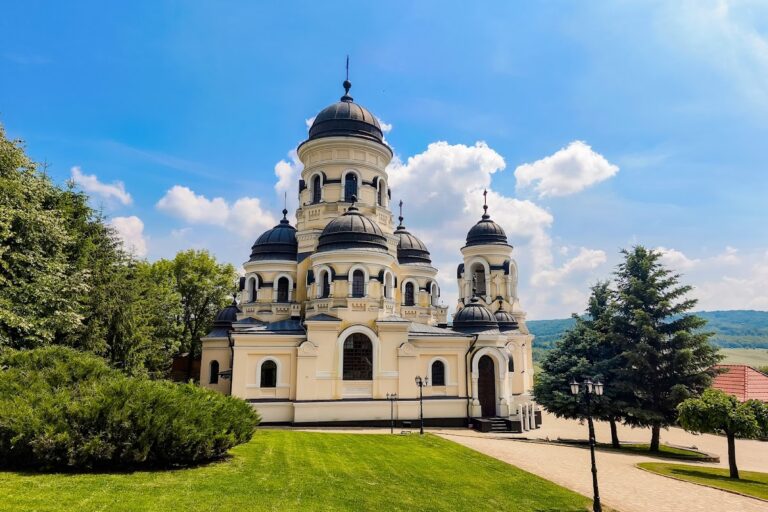
A separate church complex was built on the hill in 1828. The freestanding hilltop church was rebuilt on older remains in 1912 at the initiative of the hieromonk Inocențiu. Together with the cave churches, it forms the principal ecclesiastical architecture of the monastery.
Domestic and Service Buildings
The monastery also includes a bell tower, cells, and other nineteenth-century buildings. In 1824, the plateau above the cliffs contained a guesthouse, kitchen, stable, and two vineyards. A water mill stood near the rock-cut complex. The library then held 81 items, including four Gospel books and two old Octoech books, liturgical volumes organized around the eight musical modes used in Orthodox worship.
Gorge Landscape and Archaeological Features
The physical setting includes the Dniester, the Țipova stream, and a gorge of limestone cliffs, springs, woodland, meadows, and marshy sections. The stream forms several waterfalls, including one approximately 16 metres high, described as Moldova’s highest. The gorge also contains fragments of foundation walls from a pre-Christian Dacian fortress on its southern hillslope. The Dacians were an ancient people who inhabited parts of the lower Danube and Carpathian regions before and during the Roman period.
Local traditions add legendary associations to the landscape. One places the grave of Orpheus in a rock niche beside the pool formed by the waterfall. Another tells of a black monk appearing at night in the caves. These stories belong to the area’s oral tradition rather than serving as established archaeological evidence.