Church of St. Jerome in Split: A Medieval Roman Catholic Church


Site at a Glance
- Rating
- 4.8
- Popularity
- Low
- Country
- Croatia
- Primary era
- Medieval
- Eras represented
- Medieval
- Civilizations
- Venetian
- Site type
- Religious
- Remains
- Church
On this page6 sections
History
Medieval Origins
The Church of St. Jerome in Split is a medieval Roman Catholic church in Croatia, built during the fifteenth century in the Gothic-Renaissance tradition. It stands on the site of an earlier Church of St. Cyriacus and is dedicated to Saint Jerome, the Christian scholar and translator traditionally associated with ascetic life and hermit retreats.
Beside the church, a hermit’s cave known as the Oratory of St. Cyriacus dates from the Middle Ages and was restored during the second half of the fifteenth century. Local tradition says that Saint Jerome and Saint Cyriacus stayed there. Saint Cyriacus is traditionally commemorated as a Christian martyr, while the cave preserves the site’s association with secluded religious life.
Fifteenth-Century Use and Protection
The Split canon Jerome Natalis was buried in the church. In 1480, the sculptor and architect Andrija Aleši created the altar and its reliefs, linking the building to the artistic culture of Renaissance Dalmatia. The church is legally protected as an individually designated immovable cultural property under code Z-4684 and is classified as sacred architectural heritage.
Remains
Church Building
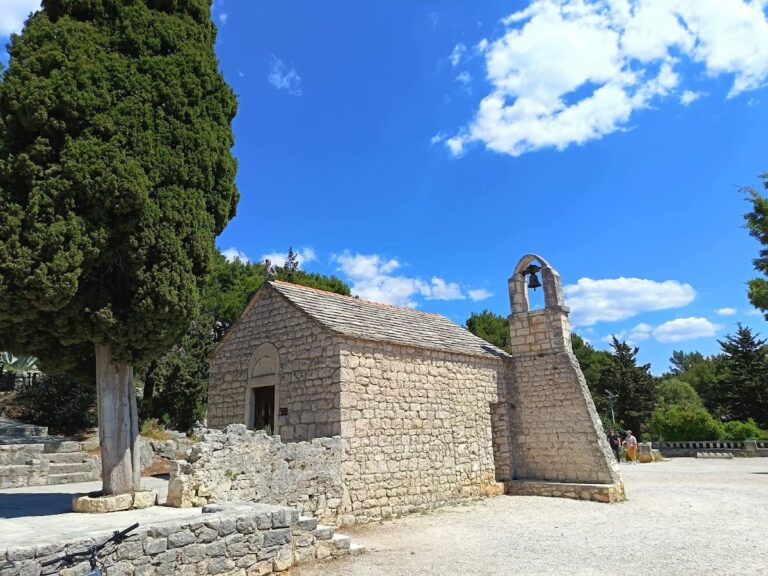
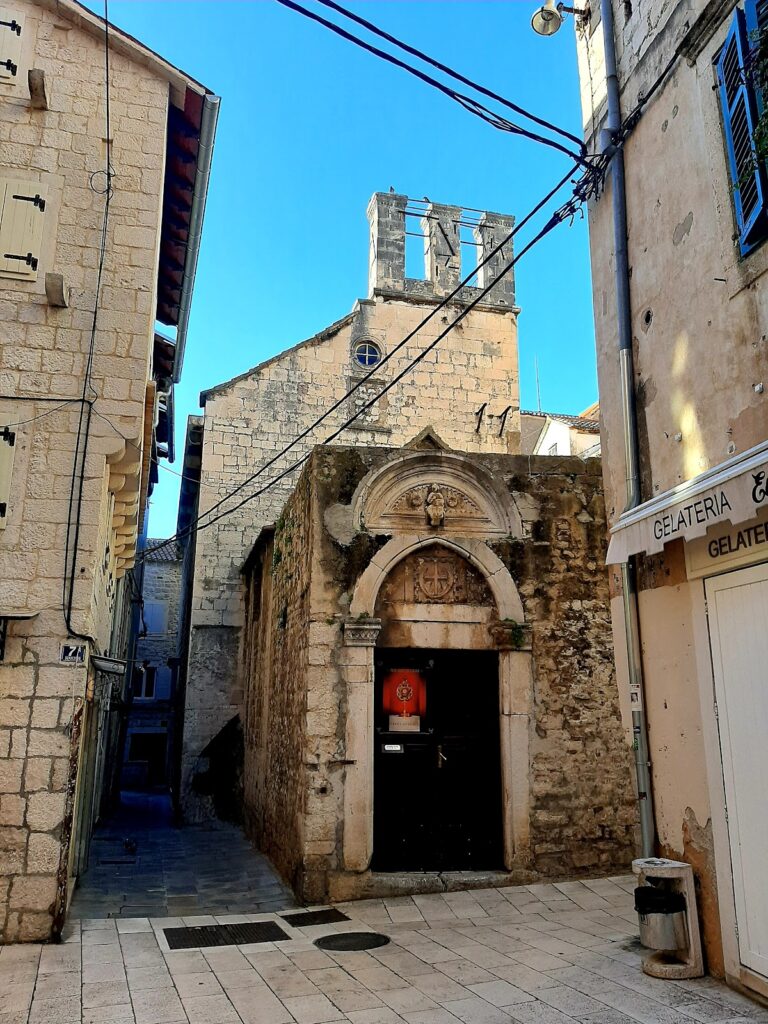
The small stone church stands beside a vertical cliff on the southern slopes of Marjan in Split. Its rectangular plan is covered inside by a Gothic cross vault, while Renaissance ornament gives the building its combined Gothic-Renaissance character. A Gothic bell gable, a wall-like structure designed to hold bells, rises above the facade.
Andrija Aleši’s 1480 altar includes reliefs of Saint John the Baptist, Saint Jerome, and Saint Anthony the Hermit. A lunette, the semicircular field above an altar or doorway, contains a Pietà showing the Virgin Mary mourning over the dead Christ. Several paintings by local Renaissance masters are also preserved inside the church.
Oratory and Enclosing Features
The Oratory of St. Cyriacus is cut directly into the rock immediately beside the church. The site also includes a stone baptismal font and a stone well near the building. A Renaissance relief of Saint John the Baptist is set into the door of the enclosing wall, adding another sculptural element to the small sacred complex.