Church of St. Dunat: An Early Croatian Church on Krk Island


Site at a Glance
- Rating
- 4.8
- Popularity
- Very Low
- Country
- Croatia
- Primary era
- Medieval
- Eras represented
- Medieval
- Civilizations
- Unclassified
- Site type
- Religious
- Remains
- Church
On this page7 sections
History
The Church of St. Dunat is a Roman Catholic church in Croatia, on the island of Krk near Kornić. Associated with the early medieval architectural traditions of Croatian lands, it may date from the ninth century, although an information board beside the building gives the twelfth century. Together with churches in Nin and Zadar, it is regarded as one of the important monuments of early Croatian architecture.
Origins and dedication
The church’s original dedication is unknown. Its present name is apparently connected with Bishop Donato della Torre, who served from 1484 to 1515 and was said to have donated the church and nearby land to owners of property near Kornić. The building is now dedicated to St. Dunat, an early Christian martyr who was killed during the persecution under the Roman emperor Julian the Apostate in the second half of the fourth century. Julian briefly attempted to restore traditional Roman religious practices after Christianity had become established within the Roman Empire.
Decline and restoration
The church was first recorded in 1565, during a visitation by Bishop Pietro Bembo. Witnesses stated that Donato della Torre had given the church and surrounding land to local property owners. After his death, his relatives sold the land around it, and the church entered a period of decline. The 1565 account describes a ruined building whose floor and door had gone, while an altar and an ancient altarpiece remained. The church may no longer have been used for regular services, and it continued to deteriorate.
Anton Gnirs, an Austrian conservator from Pula, directed a restoration in 1914. On 3 October 1945, shortly after the Second World War, an explosion at the nearby Maračić family inn severely damaged the church, particularly its upper section and dome. Yugoslav Partisans had stored weapons and ammunition in the inn during the war. The blast killed 15 islanders in the surrounding fields and along the coast and left a crater where the inn had stood.
The church was restored again in 1948 under the direction of architect Aleksandar Freudenreich, giving it its present appearance. The inn was rebuilt, and the surrounding area later developed a small harbor for boats belonging to residents of Kornić and, in summer, to guests of the same place. The wider area is now called Dunat after the church’s patron.
Remains
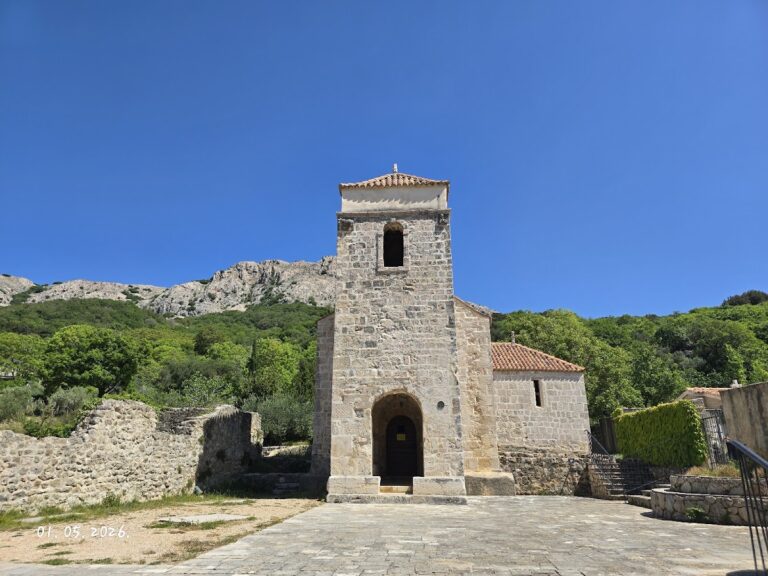
The Church of St. Dunat stands beside the sea at the innermost part of the Bay of Punat, where roads meet from Punat, Krk, Kornić, and Vrbnik. Its compact stone structure is organized around a central domed space, with four projecting lobes forming a cruciform plan and a separate entrance section on the western side.
Plan and construction
Central church
The main building measures approximately 12 metres by 7 metres. Its four-lobed cruciform plan centers on a domed section, giving the church its distinctive early medieval arrangement. The walls are built of stone, apparently limestone obtained at the site. The present exterior differs substantially from the earlier building, whose dressed-stone facing survives in the lower courses.
Entrance and interior decoration
A separate entrance section projects from the western side. The interior was probably decorated with mosaics or frescoes. The building’s irregular appearance has been interpreted as the result of construction by an unskilled master working spontaneously, without precise measurements or models.