Co-Cathedral of the Assumption of Mary, Senj: A Romanesque Cathedral Church in Croatia


Site at a Glance
- Rating
- 4.7
- Popularity
- Low
- Country
- Croatia
- Primary era
- Medieval
- External website
- Open
- Eras represented
- Classical, Medieval, Early Modern
- Civilizations
- Habsburg, Hungarian, Kingdom of Croatia
- Site type
- Religious
- Remains
- Cathedral
On this page10 sections
History
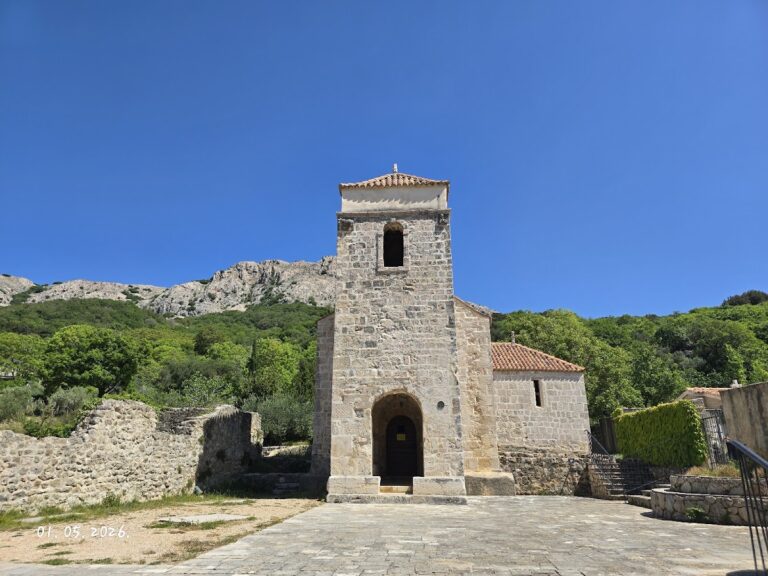
The Co-Cathedral of the Assumption of Mary in Senj, Croatia, is a Roman Catholic church completed in 1169 in the Romanesque period. It now shares the seat of the Gospić-Senj Diocese with another cathedral and is regarded as one of Senj’s most important cultural monuments.
Early foundations and the medieval cathedral
The church is thought to stand over the foundations of an early Christian basilica from the fourth or fifth century. Another interpretation places the construction of the church and bell tower around the year 1000, based on a date found during restoration of the bell tower, although that interpretation remains uncertain. Construction was completed in 1169, the year an independent diocese in the Senj area was first recorded. The same record names Mirej as Senj’s first bishop, and bishops continued to reside in Senj for centuries.
The local church dedicated to the Assumption of Mary became the cathedral of the medieval Diocese of Senj and was enlarged to serve the needs of the diocese. Fighting between Senj’s inhabitants and Mongol forces in 1239 caused severe damage, especially to the facade. Reconstruction followed, and in 1248 Pope Innocent IV, who was pope from 1243 to 1254, authorized Mass in Old Church Slavonic and the printing of liturgical books in the Glagolitic script, an early Slavic alphabet used for that language. The rebuilding ended in 1250, when the cathedral took on its Romanesque form with a single nave, the main longitudinal part of a church.
Later enlargement and restoration
A sacristy, the room used to prepare worship and store liturgical objects, was added in the fifteenth century during the episcopate of Bishop Andrew of Modena. In the eighteenth century, Bishop Benedikt Bedeković enlarged the sanctuary, the principal sacred area around the main altar. Bishop Ratkaj extended the side aisles and added walls that no longer supported the cathedral vault. This phase ended with the cathedral’s blessing in 1717.
Bishop Benzoni later rejected that reconstruction, demolished the side aisles, and replaced them with new ones containing altars dedicated to Saint Anne, Saint Francis Xavier, the Sacred Heart of Jesus, and the Holy Cross. During the episcopate of Bishop Ježić, the cathedral acquired its present three-nave arrangement. Bishop Mirko Ožegović contributed substantially to its restoration and gave the interior a Neo-Baroque character, a later revival of Baroque architectural and decorative features.
Bishops continued to have their seat in Senj until 1969, when the diocese came under the administration of the Rijeka Archdiocese. The cathedral suffered severe damage during the Second World War and underwent repeated rebuilding in the twentieth century, including restoration carried out from 1949 to 1950.
Remains
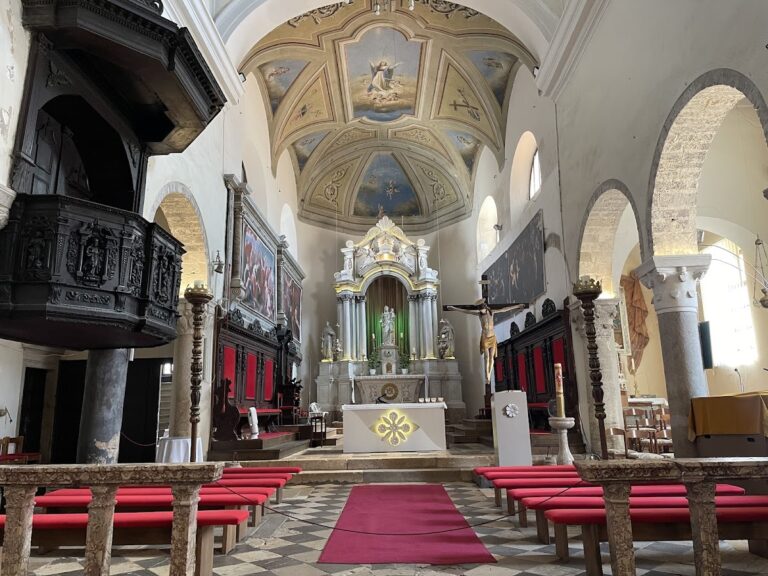
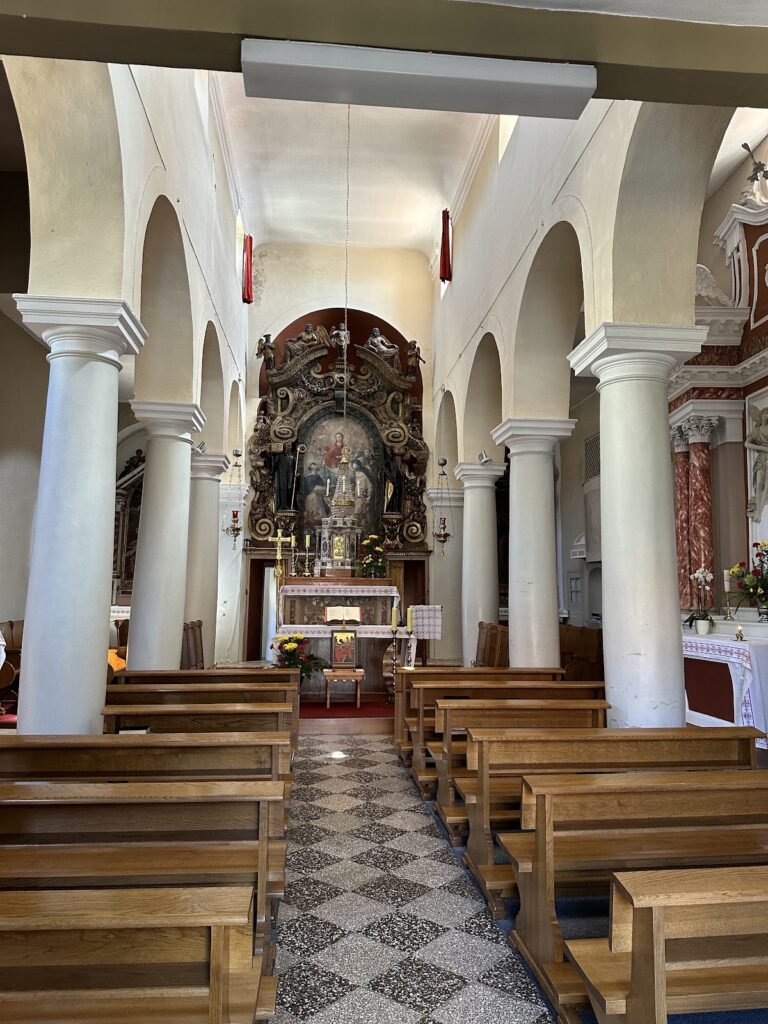
The surviving cathedral is a Romanesque building whose final layout has three naves. Its earlier single-nave arrangement was established after the rebuilding completed in 1250, while later alterations created the present side aisles and enlarged sanctuary. The remains combine medieval masonry and decoration with eighteenth-century additions and a Neo-Baroque interior treatment.
Exterior fabric and earlier remains
The facade is decorated with rounded arches and brick niches associated with architectural influence from the northern Adriatic. Similar Romanesque arches and brick niches decorate the south side. Behind the sanctuary, remains of the earlier structure can be seen at a depth of approximately 1.5 metres, preserving physical evidence of the building’s earlier phases.
Interior monuments and furnishings
Bishop Ivan Cardinalibus’s tomb
In front of the entrance to the sacristy stands the Gothic tomb of Bishop Ivan Cardinalibus, dated 1392. Its position connects a late medieval memorial with the room added to the cathedral during the fifteenth century.
Relief of the Holy Trinity
A relief of the Holy Trinity from 1492 incorporates the Perović family coat of arms in a checkerboard design. The work preserves both a religious subject and a family heraldic association within the cathedral.
Altars and episcopal tombs
The side aisles contain altars dedicated to Saint Anne, Saint Francis Xavier, the Sacred Heart of Jesus, and the Holy Cross. The cathedral also contains the tombs of the bishops of Senj. The Altar of the Holy Angels contains the body of Saint Formosa.
Inscriptions and surrounding structures
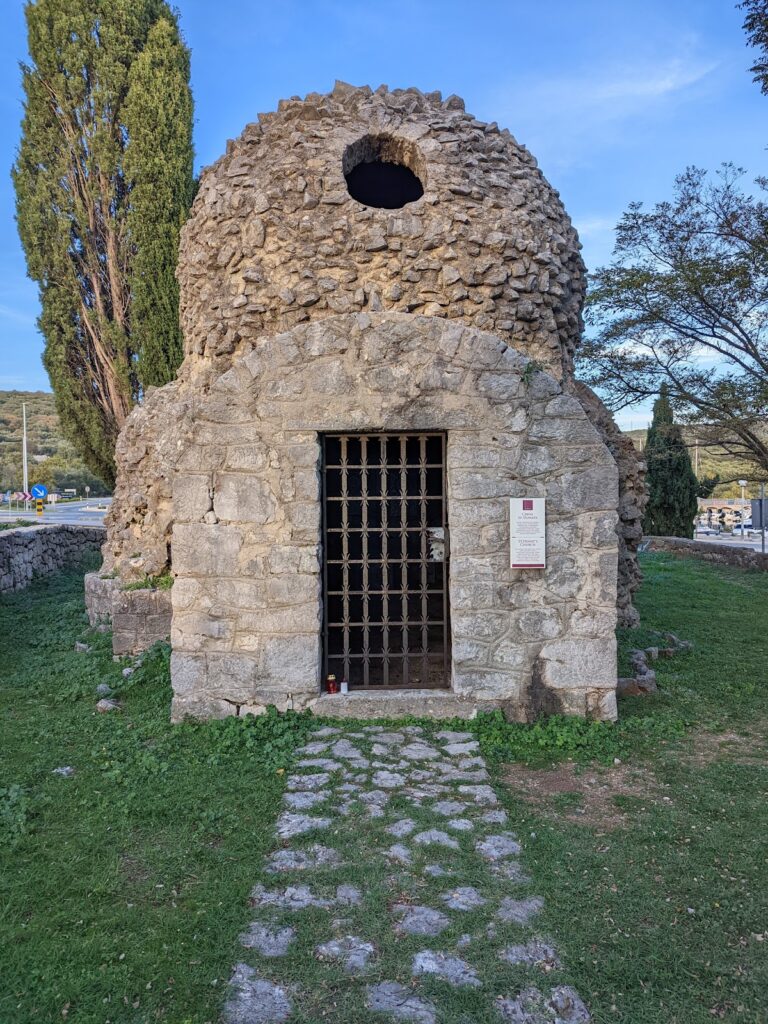
Prayer benches inside the cathedral bear Cyrillic inscriptions. Various chapels and small churches are located around the cathedral, adding to the group of religious structures associated with the building.