Church of Saint Mark’s Grave in Podudbina: A Catholic Memorial and Archaeological Ruin


Site at a Glance
- Rating
- 5
- Popularity
- Very Low
- Country
- Croatia
- Primary era
- Early Modern
- Eras represented
- Medieval, Early Modern
- Civilizations
- Habsburg
- Site type
- Religious
- Remains
- Church
On this page8 sections
History
The Church of Saint Mark’s Grave in Podudbina is a ruined Catholic church in Croatia, near Udbina, built over an older medieval church and associated with the final phase of the Battle of Krbava. Its name and history are linked to graves found at the site and to the tradition that people killed in the battle, including priests and other defenders, were buried there.
Medieval origins and the Battle of Krbava
The church stood at a place already used for Christian worship. Archaeological excavations revealed the remains of an earlier medieval church, probably Romanesque. Romanesque churches belonged to a medieval architectural tradition known for substantial masonry and rounded forms. The site may also have included an older Croatian church and a religious complex associated with Saint John.
The location probably marked the last stage of the Battle of Krbava, where the final combatants fell. Excavated graves and scattered human bones support the interpretation that a burial ground formed there after the battle. The belief that a martyred Saint Mark and several heroes of the battle were buried at the site remains part of local tradition, rather than a fully established identification of the individuals.
Ottoman rule and Catholic restoration
Udbina was captured by the Ottoman Empire in 1527. Ottoman authority then extended across Krbava and Lika, including the Lika Sanjak, until the Austro-Turkish War of 1683 to 1699, a conflict that ended with the Ottoman retreat from much of the region. During the liberation of Krbava and Lika, the remaining Catholic population took part in large numbers under the leadership of Marko Mesić, a Glagolitic Catholic priest. Krbava was liberated in 1689, followed by the rest of Lika.
After the victory over the Ottomans, Marko Mesić commissioned a church dedicated to Saint Mark. Catholic worshippers called it the Church of Saint Mark’s Grave because of the popular belief that the site contained the grave of a martyred saint and the remains of battle heroes. The church came to represent the restoration of Croatian Krbava. The word “Grave” in its name evidently referred to the cemetery that apparently developed there after the Battle of Krbava, an interpretation reinforced by the disordered human bones found during excavation.
From 1714 to 1942, an annual procession on Saint Mark’s feast day travelled from the church across the bridge over the Krbava to the parish church of Saint Nicholas the Bishop in Udbina. This religious observance connected the church with the wider Catholic community of the region.
Destruction and archaeological investigation
Greater-Serbian nationalists destroyed the church in 1942 in an effort to erase traces of Catholicism in the Udbina-Krbava region and promote the claim that the area was exclusively Serbian. In 1945, its stones were reused in the construction of a sheepfold. Before archaeological research began in 1996, a mound and a cross installed after Operation Storm marked the location. Operation Storm was the 1995 Croatian military operation that ended Serbian control over substantial parts of Croatian territory during the Croatian War of Independence.
The church was not rebuilt after the excavations, because the newly revealed archaeological remains were to be preserved. Instead, residents of Udbina displaced during the Second World War built a nearby chapel dedicated to Saint Mark’s Grave in 2000. The site is now a station on the Way of the Cross. The first station, dedicated to the suffering of Christ and the Croatian people, leads from the chapel to the Church of the Croatian Martyrs in Udbina, along a route described as running from a place of suffering to a place of hope. A procession for Croatian Martyrs’ Day on 11 September regularly begins there.
Remains
The later church
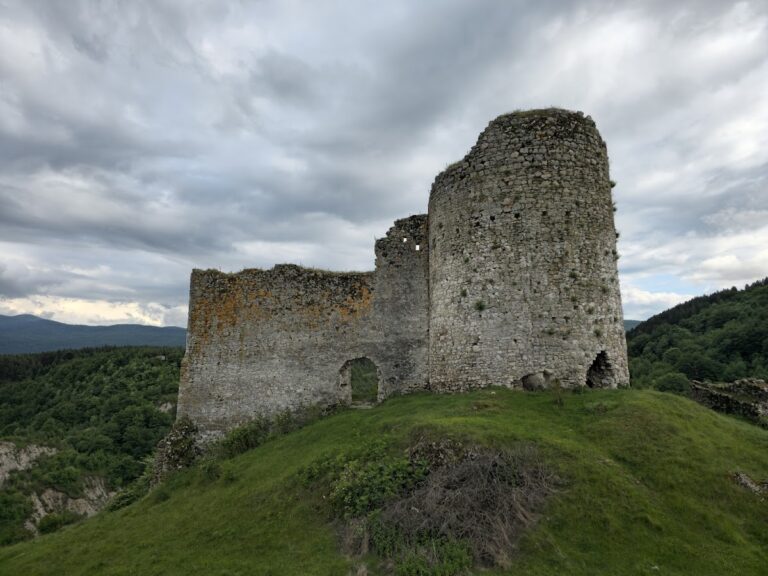
The ruined church stood on the left side of a wooden bridge over the Krbava stream. Its surviving remains measure 7.65 by 5.70 metres. The building had a three-sided apse, the polygonal end of the church containing the sanctuary, together with a paved floor and a staircase at the entrance. These remains belong to the church associated with the post-Ottoman restoration of Catholic worship at the site.
Earlier churches and religious buildings
Beneath the later church are the remains of an older medieval church, probably Romanesque, with a semicircular apse. A square apse was later constructed around that earlier apse, and a chapel was subsequently added on the north side. Excavations also exposed foundations that may belong to a Franciscan monastery dedicated to Saint John. Franciscans are members of the Order of Friars Minor, a religious community founded in the tradition of Francis of Assisi. The excavation area therefore preserves several stages of Christian building and use.
Graves and archaeological finds
Graves and human bones were found across the excavation area. Thirty-two graves dating from the fourteenth and fifteenth centuries were investigated. Their grave slabs are monolithic covers, each made from a single substantial stone, and may be connected with bilizi, medieval monumental grave markers generally formed from large slabs or other worked stones. Roman coins and remains of Roman monuments were also recovered, adding earlier material to the evidence preserved at the site.