St. Mary of Blachernae Church, Berat: A Late Byzantine Orthodox Church


Site at a Glance
- Rating
- 4.5
- Popularity
- Very Low
- Country
- Albania
- Primary era
- Medieval
- Eras represented
- Medieval, Early Modern
- Civilizations
- Byzantine, Ottoman
- Site type
- Religious
- Remains
- Church
On this page12 sections
History
Early Christian Origins
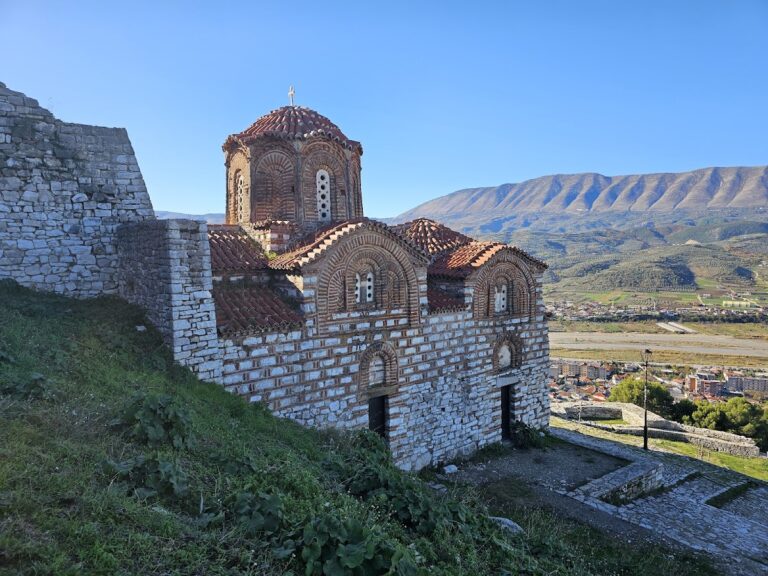
St. Mary of Blachernae Church is an Eastern Orthodox church in Berat, Albania, built in the thirteenth century during the late Byzantine period. It is regarded as one of the city’s three oldest surviving churches, and probably the oldest. The dedication refers to the Church of St. Mary of Blachernae in Constantinople, traditionally associated with Pulcheria, a fifth-century Byzantine empress credited with its foundation.
Archaeological investigation beside the church walls revealed a pilaster and a capital from an earlier complex. These remains indicate that an Early Christian monastery and its garden occupied the site, probably during the fifth or sixth century.
The Thirteenth-Century Foundation
Berat’s inhabitants traditionally attributed the church’s construction to their gratitude after the castle was liberated in 1281 from the siege of the forces of Charles I of Sicily. Charles was an Angevin ruler, belonging to a dynasty of French origin that controlled territories in western and southern Europe. The church’s foundation therefore belongs to a period when Berat’s religious buildings were connected with the political and military struggles surrounding the castle.
Sixteenth-Century Transformation
The original building had a column-supported structure with a barrel-vaulted dome. This arrangement was damaged, possibly by an earthquake, and the church underwent major alteration during the sixteenth century. In the second half of that century, the dome was replaced by a gabled roof, changing the building’s external form while retaining its role as an Orthodox church.
In 1578, Nikollë Onufri painted the surviving frescoes. He was the son of Onufri, a major Albanian icon painter, and his work gave the church an extensive cycle of painted religious imagery.
State Control and Restoration
Albania’s 1967 anti-religious campaign was followed by the state’s declaration of the country as atheist. Like many religious buildings, St. Mary of Blachernae Church was taken over by the state and deteriorated for more than three decades. A complete renovation is also recorded for 1978. The Albanian Orthodox Church subsequently restored the building, which remains an Orthodox place of worship affiliated with that church.
The church received protection as an Albanian cultural monument in 1948, and that protection was reaffirmed in 1971. It also forms part of Berat’s historic district, which has been protected as a UNESCO World Heritage site since 2008.
Remains
Plan and Construction
St. Mary of Blachernae is a late Byzantine stone-and-brick church whose plan places a Greek cross within a square. A Greek cross has four arms of approximately equal length, while an inscribed version fits that cross-shaped arrangement within an outer square. The building contains a rectangular narthex, or entrance vestibule, an approximately square naos, the principal congregation space, and an east-facing adyton, the restricted sanctuary area.
Its unusually tall elevations are broken by numerous small window openings. The walls use cloisonné masonry, a Byzantine technique in which stones are set within or bordered by courses of brick. This produces alternating bands of stone and brick across the exterior.
Water Supply and Floor Mosaic
A rainwater cistern extends beneath the narthex. During sieges, it supplied water to the inhabitants of the castle, linking the church’s physical arrangement with the defensive life of Berat’s fortified quarter.
The stone floor of the naos contains a surviving mosaic probably dating from the sixteenth century. Its design uses diamond and triangular motifs, adding a geometric surface to the principal interior space.
Frescoes and Sacred Images
Upper Image Zones
Nikollë Onufri’s frescoes cover the four walls in six image zones. The first shows Jesus seated on a heavenly throne among prophets, including Moses and Elijah. Another zone contains a further group of prophets, while a fifth presents saints within mandorlas, almond-shaped halos surrounding sacred figures.
Biblical Narratives
The third zone combines scenes and figures associated with the life and Passion of Jesus. It includes the Virgin Mary of Blachernae holding a writing tablet, Abgar V of Edessa with an image of Jesus, the sun and moon, visions of Ezekiel, the Nativity, the Visitation of Mary to Elizabeth, the Presentation of the infant Jesus in the Temple of Jerusalem, the Baptism, the Transfiguration, the raising of Lazarus, the Entry into Jerusalem, the Last Supper, the Crucifixion, and the Deposition from the Cross.
The fourth zone shows the Evangelists Mark, Matthew, John, and Luke, together with Doubting Thomas, Jesus appearing on the road to Emmaus, and Jesus appearing to Mary Magdalene. It also includes signs of the miraculous healing of the lame and blind, the birth and death of the Virgin Mary, the betrayal by Judas Iscariot, the Good Samaritan, and the descent of the Holy Spirit at Pentecost.
Saints and Church Figures
The sixth zone depicts Jesus healing a lame man and presents a large group of saints and religious figures. They include Simeon Stylites, Nicholas of Myra, apostles and Church Fathers, Cyriacus, Barbara, Anthony the Great, Euthymius the Great, Theodore the Studite, Theodore of Amasea, Theodore Stratelates, Constantine and Helena with the True Cross, Panteleimon, Damian and Cosmas, Demetrius, and George.
A large bust of Saint Constantine is installed beside the church’s northwestern wall. Saint Constantine refers to Constantine I, the Roman emperor who legalized Christianity in the Roman Empire and became an important Christian saint.