Chekotin Monastery: An Active Bulgarian Orthodox Monastery


Site at a Glance
- Rating
- 4.8
- Popularity
- Low
- Country
- Bulgaria
- Primary era
- Medieval
- External website
- Open
- Eras represented
- Medieval, Modern
- Civilizations
- Ottoman, Second Bulgarian Empire
- Site type
- Religious
- Remains
- Monastery
On this page7 sections
History
Chekotin Monastery is an active male monastery of the Bulgarian Orthodox Church in Bulgaria, standing along the Malak Iskar River near Svode village, about 15 kilometres from Pravets. Founded in the late twelfth century, it belongs to the Lovech Diocese, the church’s regional administrative district, and takes its name from the nearby hamlet of Chekotin.
Medieval Foundation and Ottoman Destruction
The monastery was destroyed during the Ottoman invasions in the fourteenth century and restored in the following century. It became a spiritual centre where monks copied liturgical literature, while maintaining close relations with Bozhenishki Urvich fortress, located about four kilometres to the west.
Later Restoration and Religious Continuity
In the late seventeenth century, kardzhalii, armed marauding groups active in the Ottoman Balkans, burned and looted the monastery. Restoration followed between the mid- and late eighteenth century. In the nineteenth century, some monks took part in the revolutionary committees organized by Vasil Levski, a central figure in the movement against Ottoman rule.
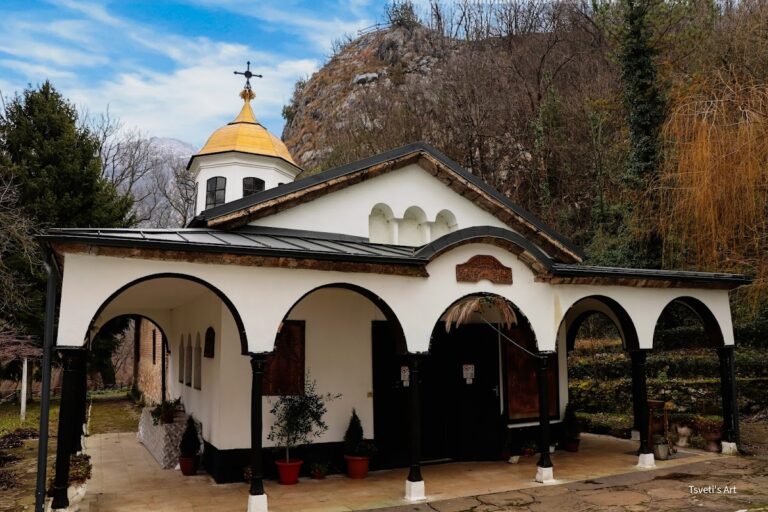
The monastery’s present appearance is associated with Bishop Genady of Melnik, who served as its abbot from 1981 to 1998. The Saint Genady Chapel on the eastern side of the second floor was dedicated to Saint Genady, Patriarch of Constantinople. Chekotin Monastery continues to function as an active religious institution.
Remains
The Monastery Church
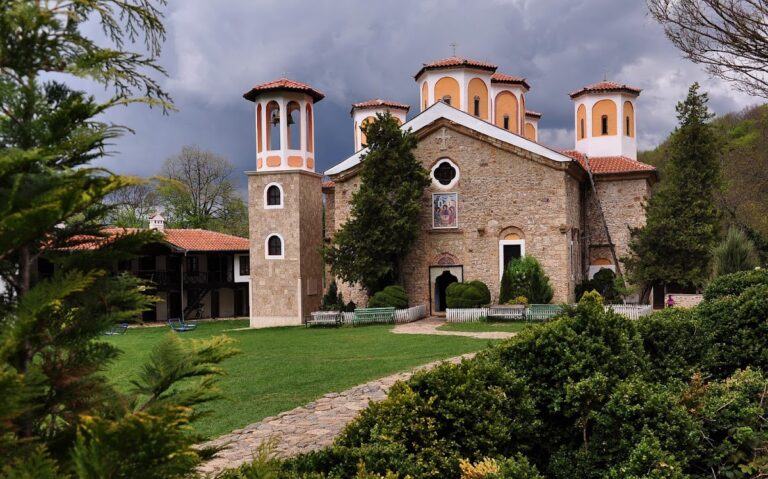
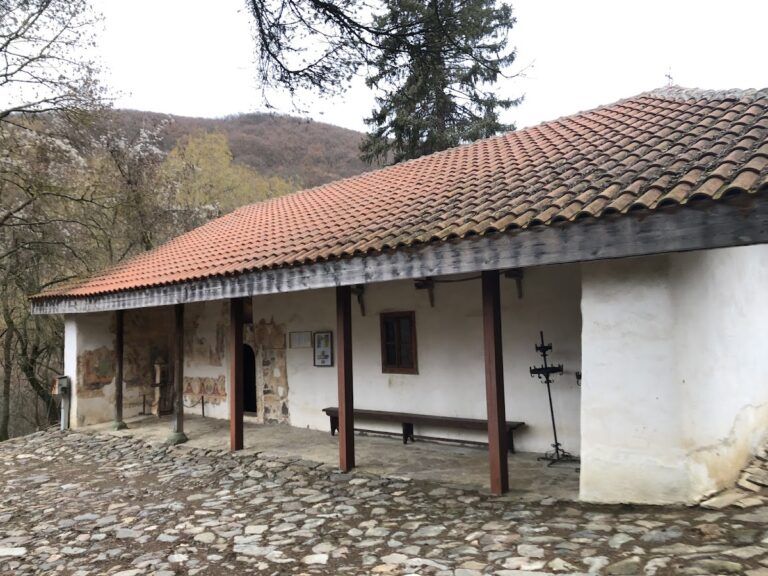
The complex includes the Church of Saint Michael the Archangel, residential and farm buildings, and the Saint Genady Chapel. The church is the only partially surviving building from the medieval monastery. It is a single-nave, three-lobed basilica with an apse, a vestibule, and a cylindrical vaulted ceiling. Its low, arched entrance has a surround made from dressed stone, while the narthex, or entrance hall, was reconstructed in 1841.
Inside, a richly carved wooden iconostasis separates the sanctuary from the nave. Its decoration includes stylized vine leaves and grape clusters in the tradition of the Trevna School, a Bulgarian school of woodcarving and icon painting associated with the town of Trevna. Icons in the church were painted by Dimitar Zograf, Yovan Ikonopisets of Samokov, and Hadzhi Ivancho of Gabrovo. The wall paintings date from 2012–2013.
Residential Buildings and Chapel
The Saint Genady Chapel occupies the second floor of the monastery’s three-story residential building. Its interior is richly painted, and the chapel is frequently used for festive church services. Residential buildings and farm structures complete the monastic complex.
Courtyard Spring
An ayazmo, a spring regarded in Orthodox tradition as sacred or healing, stands in the monastery courtyard.