Cherepish Monastery: A Bulgarian Orthodox Monastic and Cultural Center


Site at a Glance
- Rating
- 4.7
- Popularity
- Medium
- Country
- Bulgaria
- Primary era
- Modern
- External website
- Open
- Eras represented
- Early Modern, Modern
- Civilizations
- Ottoman
- Site type
- Religious
- Remains
- Monastery
On this page12 sections
History
Cherepish Monastery is a Bulgarian Orthodox male monastery in Bulgaria, dedicated to the Dormition of the Mother of God and belonging to the Vratsa Diocese. Traditionally associated with the reign of Tsar Ivan Shishman, the last ruler of the medieval Bulgarian Tarnovo Empire before the Ottoman conquest, it is generally placed in the late fourteenth century. Its precise foundation date remains uncertain, but the monastery existed before the Ottoman invasion of the Bulgarian lands and grew from the medieval settlement of Koriten in the nearby Ritlite area.
Foundation and Ottoman Conquest
The monastery’s earliest surviving testimony is a monastic typikon, a rulebook governing religious order, administration, and worship. Written around 1390–1398, it describes the rebuilding of the monastery and its church after their destruction in 1396. According to the text, the destruction followed a battle with Ottoman forces, while local people took part in restoring the buildings. The typikon, preserved in the Historical and Archaeological Museum in Sofia, provides an important link between the monastery and the final decades of the Second Bulgarian Empire, the medieval Bulgarian state that lasted from the late twelfth century until the Ottoman conquest.
Little is known about the monastery’s history during the next two centuries. A rebuilding in the late sixteenth century is associated with Pimen Zografski, a Bulgarian Orthodox monk, painter, scribe, and church builder connected with the Zograf Monastery on Mount Athos. The monastery was restored again in 1660. Pimen helped establish it as a center of religious writing and spiritual activity, and work in its scriptorium, a room or workshop for copying manuscripts, continued into the eighteenth century.
Rebuilding under Ottoman Rule
During the centuries of Ottoman rule, fire repeatedly damaged the monastery, but the community rebuilt it several times. In 1786, during a local revolt, the monks withdrew to caves in the surrounding cliffs and the monastery suffered serious damage. Armed bands caused further violence at the end of the eighteenth century, prompting another temporary departure. By 1802, the monks had returned and active monastic life had resumed.
Major construction followed in the nineteenth century. In 1836, Abbot Joseph initiated the erection of new residential buildings for the monks. A wealthy Turkish donor, Rashid, also contributed to the work after his daughter was believed to have been miraculously healed during a visit. By this period, Cherepish Monastery had acquired substantial property and maintained small monastic settlements, known as sketes, together with dependent religious establishments.
Education and the Bulgarian National Revival
During the Bulgarian National Revival, the nineteenth-century movement of Bulgarian cultural, educational, ecclesiastical, and political development under Ottoman rule, Cherepish Monastery became an educational and intellectual center. Bulgarian schools operated at the monastery and at associated sketes. Classes for a priests’ school, a theological institute, and the Sofia Theological Seminary were held there at different times, and the Sofia Theological Seminary occupied the monastery from 1950 to 1990.
The monastery also supported the Bulgarian national movement. Revolutionary committees from the Vratsa and Belogradchik areas met there, while conspirators and revolutionaries repeatedly found refuge within the complex. During the April Uprising of 1876, the hieromonk Epiphanius, a monk ordained as a priest, chaired the revolutionary committee at Lyutibrod.
Sophronius of Vratsa, a Bulgarian Orthodox bishop, writer, and leading figure of the National Revival, stayed at Cherepish for a period. The writer Ivan Vazov wrote his short story A Bulgarian Woman at the monastery during the nineteenth century. The landscape also attracted the Hungarian traveler Felix Kanitz, who described the setting as “the most beautiful place.” During the interwar period, Metropolitan Klemens of Vratsa, a senior bishop governing the Vratsa diocese, established theological courses for clergy at the monastery.
Cherepish remains an active religious institution and is designated a monument of culture of national significance. Its continuing religious use, educational history, literary associations, and connections with the Bulgarian national movement have shaped its modern historical interpretation.
Remains
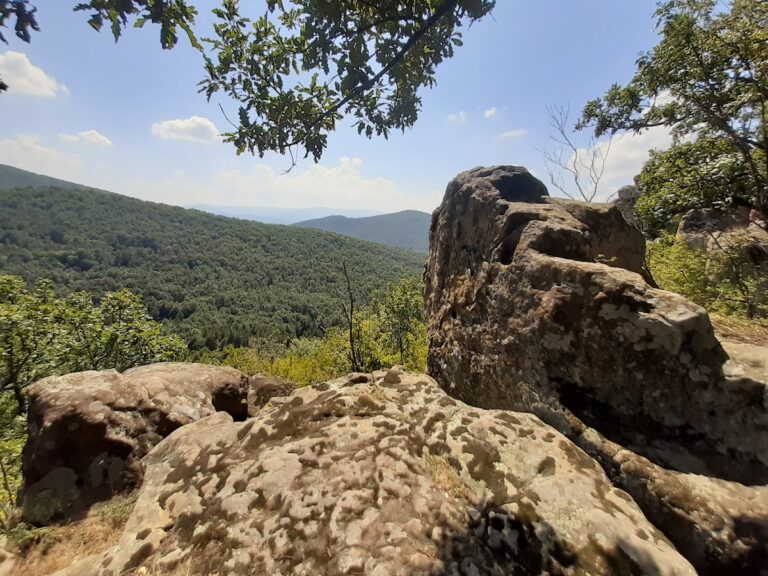
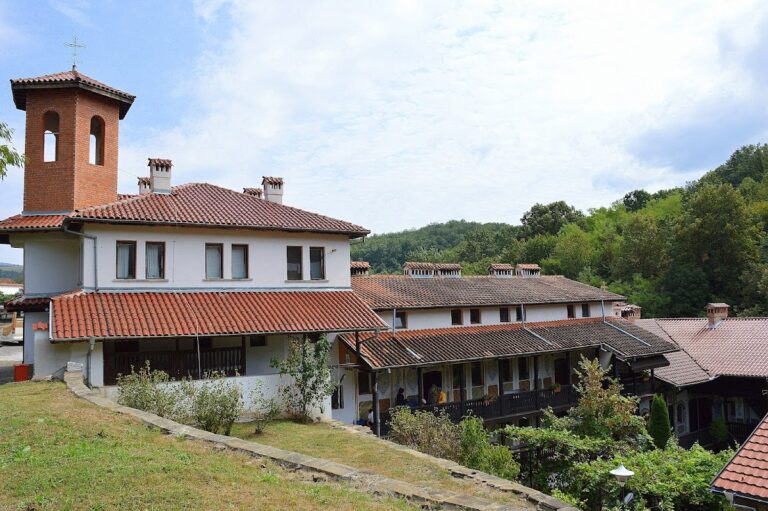
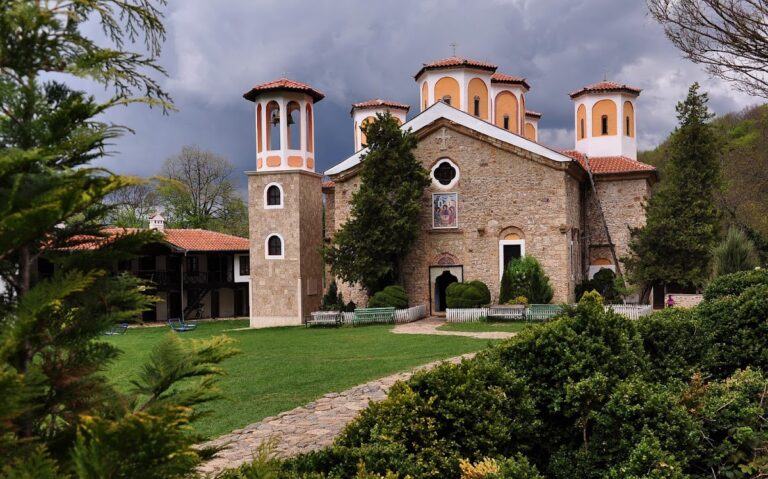
Cherepish Monastery occupies the Iskar Gorge at the foot of imposing cliffs pierced by numerous caves. Its buildings and churches are integrated with this rocky setting, while steep stairs connect the monastery to the ossuary and church above it. The complex combines a Byzantine-Balkan church tradition with later nineteenth-century construction, restored monastic buildings, cliffside spaces, murals, manuscripts, and carved furnishings.
Churches and Religious Interiors
Church of the Dormition
The principal church, dedicated to the Dormition of the Mother of God, is a single-nave vaulted building with a broad narthex, an entrance hall at the western end, an open gallery, and a pointed dome. Its present form reflects several building phases. The church was built or rebuilt in the late sixteenth century, reconstructed in the early nineteenth century, fitted with a new dome in 1888, and given an enlarged narthex in 1939. In 1908, Velko Iliev repainted the dome and the western extension. An inscription identifies this work as completed during the tenure of Hieromonk Mitodia.
Inside, an intricately carved wooden iconostasis, the screen of icons separating the sanctuary from the nave, remains a major feature. The church also preserves a liturgical shroud embroidered in 1844. Its icons are attributed to Vitan Karchov of Tryavna. Murals in the monastery complex are attributed to Yonko Popvitanov. Earlier paintings by Pimen Zografski included a Jesse Tree, a Christian image tracing Christ’s lineage from Jesse, the father of King David, together with biblical scenes. During the early nineteenth-century rebuilding, those church paintings were replaced by works attributed to the priest Ivannikiy.
Church of Saint George
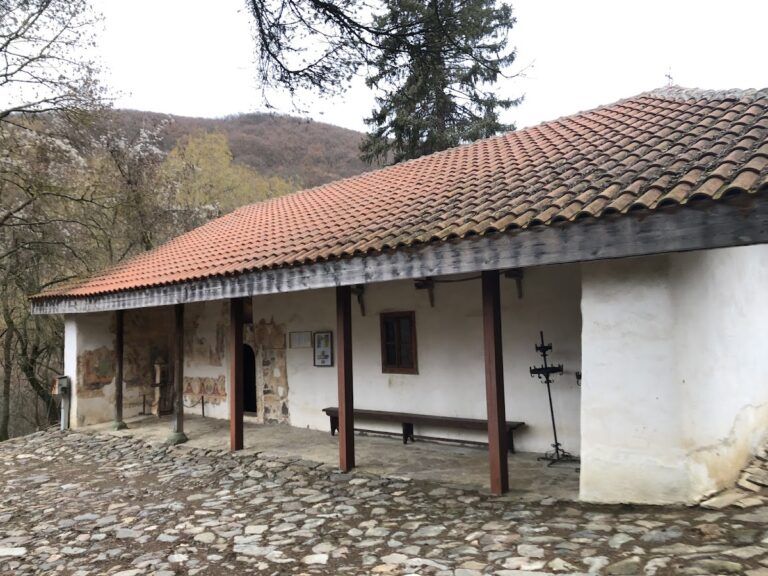
The Church of Saint George has undergone numerous alterations while retaining its original appearance. Part of its murals also survives, preserving a portion of the church’s earlier painted decoration within the altered building.
Monastic Buildings and Cliffside Structures
Nineteenth-Century Buildings
Most of the present monastery buildings date from the nineteenth century. Restored structures include the Episcopal, School, Reception, Danailov, and storage buildings, as well as the Rashid House. Beside the old church, another building contains the monks’ sleeping quarters. Near it, an inscription identifies a terrace as “the favorite terrace of the patriarch of Bulgarian literature, Ivan Vazov.”
Ossuary and Chapel
Steep stairs lead up to the ossuary, a structure for keeping or burying human bones, which was built in 1784 in the cliffs above the monastery. The two-storey building includes a chapel dedicated to Saint John the Baptist. The bones of members of Hristo Botev’s revolutionary detachment are interred there. Botev was a Bulgarian poet, journalist, and revolutionary who led an armed detachment during the struggle against Ottoman rule.
Books and Material Heritage
The monastery’s role in ecclesiastical book production is represented by a silver binding made in 1612 for a Four Gospels manuscript. The craftsmen Nikola and Pala produced the binding for the monastery, linking the surviving object with the early-modern literary activity associated with its scriptorium. Together with the churches, murals, iconostasis, ossuary, chapel, and restored residential buildings, it forms part of the material heritage of a monastic complex shaped by repeated rebuilding and continued religious use.