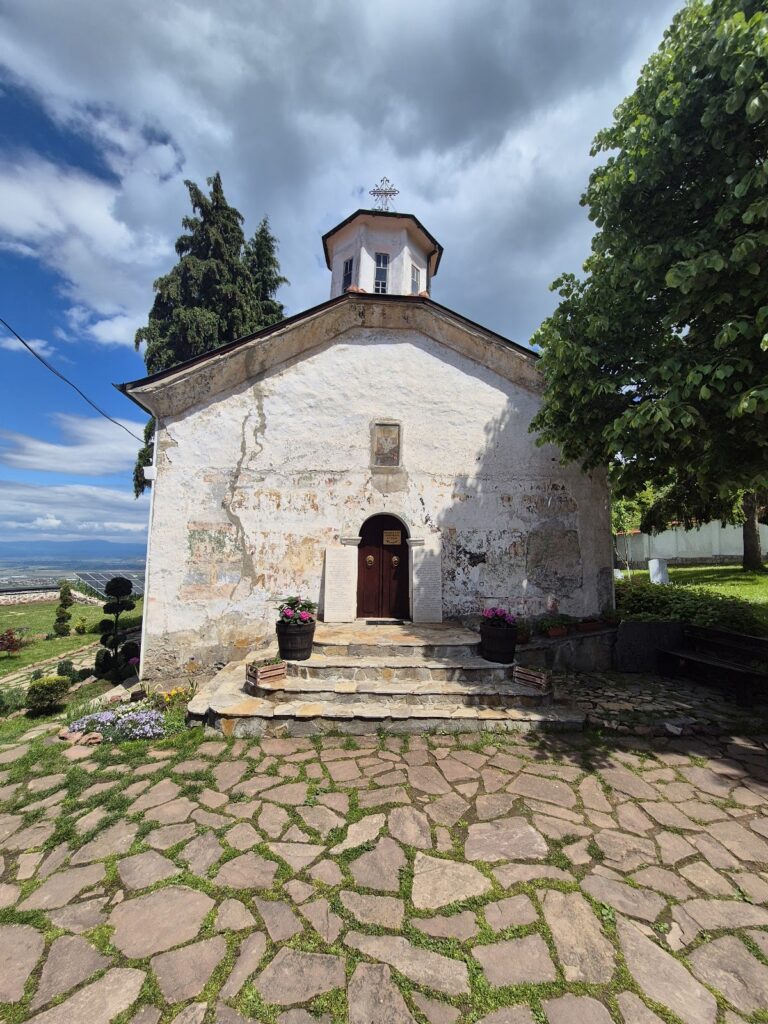
Etropole Monastery: A Bulgarian Orthodox Monastic and Literary Centre


Site at a Glance
- Rating
- 4.8
- Popularity
- Medium
- Country
- Bulgaria
- Primary era
- Modern
- External website
- Open
- Eras represented
- Modern
- Civilizations
- Ottoman
- Site type
- Religious
- Remains
- Monastery
On this page8 sections
History
Etropole Monastery, dedicated to the Holy Trinity, is a Bulgarian Orthodox monastery near Etropole in Bulgaria. Its origins belong to the twelfth or thirteenth century, although the exact foundation date is uncertain. Tradition associates its establishment with 1158, based on an inscription found in the foundations of the church. That date falls before the Second Bulgarian Empire, the medieval Bulgarian state conventionally dated from 1185 until the late fourteenth-century Ottoman conquest, when Bulgaria was under Byzantine rule.
Medieval origins and traditions
A longstanding tradition links the monastery with Saint Ivan of Rila, a tenth-century Bulgarian hermit traditionally regarded as the founder of Rila Monastery. He is said to have lived in a nearby cave at Varovitets before withdrawing to the Rila Mountains. The monastery’s medieval history is preserved in a commemoration codex that includes lists of medieval Bulgarian and Serbian rulers.
The Etropole Literary School
Under Ottoman rule, from the sixteenth through the eighteenth century, Etropole Monastery developed into a major literary, educational, and cultural centre in northern Bulgaria. Its scriptorium, a workshop for writing and producing manuscripts, and its calligraphic school created mainly religious books and influenced other literary schools across the Balkans.
The Etropole Literary School became known for a highly ornamental and geometrically regular form of writing called the Etropole semi-uncial style. Its methods also shaped the Karlovo-Adzhar ornamentation school and the Kuklen manuscript school during the seventeenth century. Hieromonk Daniel, a monk ordained as a priest, is regarded as the school’s founder and leading representative. One of his earliest known manuscripts may be a liturgical book from 1592.
Abbots Anthony, Zachary, and Raphael directed the monastery during the 1620s and 1640s. Among the scribes working there were the priest Valcho, hieromonk Daniel, John the Grammarian, Basil of Sofia, and other copyists, compilers, and painters. Manuscript sales helped support the monastery financially, together with donations from wealthy local inhabitants. Seventy-six works associated with the Etropole Literary School are preserved in the National Library of Bulgaria and the Museum of Church History. They include a 1577 Gospel, a 1602 monthly Prologue, and several Gospels from the seventeenth century.
Renewal and revolutionary refuge
The earlier monastery church was destroyed after its condition deteriorated. During the renewal of the monastery in 1858, Abbot Chrysant found the foundation inscription associated with the year 1158. The stone was incorporated into the foundations of the new church, whose construction continued into 1859.
In the late nineteenth-century Bulgarian struggle for independence from Ottoman rule, the monastery sheltered Vasil Levski, a leading Bulgarian revolutionary and organizer, along with other anti-Ottoman revolutionaries. Abbot Chrysant arranged a hiding place for Levski. Tradition attributes its excavation to Valko Tsolov Topalski, a collaborator of Levski and a member of the secret revolutionary committee in Pravets.
Etropole Monastery remains active and is inhabited by a small community of nuns. It belongs to the Bulgarian Orthodox Church and is associated with the Lovech Diocese. Its principal feast is Pentecost, which celebrates the Holy Trinity. The monastery is legally recognized as a cultural monument and is included among Bulgaria’s one hundred national tourist sites.
Remains
Setting and main church
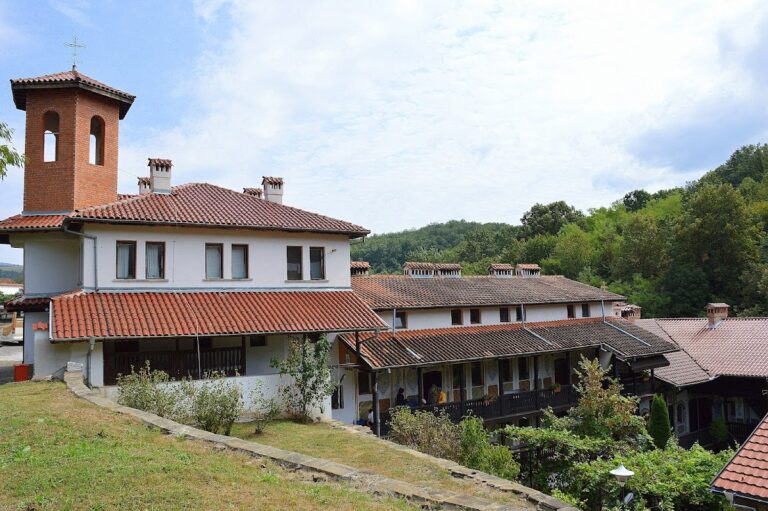
The monastery stands at the foot of the Balkan Mountains in woodland containing maples and beeches, near Cherni Vrah at an elevation of about 1,070 metres. It lies approximately 5 kilometres from Etropole, while Ribaritsa is about 4 kilometres to the west. The complex is organized around a grass-covered courtyard enclosed by residential buildings in the Bulgarian National Revival style.
The principal church, or katholikon, is the main church of an Orthodox monastery. Built in 1858 and 1859, it replaced the earlier church and has a large Greek-cross plan, three naves, and five hexagonal turret domes. Architect Ivan Boyanov, also known as Boyanin, from Bratsigovo, designed the building. Its exterior decoration was completed in 1860, while the interior frescoes were painted between 1896 and 1907. Limestone is the church’s principal building material, a feature associated with the alternative name Varovitets, derived from a Bulgarian term meaning “limy.”
Chapels and residential buildings
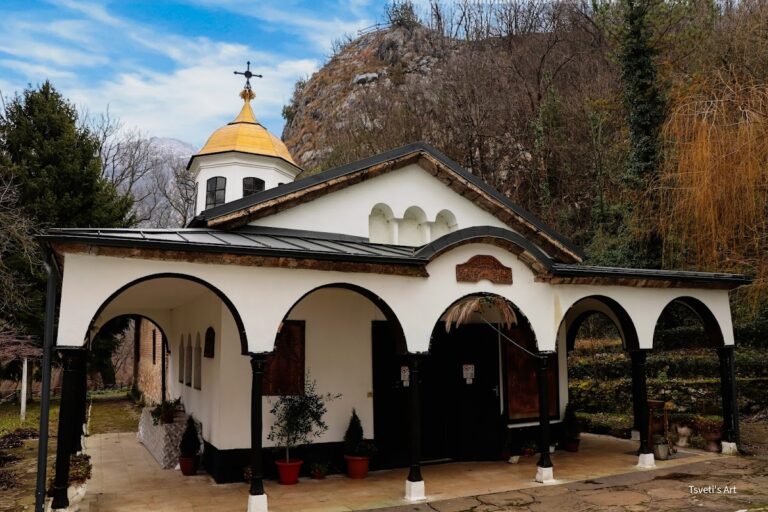
Two smaller chapels form part of the monastery complex. One is dedicated to Saint John the Baptist, and the other to Saints Cosmas and Damian. The surrounding residential quarters follow the Bulgarian National Revival style and enclose the central courtyard. One room in these quarters serves as a small museum devoted to Vasil Levski and the period when he found refuge at the monastery.
Objects and the Varovitets waterfall
Objects associated with the monastery include two fifteenth-century crosses with rich silver decoration and a gold-plated ossuary. The oldest icon is a 1598 representation of the Old Testament Trinity, a Christian subject showing three angels visiting Abraham as a symbol of the Trinity, painted by Nedyalko of Lovech. Several seventeenth- and eighteenth-century icons once used at the monastery are now held by Bulgaria’s National Art Gallery, while other relics connected with the monastery are preserved in museums, libraries, and galleries.
In the nearby woods, the Varovitets Waterfall falls about 15 metres from a karst spring. Both the waterfall and its source bear the name Varovitets.
Nearby sites