Muradie Mosque: An Ottoman Mosque in Vlorë, Albania


Site at a Glance
- Rating
- 4.6
- Popularity
- Low
- Country
- Albania
- Primary era
- Early Modern
- Eras represented
- Early Modern
- Civilizations
- Ottoman
- Site type
- Religious
- Remains
- Mosque
On this page10 sections
History
Muradie Mosque is an Ottoman mosque in Vlorë, Albania, built during the rule of Sultan Suleiman I between about 1537 and 1542 in the early Ottoman architectural tradition. Also known as the Lead Mosque, it is one of Vlorë’s oldest buildings. The Ottoman Empire was the Islamic empire that ruled much of southeastern Europe, Anatolia, the Middle East, and North Africa for several centuries.
Ottoman construction
The mosque is attributed to Mimar Sinan, the leading architect of the Ottoman Empire, who is also associated with the Suleymaniye Mosque in Istanbul. Its founder and exact date remain uncertain, although construction is generally placed from around 1537 to 1542. The building may have been commissioned by Sultan Suleiman I, commonly known as Suleiman the Magnificent, during a naval expedition against Italy.
The mosque’s construction belongs to an early phase of Ottoman architecture, before the mature classical style that developed later in the sixteenth century. Its surviving form reflects the period’s effort to place a domed structure over a square prayer hall.
Names and later history
The building was known primarily as the Lead Mosque until the early twentieth century, when the name Muradie Mosque became more common. In 1948, it became part of Albania’s cultural heritage as a Cultural Monument of Albania.
In 1967, Enver Hoxha’s government closed or repurposed religious buildings throughout Albania. Muradie Mosque escaped the destruction that affected Vlorë’s other Ottoman mosques, but it was converted into a municipal and regional museum of architecture. A full restoration was announced with Turkish support in 2018, but the project was not implemented. Severe flooding on 4 October 2024 caused major damage to the mosque.
Remains
The complex is formed by a nearly square prayer hall and a minaret at its northwestern corner. The prayer hall measures approximately 10 to 11 metres on each side and takes the form of a high cube supporting a twelve-sided drum and a dome. The entrance is on the northern side, while the mihrab, the prayer niche indicating the direction of Mecca, is on the southern side.
Prayer hall and dome
Main building
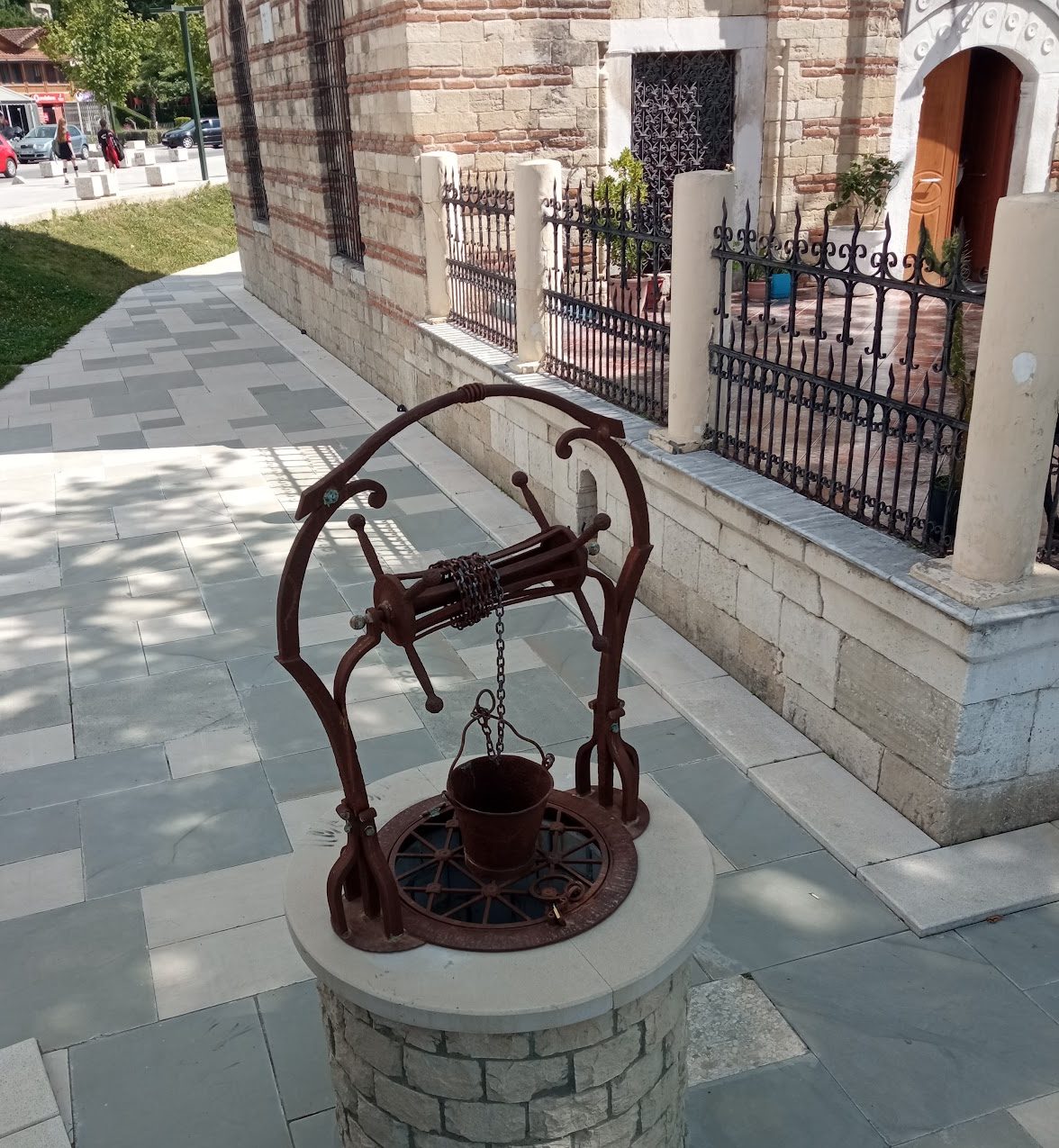
The walls of the prayer hall are built in regularly alternating courses of dressed stone and brick, including sequences of two rows of stone followed by two rows of brick. Two colours of brick create a distinctive striped appearance. Cornices separate the twelve-sided drum from the lower walls, while small triangular roof forms occupy the corners where the square body passes directly into the drum.
Dome structure and windows
Four parabolic, melon-shaped squinches support the dome. A squinch is a structural device that carries a dome or polygonal upper form over a square room. The mosque’s windows are arranged in several rows. The upper openings are smaller and more proportionate to the building, while the two lower windows have lost their original frames and now appear disproportionately large. The side walls contain arched or flattened pointed-arch openings, with classical triangular forms at their tops.
Minaret and entrance remains
Minaret
The minaret rises approximately 18 metres at the northwestern corner. Its masonry is bonded into the mosque walls, and its polygonal base is built from squared stones. Unlike the prayer hall, which combines brick and stone, the minaret uses larger, finely dressed white stones with a different texture, quality, colour, size, and construction sequence. A balcony serves the muezzin, the person who traditionally calls Muslims to prayer, and the top carries a conical lead roof.
Former portico
A hajati, or covered entrance porch, formerly stood against the northern entrance wall. Traces remain in the northern wall, together with part of the foundation and the base of the floor.