St. Mary’s Monastery, Zvërnec: An Albanian Orthodox Monastery


Site at a Glance
- Rating
- 4.3
- Popularity
- Medium
- Country
- Albania
- Primary era
- Medieval
- Eras represented
- Medieval
- Civilizations
- Byzantine
- Site type
- Religious
- Remains
- Monastery
On this page6 sections
History
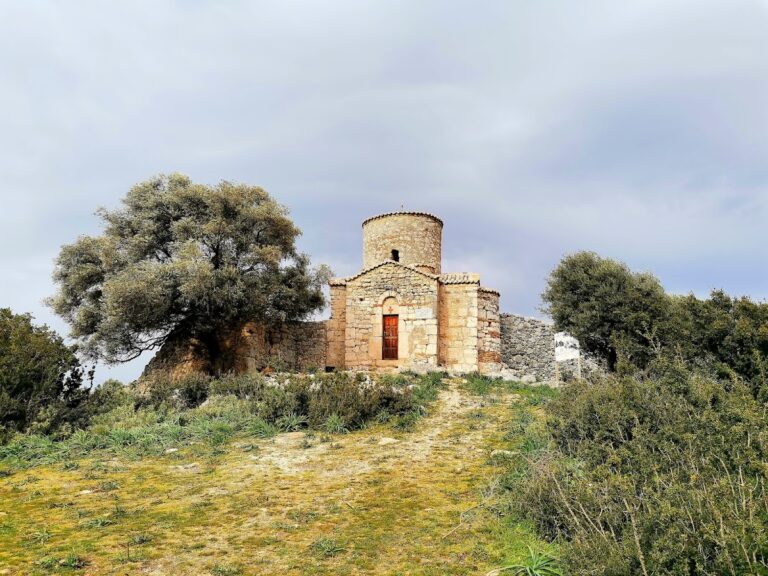
St. Mary’s Monastery, Zvërnec, in Albania, is an Albanian Orthodox monastery on Zvërnec Island in the Narta Lagoon, near the village of Zvërnec. Dedicated to the Dormition of Mary Theotokos, the Eastern Christian feast commemorating Mary’s death and bodily assumption into heaven, the monastery developed around a domed church built within the Byzantine architectural tradition. The church’s precise date remains uncertain, with proposed origins ranging from the tenth to the fourteenth century.
Origins and medieval traditions
Different interpretations place the church’s construction at different points in the medieval period. Helmut and Herta Bushhausen proposed the tenth century, while Richard Krautheimer associated its architectural type with Roman mausoleums built outside urban centres in the tenth or eleventh century. Aleksandër Meksi dated it to the thirteenth or fourteenth century, while another interpretation places the monastery’s first nucleus probably between the twelfth and fourteenth centuries.
Several traditions connect the monastery with Byzantine figures and events. One tradition, attributed to Theofan Popa, tentatively identifies the church’s tomb with Argjiro Karanxha. Citing Anna Komnene, a Byzantine historian and daughter of Emperor Alexios Komnenos, Popa identified Karanxha as a Byzantine commander sent to the region in the eleventh century. In 1091, Karanxha, commander of the Byzantine imperial guard, was sent by Alexios to Durrës with orders concerning the Duke of Durrës and, if necessary, to secure assistance for his arrest. The mission ended with the duke’s return to the emperor.
Another tradition says that the Norman commander Robert Guiscard ordered the treacherous wife of the Byzantine commander of Kaninë to be imprisoned at the monastery after the Norman campaign of 1081. The same story is linked with a short biography attributed to Demetrios Chomatianos, Archbishop of Ohrid, and published in 1230. Saint Niphon, described as Patriarch of Constantinople, is also traditionally said to have served at the monastery during part of the fifteenth century.
Administration and modern disruption
At least until the 1950s, the monastery was administered by the Metropolis of Berat. It was protected as a cultural monument in 1963, but was abandoned in 1967 during Albania’s anti-religious campaign, a state drive against religious institutions and practice. Neglect damaged the complex, and the monastery was used as a stable. During the socialist period, it was also converted into an internment camp for political prisoners. A fire destroyed the monastery library in 1967.
By the end of the 1960s, the church was in very poor condition. Conservation work followed in 1972, with further restoration interventions in 2001 and 2003. The monastery cemetery also preserves the grave of Marigo Pozio, who was buried there in 1932. Pozio was known for embroidering the Albanian national flag displayed by Ismail Qemali at the proclamation of Albanian independence in Vlorë on 28 November 1912. Her previously forgotten grave was located during searches in the mid-1980s after a relative reported that an iron cross was fixed at its lower end.
Remains
The monastery occupies Zvërnec Island in the Narta Lagoon. Its surviving complex consists of the church and five other buildings. These include a structure supported by the perimeter wall that served as the bishop’s or metropolitan’s residence, the building known as the Nartiots’ house, a storehouse, a residence for distinguished guests, and the priest’s house. A cemetery forms another part of the complex.
The church
The church is a domed, free-cross building developed in two principal phases. A free-cross church has arms projecting from a central space, usually beneath a dome. The earlier phase comprises the main worship space, or naos, and the narthex, an entrance vestibule. The later phase added the exonarthex, an outer vestibule or portico, together with a bell tower.
The naos follows a free-cross plan in which the eastern and western arms are longer than the northern and southern arms. It contains an apse, a semicircular prothesis beside the sanctuary for preparing the Eucharistic offerings, and a diakonikon used for related liturgical functions. Much of the space is occupied by the drum, the structural cylinder that raises the dome, and the dome itself. Both are built from stones and brick fragments set in mortar.
The older narthex is rectangular. Beyond it, the later exonarthex uses the same construction technique as the earlier part of the church and presents a facade of seven arches supported by six columns. This arrangement reflects Roman influence on Byzantine architecture. A small cylindrical dome and a small bell tower are associated with the exonarthex, and the bell tower may have been built at the same time as that addition.
Within the naos lies a limestone funerary slab measuring 1.87 by 0.67 metres. It once covered a sarcophagus, which may have belonged to the church from its beginning or may have been reused by the builders as flooring. The slab carries the church’s only inscription, arranged in three lines within a book-like field. In translation, it reads: “Here lies Kondos Karanxhas, a noble man descended from a noble tribe, a noble branch.” Classical column motifs and an arch decorate its sides. Beneath the inscription, a carved human skull is surrounded by a serpent and crowned by two bones. The meaning of this symbol remains unexplained.
Images and cemetery
An icon of the Virgin Mary found in the church is attributed to the icon painter Terpo Zografi. Zografi’s artistic activity began in 1782 and also included work at Saint Naum, Voskopojë, Libofshë, and Mount Athos.
Marigo Pozio’s grave is an identified feature of the monastery cemetery. Rediscovered in the mid-1980s, it is marked by an iron cross set into the ground.