Amantia Archaeological Park: An Ancient Illyrian and Hellenistic Urban Center in Albania


Site at a Glance
- Rating
- 4.5
- Popularity
- Very Low
- Country
- Albania
- Primary era
- Classical
- Eras represented
- Classical, Medieval
- Civilizations
- Byzantine, Roman
- Site type
- City
On this page16 sections
History
Amantia Archaeological Park is an ancient settlement in Albania, built by the Amantes, an ancient regional people associated with the Illyrian and Epirote worlds. Its earliest settlement dates to the second half of the sixth century BC, and the city developed into an urban center with Greek architectural and civic influences during the fifth and fourth centuries BC. Located on a ridge controlling movement through the Vjosa valley and routes toward the coast and Aulon, Amantia became the principal center of the Amantes.
Origins and Urban Development
The date and meaning of Amantia’s foundation remain uncertain. Different traditions use foundation to mean the first settlement, the construction of the city walls, or the later formation of a Hellenistic city. Ancient accounts attributed the city’s origins to Locrians from Thronion and Abantes from Euboea, although these stories may concern another settlement or reflect later traditions of migration.
A fortified settlement existed by the fifth century BC. During the fifth and early fourth centuries BC, Amantia grew into an urban center, while its acropolis and lower town continued to develop during the fourth century. The city combined elements of northern Illyrian material culture with increasingly influential Greek forms of pottery, art, religious practice, language, political organization, architecture, and town planning. By the second century BC, some contexts treated Amantia as part of the Greek world, although its exact ethnic and political character remains debated.
Hellenistic Political and Religious Life
During the Hellenistic period, Amantia became one of the principal centers of the Amantes and an important religious center. In the early third century BC it came under the authority of the Epirote kingdom of Pyrrhus. Around 230 BC it joined the Koinon of the Epirotes, a federation of communities. Other evidence places its political separation from Epirus later in the third century, when the Amantes began issuing their own bronze coins. Proposed dates for this independence range from approximately 262 to 230 BC or from a time after 268 BC.
Amantian coins adopted symbols associated with Epirus but replaced the Epirote ethnic inscription with AMANTON, identifying the Amantes. A hoard of 317 coins found at Amantia contained Epirote, local, Apollonian, Orician, and Epidamnian issues. Amantian coins have also been found in the former territory of Parthinia. Together, these finds point to political and commercial connections with neighboring Illyrian, Epirote, and Greek communities.
Amantia participated in the religious networks of the Greek world. In the second century BC it received sacred envoys from Delphi, known as theoroi, who announced festivals and invited participation. The city had earlier received similar envoys from Argos. At the same time, it maintained strong connections with the surrounding Illyrian communities, reflecting the mixed cultural character of the settlement.
Roman Rule and Economic Change
Amantia supported Rome during the Third Macedonian War, the conflict in which Rome defeated the Macedonian kingdom in 168 BC. Because of this alignment, it was spared the destruction that affected many Epirote settlements after the Roman victory. Amantia retained a degree of autonomy, continued to use Greek, and was recognized as a free city, or civitas libera, a community with specified local privileges within the Roman system. In the middle of the second century BC it was allied with Apollonia, probably as part of a wider pro-Roman policy. The Amantes later supported Caesar during his war against Pompey in 49 to 48 BC.
Following the Roman annexation of the region in 148 BC, Amantia belonged first to the province of Macedonia and later to Epirus Nova, a late Roman province in the western Balkans. It remained a free city, although its federative institutions gradually became municipal offices. The settlement also served as a station on the route between Apollonia and Nicopolis, and its craftsmen supplied weapons to Roman armies.
Economic changes during Roman rule reduced Amantia’s importance. The destruction of settlements in the Epirote hinterland after the Third Macedonian War weakened the city’s role between the interior and the coast. The construction of the Via Egnatia during the first century AD also bypassed routes near Amantia. A bilingual Greek and Latin inscription from the second century AD records the construction of a public granary by Publius Pomponius Aelianus, apparently in response to a food shortage.
Late Antique Transformation and Rediscovery
Amantia survived the Gothic incursions of the fifth century. Under Byzantine rule it became an early Christian bishopric, a Christian jurisdiction administered by a bishop. Eulalius, associated with the Council of Sardica in AD 343, was probably its bishop, although that identification is uncertain.
During the reign of Justinian, the Byzantine emperor who ruled from AD 527 to 565, parts of Amantia’s defenses were strengthened and the city was reconstructed or adapted as a military center. An early Christian basilica was built beside the former sanctuary of Aphrodite Pandemos. Amantia later declined as inhabitants moved toward the nearby port of Aulon. After the episcopal seat was transferred, the settlement was gradually abandoned by the end of the sixth century or the beginning of the medieval period.
Carl Patsch published the first modern report of the ruins in 1904, and the remains were identified with Amantia during the early twentieth century. Excavations after the Second World War exposed walls, cemeteries, sanctuaries, and other structures. Hasan Ceka and Skënder Anamali directed work on the stadium from 1952 to 1957, while Vasil Bereti led excavations of fourth- to second-century BC tombs in the western part of the site between 1985 and 1990. The Albanian government designated Amantia an archaeological park on 7 April 2003, and the site is protected as a cultural monument of Albania. Some excavated objects are held by the Historical Museum of Vlorë.
Remains
Ridge Settlement and Fortifications
Amantia occupies the east to west ridge of Ploçë Hill in the Griba mountain range, between the Vjosa and Shushica rivers, at approximately 621 metres above sea level. The settlement follows the narrow, elongated ridge for about 950 metres and covered approximately 15 to 20 hectares, with a maximum width of roughly 150 metres. Steep rocks and cliffs protect most sides, while a gentler ridge lies to the north. The sanctuary of Aphrodite Pandemos and the stadium stand more than one kilometre apart, reflecting the settlement’s dispersed arrangement.
City Walls and Gates
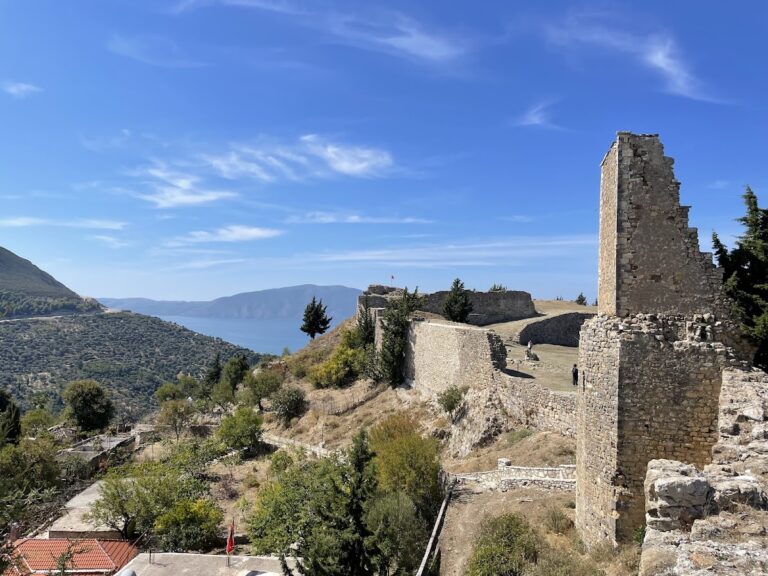
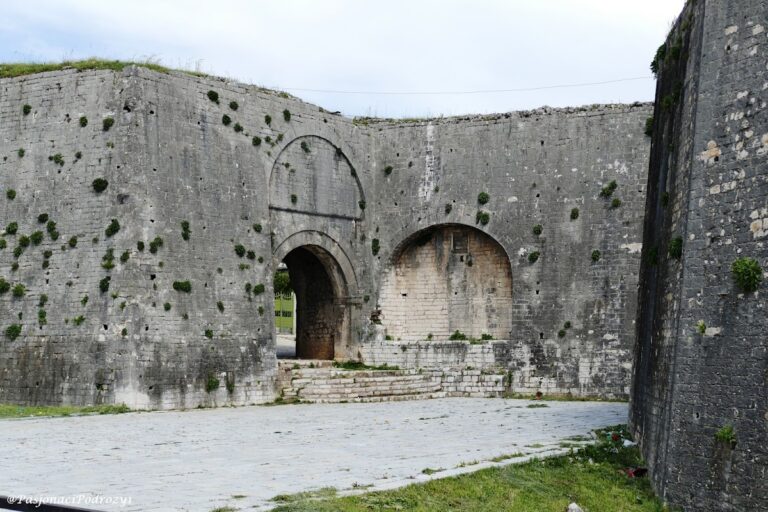
The city wall extends for approximately 2,100 metres. The settlement was fortified by the fifth or fourth century BC, with early sections built from irregular polygonal limestone blocks. During the fourth century BC, parts of the circuit were rebuilt or altered with carefully cut rectangular ashlar blocks. Projecting saw-tooth sections, buttresses, towers, and bastions were added or modified under defensive influences associated with Epirus, Phoinike, and Kassope. Three arched city gates were constructed or remodelled during the same period. A separate large fortification on the northern side had two gates and two defensive towers. The eastern wall reaches approximately three metres in height in places, and sections of the sixth-century Byzantine strengthening remain visible alongside towers, buttresses, bastions, and gates.
Acropolis and Urban Terraces
The acropolis developed especially during the first half of the fourth century BC and was only partly fortified because natural rock formations offered protection in some areas. Its entrances included gates closed above by false arches. A prytaneion, a civic or religious building associated with a city’s governing body and public hearth, or a temple once stood at an upper extremity of the acropolis.
Houses and public buildings occupied artificial terraces supported by retaining walls, with some foundations cut directly into the rock. The available remains suggest construction that followed the slope relatively spontaneously rather than a clearly demonstrated regular Greek or Epirote grid. Near the center of the city, surface finds such as column fragments, architectural decoration, and pieces of sculpture indicate a substantial Hellenistic complex in the agora, the civic marketplace and public space.
Sacred Precincts and Christian Architecture
Religious buildings occupied several parts of Amantia. A sanctuary in the northeastern part of the city existed by the sixth century BC and continued in use during the fourth and third centuries BC. Apollonian terracotta figurines found there provide evidence of its early cult activity. During the third century BC, a larger temenos, or formally bounded sacred precinct, developed in front of the southwestern fortifications in the area also known as the Peç district.
Sanctuary of Aphrodite Pandemos
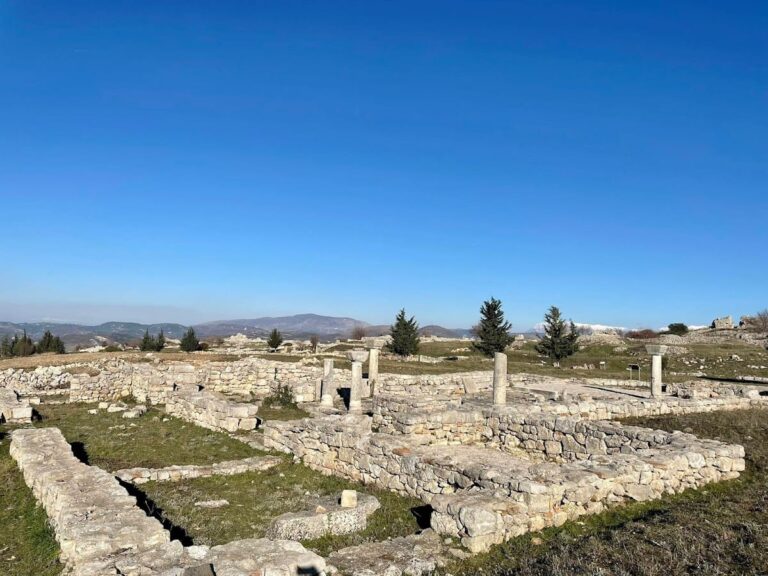
The principal monument in the precinct was the sanctuary of Aphrodite Pandemos. Built from rectangular ashlar blocks on a terrace reinforced with retaining walls, it survives chiefly in its foundations. The temple was a peripteros, a building surrounded by a single external colonnade, measuring approximately 17 by 7 metres. Its inner naos, the principal chamber, measured approximately 8.06 by 4.76 metres and was divided by two rows of arcades into a broad central cell and two narrower side cells.
A front pronaos, or vestibule, and a rear opisthodomos formed part of the plan. Four Doric columns created a tetrastyle colonnade along the entrance side. Fragments of the cult statue of Aphrodite were found within the naos. An inscription states that the sanctuary was renovated during the first century AD. The precinct also included worship of Zeus of Dodona, Pan, the nymphs, and a local male fertility deity comparable to Priapus. A third-century BC stone carving represents this deity with an exaggerated erect phallus, and some interpretations connect him with the Vjosa River.
Early Christian Basilica
A smaller Hellenistic sanctuary stood beside the temple of Aphrodite. During the sixth century, under Justinian, an early Christian basilica was built over its foundations. The basilica had an approximately square plan, with a central nave and two aisles. A narthex, or entrance hall, crossed the nave’s axis and was flanked by side chapels. The sanctuary ended in a semicircular apse. Surviving elements include the stone supports of the former altar table and fragments of stone window frames.
Stadium and Burial Areas
Ancient Stadium
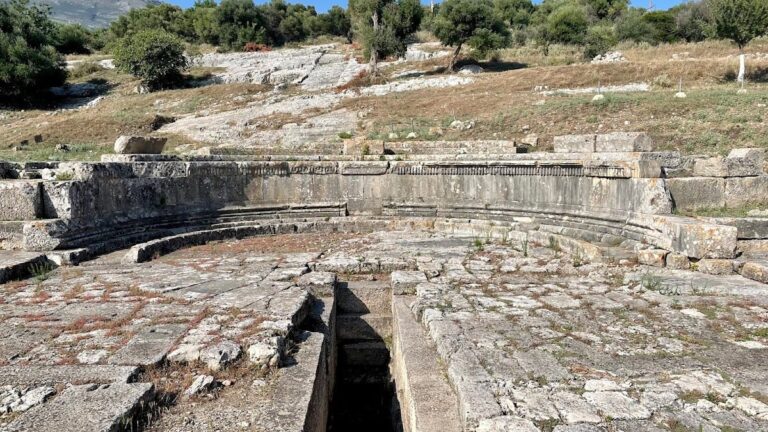
The stadium stood outside the southeastern fortifications, about 200 metres below the acropolis walls. Built in the third century BC according to Greek models, it has a horseshoe-shaped plan measuring approximately 60 by 12.25 metres. Its entrance opened toward the northeast. Seventeen seating rows survive on the northwestern side and eight on the southeastern side. The surviving wings measure approximately 46.50 and 44.50 metres, joining at the south with a short run of seats. The northern section served as the spectator entrance.
Limestone blocks formed the seating, which could accommodate approximately 3,000 to 4,000 people. Inscriptions show that the stadium hosted athletic contests such as running, discus throwing, and spear throwing, as well as religious and political events. Names carved into some seats, including Socrates son of Apollonos and Iparchos, may identify citizens who helped construct the building or organized its games. Excavations produced representations of athletes, including a finely worked headless statuette of a boxer. The stadium remained in use until the third century AD, and foundations of a gymnasium have been excavated nearby.
Necropoleis and Tombs
Cemeteries extended along the roads that led east and west from the city and around the stadium. Their rich grave goods reflect an urbanized and prosperous community. Among the burials are monumental Macedonian-type tombs dating from the middle of the fourth century BC. Each tomb consisted of a passage, or dromos, leading to a vaulted burial chamber.
Material Culture
Objects from Amantia include Corinthian and Attic pottery, Italian red-figure vessels, locally produced red-ochre ceramics decorated with circular or dotted motifs, bronze figurines and sculpture, Apollonian terracotta figurines, inscriptions, architectural fragments, and coins. Together, these remains express the combination of local Illyrian traditions with imported and locally adapted Greek forms that shaped the city’s material culture.