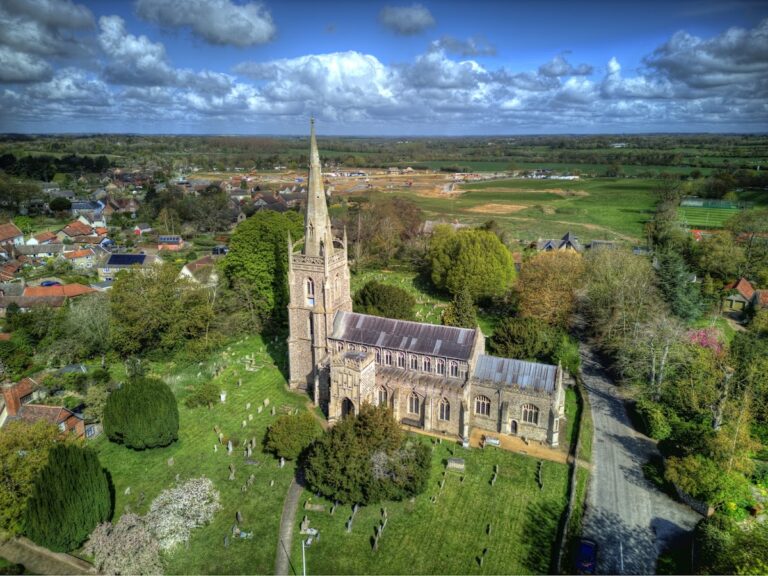
St Mary and St Peter’s Church: An Anglo-Saxon Parish Church in Barham


Site at a Glance
- Rating
- 4
- Popularity
- Very Low
- Country
- United Kingdom
- Primary era
- Medieval
- External website
- Open
- Eras represented
- Medieval
- Civilizations
- Anglo-Saxon
- Site type
- Religious
- Remains
- Church
On this page11 sections
History
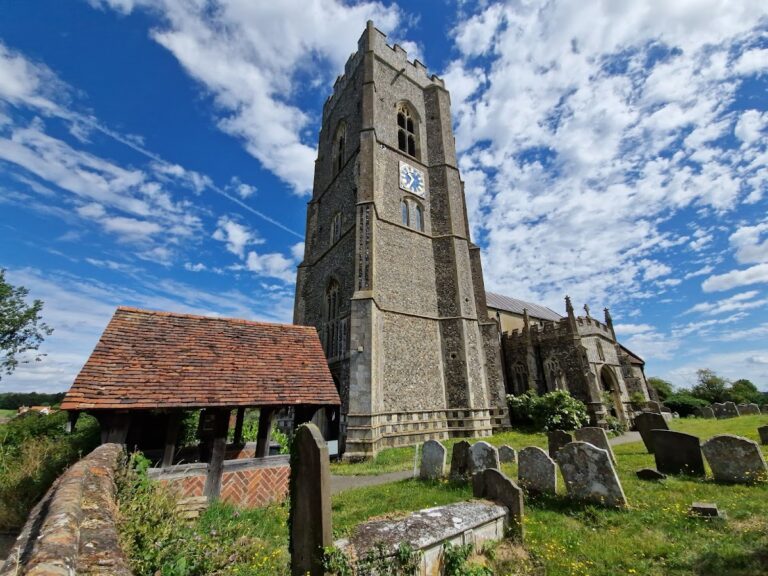
St Mary and St Peter’s Church is an Anglican parish church in Barham, United Kingdom, with a tower whose masonry suggests origins in the Anglo-Saxon period. A church at Barham was recorded in the Domesday Book, the great survey of English landholding and resources commissioned by William the Conqueror in 1086. The building is now part of the parish of Claydon and Barham and was designated a Grade I listed building, the highest category of listing in England, on 9 December 1955.
Early church and medieval parish
The tower contains long-and-short work, an Anglo-Saxon masonry technique that alternates long and short stone blocks, particularly at building corners. This feature suggests that the church dates from the Saxon period, before the Norman Conquest of 1066. The parish was known as St Mary by at least 1538, when it included the inhabitants of Barham Green.
Changes to the parish
In 1975, the parish was extended to include Claydon. After St Peter’s Church in Claydon was officially declared redundant, the Barham church was renamed St Mary and St Peter. It remains an active Anglican parish church within the Archdeaconry of Ipswich, the Diocese of St Edmundsbury and Ipswich, and the Province of Canterbury. These are administrative divisions within the Church of England, with provinces containing dioceses and dioceses divided into archdeaconries.
Memorial history
When St Peter’s Church in Claydon closed, its Henry Moore war memorial was moved to St Mary and St Peter’s Church. The statue, made by the major twentieth-century English sculptor Henry Moore, commemorates villagers who died in the Second World War. Other monuments and brasswork associated with the church were removed or destroyed during earlier phases of its history.
Remains
The surviving church is organized around a parish church body with a tower containing early masonry at its corners. Its architectural evidence is joined by a transferred twentieth-century memorial, while the chancel is associated with monuments connected to local families and estates.
Early masonry and memorial sculpture
Anglo-Saxon tower work
The tower’s quoins, the stones forming the corners of a wall, use long-and-short work. The alternating blocks are characteristic of Anglo-Saxon construction and provide the principal physical evidence for the building’s early origins. This masonry survives as part of the church tower.
Henry Moore’s Madonna and Child
The church contains Henry Moore’s statue of the Madonna and Child, a mother-and-child sculpture originally made as a war memorial for St Peter’s Church, Claydon. It commemorates villagers who died in the Second World War and was transferred to the present church after St Peter’s closed.
Chancel monuments
Monument to Jon Southwell
The chancel was associated with a monument to Jon Southwell, identified as the grandfather of Thomas Bedingfield.
Shrubland Hall burial tomb
A tomb in the chancel was used for the burial of an unnamed inhabitant of the Shrubland Hall estate, linking the church’s interior memorial history with the local estate community.