Sutton Hoo: An Anglo-Saxon Burial Landscape in England
Site at a Glance
- Popularity
- Very High
- Country
- United Kingdom
- Primary era
- Medieval
- Eras represented
- Bronze Age, Iron Age, Medieval
- Civilizations
- Anglo-Saxon
- Site type
- Burial
- Remains
- Necropolis
On this page24 sections
History
Sutton Hoo is an early Anglo-Saxon burial landscape near Woodbridge, England, in the United Kingdom. Anglo-Saxon describes the Germanic-speaking peoples and kingdoms that developed in England after Roman rule. The principal cemetery served elite burials from about 575 to 625, during a period when the East Angles, an Anglo-Saxon people with a kingdom in eastern England, were establishing royal power.
Before the cemetery
People used the Sutton Hoo landscape from the Neolithic period, around 3000 BC. Farming and settlement continued through the Bronze Age, Iron Age and Romano-British period, the era of Roman rule and the society shaped by it. Eventually, depleted sandy soils and encroaching vegetation contributed to the area’s abandonment.
An East Anglian burial ground
After Roman rule ended in southern Britain around AD 410, Angles and Saxons settled in the region. The tidal River Deben connected Sutton Hoo to a busy network for transport and trade. The surrounding area may have become an early centre of East Anglian royal authority, focused either at Sutton Hoo or at Rendlesham. The location of any larger aristocratic administrative centre remains uncertain.
The cemetery’s sequence included cremations, burials of bodies with grave goods, and two ship burials. The burial in Mound 1, dated by its coins to about 610–635 and often placed in the 620s, was probably that of an East Anglian king. Rædwald is the leading proposed identification, although the occupant is unknown; Eorpwald, Sigeberht and other high-status people have also been suggested. The grave’s rich objects and elaborate treatment point to exceptional rank. Its burial customs are generally interpreted as pagan, despite Christian imagery on some objects.
Mound 2 held the cemetery’s other ship burial. Its chamber and grave goods differed from those of Mound 1, while similarities between objects from the two graves suggest a connection. Mound 14 contained the burial of a high-status woman. She may have been a queen, perhaps Rædwald’s widow, but her identity is uncertain.
Later burials and the name Sutton Hoo
A later group of graves held people who had died violently, including by hanging or decapitation. The burials form two clusters, one around Mound 5 and another east of the main cemetery. A gallows may have stood on Mound 5 near an important river crossing. One interpretation links the dead to executions of criminals from the eighth or ninth century onward. A broader dating places these burials between the eighth and eleventh centuries, and some have been interpreted as people who resisted Christian rule. Their circumstances remain uncertain.
The name Sutton Hoo combines Old English words for a southern settlement or farmstead and a hill shaped like a spur. The Domesday Book, William I’s survey of English land and property completed in 1086, gives forms of the name rendered as Hoi or Hou. A pit dug into Mound 1 in the sixteenth century came close to, but did not reach, the burial. Around 1860, the opening of a mound appears to have produced nearly two bushels of iron ship rivets, probably from Mound 2. Nineteenth-century work at the cemetery included a viewing platform.
Excavation and changing interpretations
At landowner Edith Pretty’s initiative, Basil Brown began excavating in 1938. After investigating Mounds 2, 3 and 4, he uncovered the ship burial in Mound 1 in 1939. Once its importance became clear, archaeologist Charles Phillips directed work in the burial chamber with a team of specialists. An inquest awarded the treasure to Pretty, who gave it to the nation.
When the Second World War began in 1939, the finds went into storage and military vehicles used the site for training. After the war, a British Museum team led by Rupert Bruce-Mitford studied and conserved the objects, reconstructing pieces that included the helmet and sceptre-like object. Excavations in the 1960s and 1970s returned to the ship burial and other areas. Chemical analysis in 1967 found phosphate traces consistent with a body having decomposed in the acidic soil, addressing the possibility that the ship had served as an empty memorial.
From 1983 to 1992, Martin Carver directed wider investigations of several mounds and the ground between them. This work uncovered execution burials, re-examined and rebuilt Mound 2, and excavated the previously undisturbed burial in Mound 17. Much of the cemetery was left for future research. A second burial ground, about 500 metres upstream, was identified and partly investigated in 2000. Surveys using ground-penetrating radar and laser measurements of the ground surface examined the mounds in 2017–2018 without excavation. The National Trust took the site, including Sutton Hoo House, into its care in the 1990s.
The finds transformed understanding of early East Anglian society, its artistic and technical accomplishments, and its links beyond England. Sutton Hoo has also shaped interpretations of Beowulf, an Old English heroic poem set among Scandinavian peoples. The poem’s accounts of ship burials and elite warrior life have been compared with the cemetery, but it is not a direct record of Sutton Hoo.
Remains
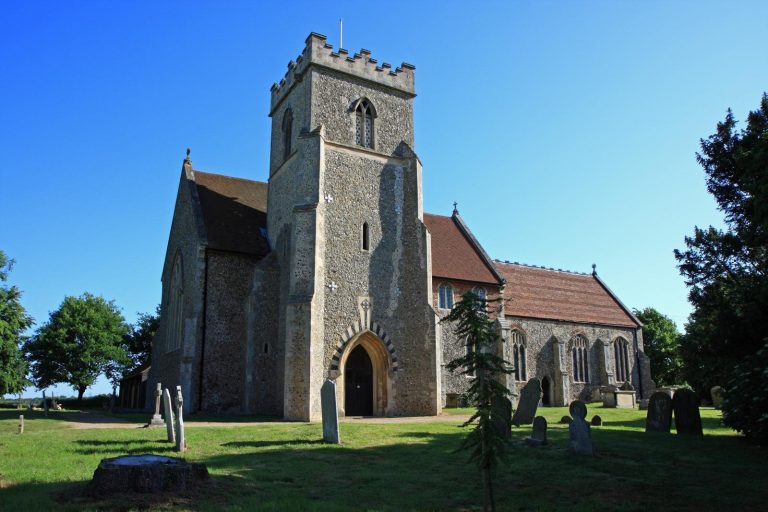
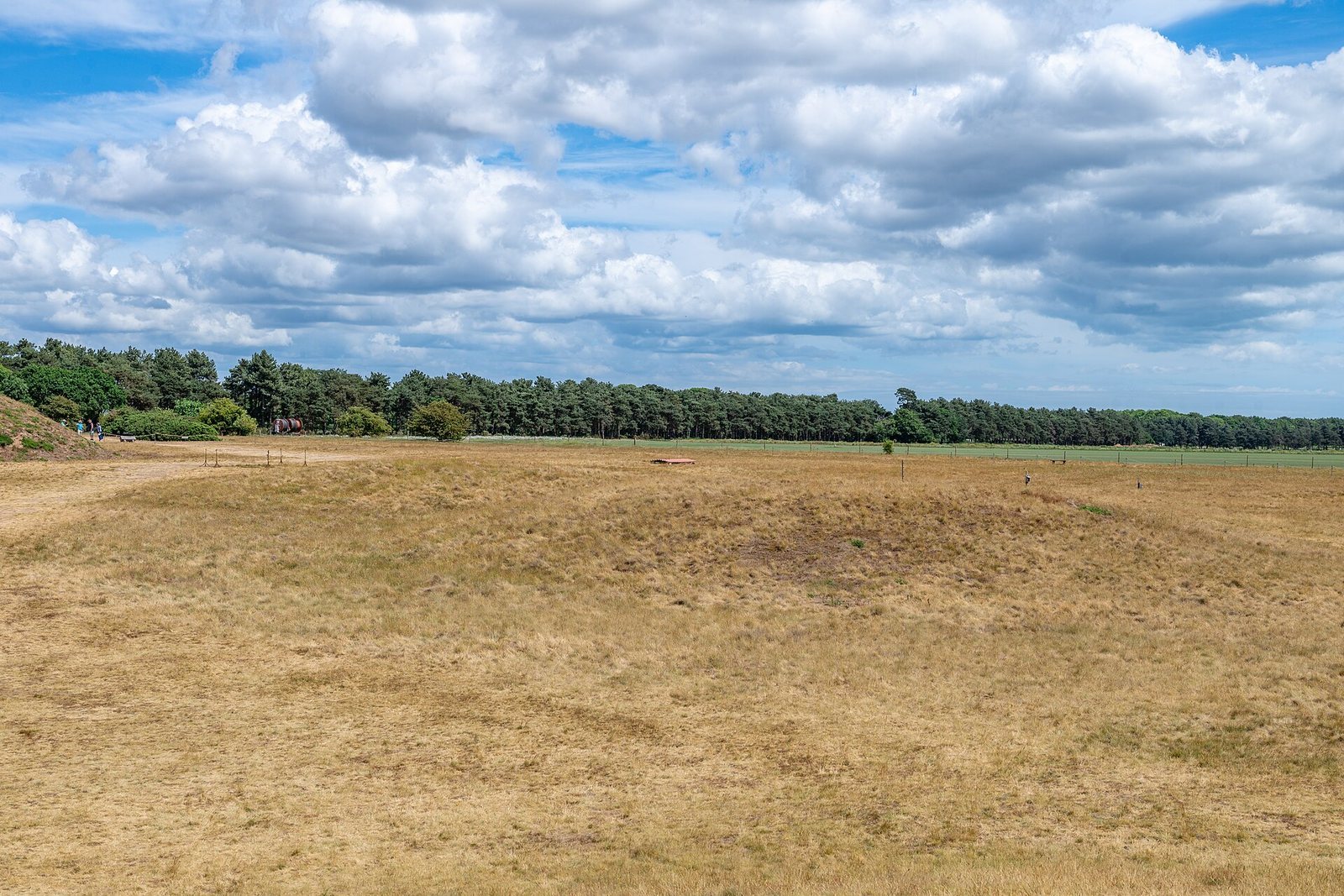
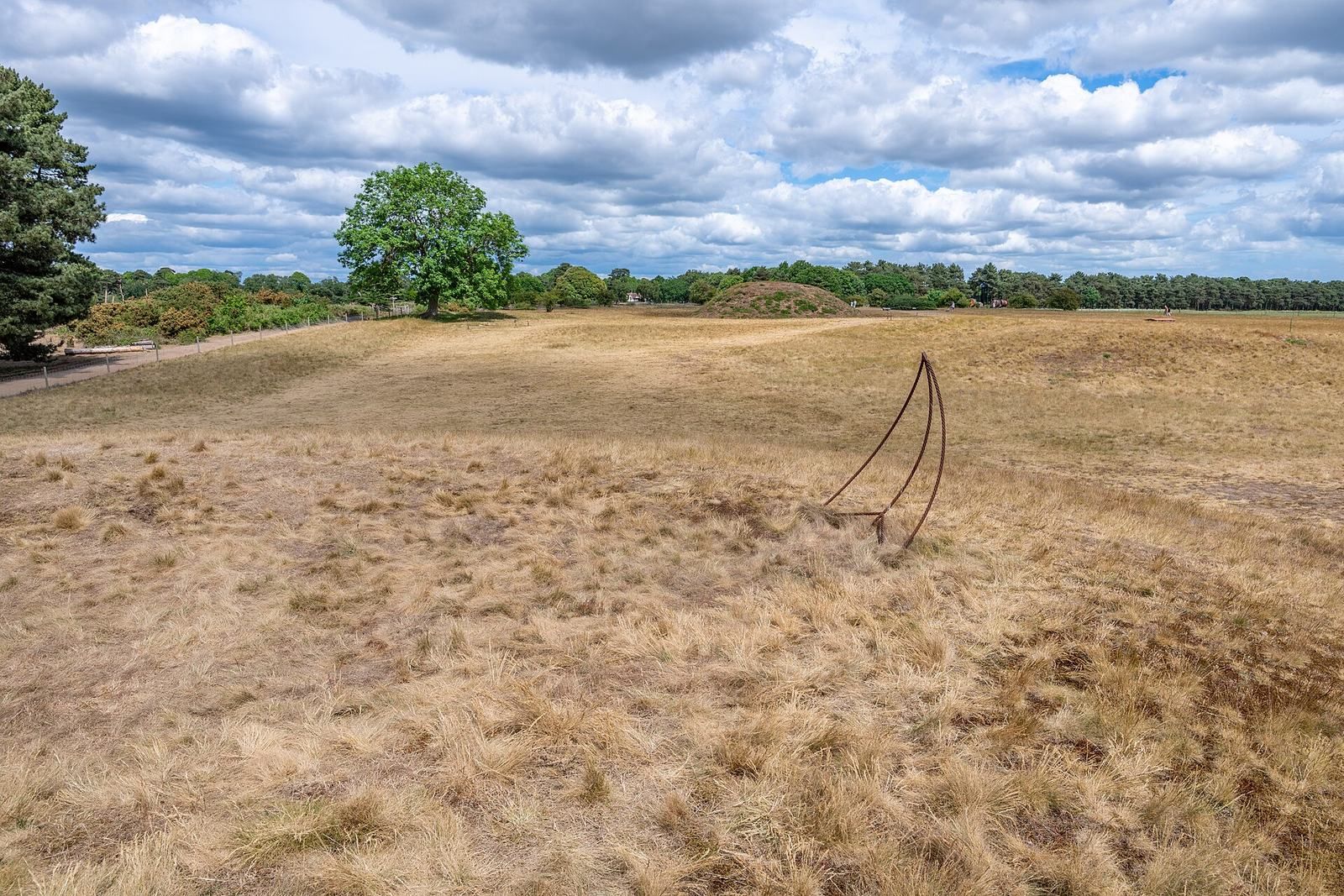
The principal cemetery occupies a spur of land beside the tidal estuary of the River Deben. About twenty earthen burial mounds form its main group, rising slightly above the horizon when seen from across the river. A second cemetery lies on another spur about 500 metres upstream; agricultural activity levelled the tops of its mounds.
Settlement and land-use remains
Neolithic activity
Small pits containing pottery tempered with flint mark Neolithic activity. Some were situated beside hollows left by uprooted trees.
Bronze Age settlement
Bronze Age remains include timber-framed roundhouses with woven wattle-and-daub walls coated in clay or mud and thatched roofs. One well-preserved house had a ring of upright posts, some up to 30 centimetres across, and a probable entrance on its southeast side. Its central hearth contained a faience bead, a glazed ceramic object. Ditches divided the surrounding land into sections.
Iron Age and Romano-British traces
Small enclosures for cultivation, sometimes called Celtic fields, date to the Middle Iron Age. Narrow trenches may relate to grape growing, while dark patches in the soil may indicate the cultivation of large cabbages. Romano-British finds include pottery fragments and a discarded fibula, a brooch used to fasten clothing.
Burials in the principal cemetery
Cremation mounds
Mounds 3 and 4 contained cremated burials excavated in 1938. Mound 3 held human and horse remains on a wooden trough or dugout bier, together with a Frankish throwing axe with an iron head, a bronze ewer lid, part of a carved plaque showing a winged Victory, and decorated bone fragments. Mound 4 contained the cremated remains of a man and woman, a horse and possibly a dog, as well as fragments of bone gaming pieces.
Mounds 5, 6 and 7 held cremations in bronze bowls, and Mound 18 was badly damaged but contained a burial of similar type. The goods from Mound 5 included gaming pieces, small iron shears, a cup and an ivory box. Mound 6 yielded animal remains, gaming pieces, a sword-belt fitting and a comb. In Mound 7, finds included gaming pieces, an iron-bound bucket, a sword-belt fitting and a drinking vessel. Burned remains of horses, cattle, red deer, sheep and pigs accompanied the deceased there.
Ground burials and Mound 14
Investigation around Mound 5 found two further cremations, two burials of bodies and a pit containing a skull and decorative foil fragments. Three furnished graves in level ground between the mounds belonged to a child, a man and a woman. The child’s grave held a buckle and miniature spear; the man’s contained two belt buckles and a knife. The woman had a leather bag, pin and chatelaine, a set of small accessories hung from a belt or chain.
Grave robbing destroyed almost all of Mound 14, but surviving objects included a silver chatelaine, a kidney-shaped purse lid, a bowl, buckles, a dress fastener and casket hinges. Embroidered cloth also survived.
Mound 17
Two undisturbed graves lay side by side beneath Mound 17, one for a young man and one for a horse. The man’s oak coffin held a sword on his right, its belt wrapped around the blade. The sword was made with pattern-welded iron, formed by joining twisted metal rods, and the belt had a bronze buckle decorated with garnets set in metal compartments. Two spears, a shield, a small cauldron, a bronze bowl, a pot, an iron-bound bucket and animal ribs were arranged around the coffin. A firesteel and leather pouch containing uncut garnets and patterned glass lay near his head. In the northwest corner, a bridle bore circular gilt-bronze plaques with interwoven ornament.
Execution burials
The execution graves include distorted human outlines preserved as stains in the sandy soil, with signs of hanging or decapitation on some. Casts were made of several outlines. Postholes near the graves may mark the position of gallows.
The second burial ground
The upstream cemetery contained thirteen cremations and nine burials of bodies. One oval grave held two ash vessels, a stamped black urn of late-sixth-century type and a large bronze hanging bowl, a vessel suspended by fittings. Its openwork hooks and circular central mount were decorated. Another grave held a man beside a spear, beneath a shield with an ornamented central boss and two metal mounts bearing a predatory bird and a dragon-like creature. Women’s graves included combs, bowls, small knives, beads and pins; many men’s graves contained spears and shields.
Ship burials
The Mound 1 ship and chamber
The ship in Mound 1 measured about 27 metres long, with a beam of approximately 4.4 metres and an inboard depth of around 1.5 metres above the keel line. Its pointed ends had high, rising stem and stern posts. The oak hull was clinker-built, meaning its planks overlapped at the edges. Nine planks on each side were fixed with iron rivets and supported by twenty-six wooden ribs. Repairs were visible in the hull. Its form suited seagoing travel, and it had no descending keel. Oar-rests along the gunwales may have provided positions for forty rowers.
The vessel lay in a prepared trench with a central burial chamber, whose timber end walls supported a roof that was probably pitched. Only the upper parts of the stem and stern posts projected above ground before an oval mound covered the ship. The burial mound rose above the river-facing horizon. Its weight eventually collapsed the chamber roof and compressed the contents. Soil evidence indicates that a body had lain on a platform or in a large coffin about 2.7 metres long, probably with the head at the chamber’s west end. The acidic soil consumed the body.
Helmet, weapons and shield
The chamber contained 263 objects and fragments made from materials including gold, silver, bronze, iron, enamel, gemstones, glass, wood, bone, horn, leather, textiles, feathers and fur. A masked helmet with a crest lay to the left of the body’s head. Its iron skull was formed from a single vaulted shell, with a full face mask, neck guard and deep cheekpieces. Tinned-bronze panels and assembled fittings decorated it. The collapsed roof broke the helmet into hundreds of pieces, which were later reassembled.
Spears lay to the body’s right, including three barbed spears with hooked heads that had been thrust through the handle of a bronze bowl. Nearby were a wand with a wolf fitting and a sword about 85 centimetres long. Its gold-and-garnet pommel, patterned iron blade and decorated belt and harness formed an elaborate set. Wear on the hilt and the sword’s position have led to the suggestion that the dead person was left-handed. A large round shield stood along the inner west wall, near a tall iron stand. Garnets, gilt-bronze fittings and animal ornament decorated the shield, which also carried a predatory-bird emblem and a flying dragon. A small bell lay nearby.
Gold fittings and purse
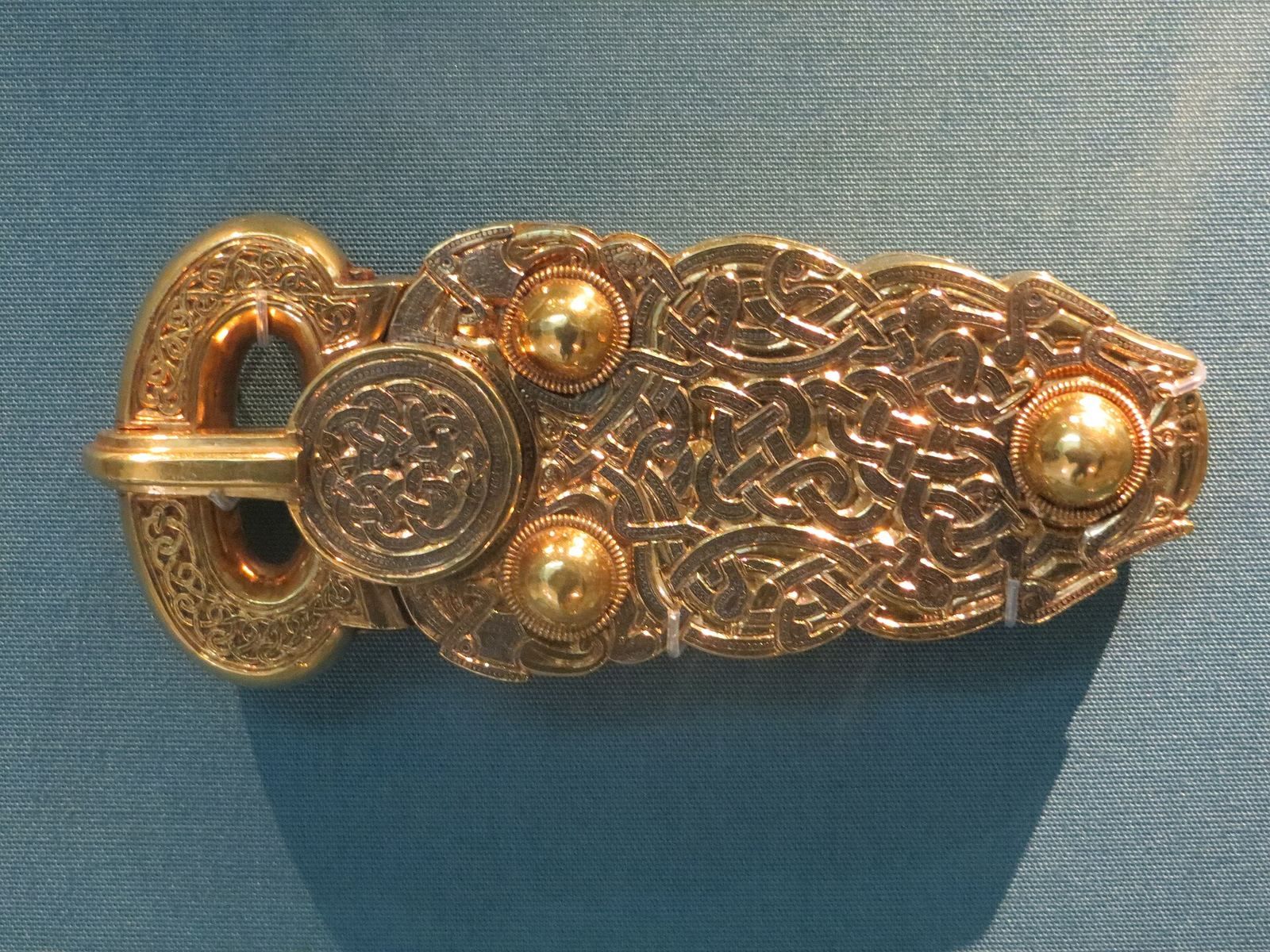
Upper-body objects included a three-part gold buckle with an elongated oval plate and interwoven animal ornament. Its hollow hinged back concealed a compartment that may have held a relic. Two gold shoulder clasps had curved halves joined by removable chained pins. Garnets, patterned glass, interwoven designs and boar motifs adorned them. Fittings on their reverse attached them to a stiff leather cuirass, a protective garment.
A decorated purse lid covered a leather pouch. Its kidney-shaped frame was set with garnets and enclosed horn, bone or a similar material. Garnet plaques showed birds, wolves devouring people, geometric designs and interwoven animals. Inside the pouch were thirty-seven gold shillings, or tremisses, small coins worth one-third of a solidus, from different Frankish mints, along with three blank coins and two small gold ingots. These coins provide key evidence for dating the burial.
Vessels and dining equipment
Ten nested silver bowls lay to the right of the head and were probably made in the Eastern Roman Empire in the sixth century. Two silver spoons beneath them carry the names PAULOS in Greek lettering and SAULOS in a Frankish-style script. The spoons, and perhaps the bowls, may have been given for a baptism. Near the lower legs were two drinking horns made from aurochs horns, with gilt fittings, and maplewood cups with similar mounts. Folded textiles lay nearby.
Two compact heaps at the chamber’s eastern end contained a rare coat of ring-mail made from alternating welded and riveted iron links, two hanging bowls, leather shoes, a feather-filled cushion, folded leather objects and a wooden platter. Beside them lay an iron hammer-axe with a long iron handle, whose purpose is uncertain. A fluted silver dish with drop handles rested on the packed goods. Made probably in Italy, it had a relief of a woman’s head in a late Roman style. Inside it were small wooden cups, antler combs, metal knives, a small silver bowl, a bone gaming piece thought to represent a king and other small objects. A silver ladle with gilt chevrons lay above this group. At the top was a large chased silver platter made in the Eastern Roman Empire around AD 500 and stamped with control marks of Emperor Anastasius I, who ruled from 491 to 518. A piece of unburnt bone of uncertain origin rested on the platter.
Musical instrument, carved object and textiles
A long, square-sectioned whetstone tapered at both ends and bore carved human faces. A ring fitting and bronze stag figurine were attached to its upper end. It may have served as a sceptre, although its purpose is disputed. In the chamber’s southwest corner, a bronze bowl with drop handles and animal figures, probably from the eastern Mediterranean, lay beside a damaged six-stringed lyre, a stringed instrument, in a beaver-skin bag. Above them hung a large bowl fitted with three hooks, enamel and patterned-glass decorations, spiral designs and red crosses. A metal fish inside it was fixed to a swivel pin.
Textile remains included quantities of twill, perhaps from cloaks, blankets or hangings, and fragments of long-pile cloaks. Some coloured hangings may have been imported and made with a Syrian weaving method that used looped threads to create a textured surface. Other patterned textiles found near the head and foot resemble Scandinavian work of the period.
Mound 2 ship burial
Looting disturbed Mound 2, but re-examination revealed a rectangular chamber lined with planks, measuring five metres long and two metres wide below ground level. A small ship had been set above it on an east–west axis, and a large earth mound covered the burial. Chemical analysis suggests a body lay in the chamber’s southwest corner. Finds included fragments of blue glass cups with raised decoration, gilt-bronze discs with animal patterns, a bronze brooch, a silver buckle and a gold-coated buckle stud. Other objects included the tip of a patterned iron sword blade, silver-gilt drinking-horn fittings and fragments of dragon-like mounts.
Objects from the wider landscape
Fragments of the sixth-century Bromeswell bucket, a copper-alloy vessel from the eastern Mediterranean, were recovered in the Sutton Hoo area in 1986, with further pieces found in 2012 and 2024. Its frieze, in a Syrian or Nubian style, depicts unclothed warriors fighting lions. A Greek inscription wishes the user good health and many happy years. The vessel probably belonged to a furnished burial and may have been used for bathing. Finds from Mound 1 are held mainly by the British Museum; objects from Mounds 2, 3 and 4 are also held at Ipswich Museum.