Sint-Adriaansabdij: Former Benedictine Abbey in Geraardsbergen


Site at a Glance
- Rating
- 4
- Popularity
- Low
- Country
- Belgium
- Primary era
- Early Modern
- Eras represented
- Early Modern
- Civilizations
- County of Flanders, Spanish
- Site type
- Religious
- Remains
- Monastery
On this page10 sections
History
Sint-Adriaansabdij is a former Benedictine abbey in Geraardsbergen, Belgium, established there in 1096 when the Abbey of Saint Peter at Dikkelvenne was transferred at the request of Robert II of Jerusalem, Count of Flanders. The Benedictines are a Catholic monastic order governed by the Rule of Saint Benedict. The abbey developed into a pilgrimage centre after receiving relics of Saint Adrian in 1110, and it took the name Sint-Adriaansabdij in 1175.
Medieval development
Over the following centuries, the abbey grew into an extensive monastic complex. Its religious importance also brought it into contact with the political life of the period. On 1 May 1404, the funeral procession of Philip the Bold, Duke of Burgundy and father of John the Fearless, stayed overnight at the abbey.
Early modern expansion
Abbot Martinus Lebrun, who governed the abbey from 1624 to 1656, founded a Latin school within the complex in 1629. This educational foundation formed part of the abbey’s wider institutional role during the early modern period.
Confiscation and civic reuse
During the French Revolution, the abbey buildings were confiscated in 1794 and publicly sold in 1797. The church and monastic wing were later demolished, changing the form of the former complex. From 1839, the surviving buildings and park were converted into a spa. The estate later passed by inheritance to the city of Geraardsbergen on the condition that it establish a museum and public park there.
Sint-Adriaansabdij is designated as built heritage under monument number 8317. Restoration of the abbot’s house began in 2021, while Abbey Park was redesigned between 2019 and 2021.
Remains
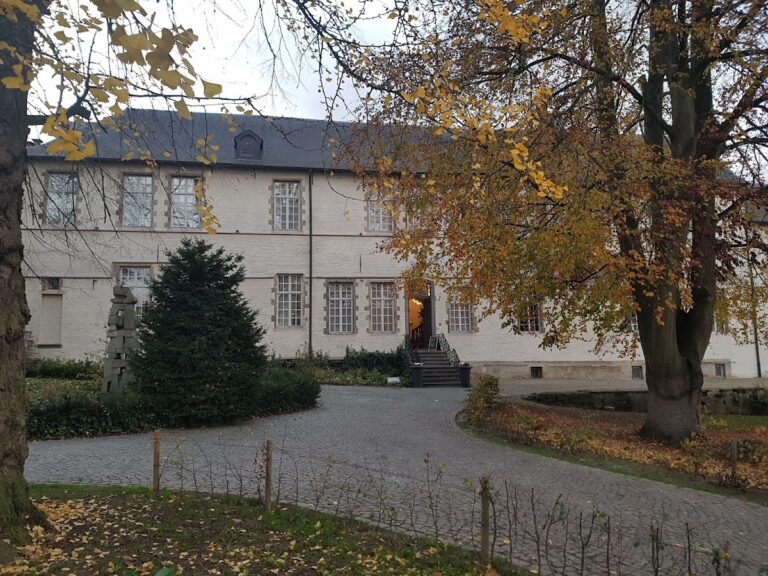
The surviving complex is arranged around the gate building on Abdijstraat, the abbey wing or abbot’s house with its prelate’s quarters, the southern stable wing known as the carriage house, and the remains of an ice cellar. These buildings stand within Abbey Park. The former abbey also included a cruciform church with a surrounding cemetery, a brewery, a courtyard, a U-shaped cloister, and several stables and storage buildings.
Surviving buildings
Gate building
The gate building forms the surviving entrance structure on Abdijstraat. It belongs to the remaining architectural group that defines the approach to the former abbey complex and its park.
Abbot’s house
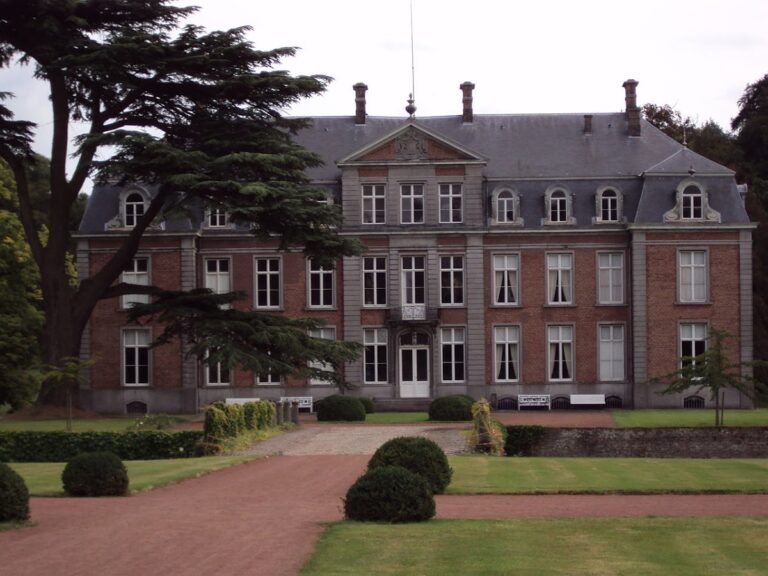
The abbot’s house was first built in 1506. A fire led to its rebuilding and enlargement in 1629, and its interior received Rococo stucco during the eighteenth century. Rococo is a decorative style known for delicate ornament, asymmetrical designs, and flowing forms, while stucco is plaster-based architectural decoration.
The first floor remains relatively intact. It contains a museum with furniture and the private collection of the Guillemin family, from whom the city inherited the estate, together with a reconstruction of the former abbey kitchen. Museums devoted to Chantilly lace, tobacco, pipes, and matches were established on the second floor during the 1980s, reflecting industries for which Geraardsbergen was historically important. A restaurant occupies the ground floor.
Carriage house and ice cellar
The southern stable wing, known as the carriage house, is one of the surviving service buildings. Beside it, the remains of the ice cellar are used as a reserve for bats, giving this remnant a continuing function within the former abbey grounds.
Former monastic structures
The demolished church was a cruciform building erected in 1373 and surrounded by a cemetery. The wider monastic complex included a U-shaped cloister, brewery, courtyard, stables, and storage buildings, as well as the abbey wing with the abbot’s residential and administrative quarters. The surviving buildings and park preserve part of this former arrangement.