Parish Church of Saints Martin and Nicholas, Wiesing: A Baroque Church in Austria


Site at a Glance
- Rating
- 4.7
- Popularity
- Very Low
- Country
- Austria
- Primary era
- Early Modern
- External website
- Open
- Eras represented
- Medieval, Early Modern, Modern
- Civilizations
- Habsburg, Holy Roman Empire
- Site type
- Religious
- Remains
- Church
On this page11 sections
History
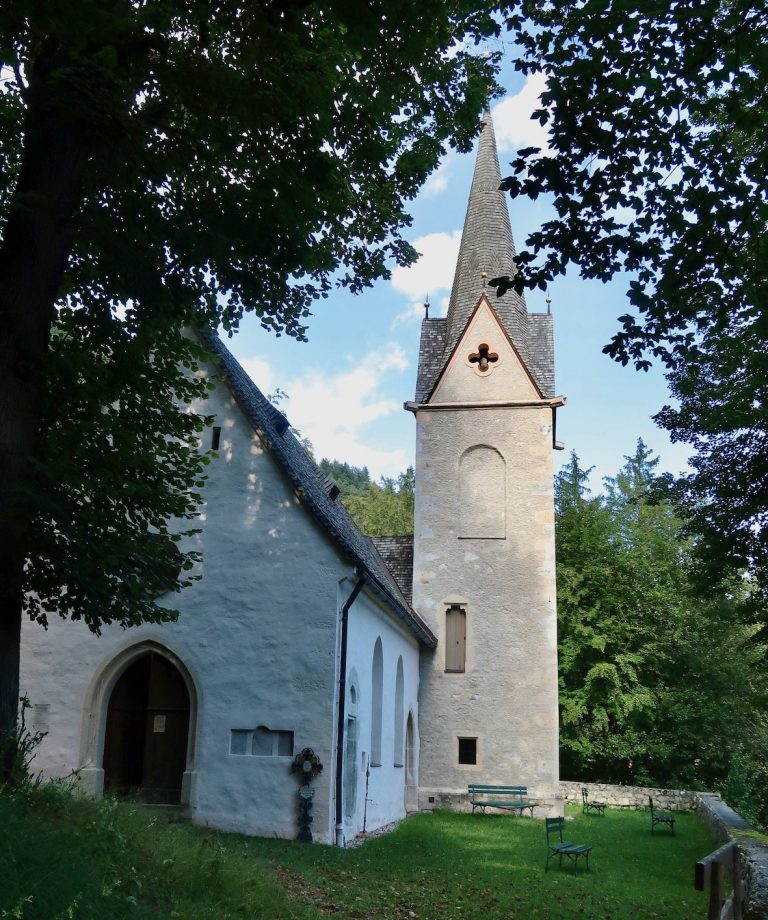
The Parish Church of Saints Martin and Nicholas is a Roman Catholic church in Wiesing, Austria, whose present form combines a Gothic tower with an eighteenth-century Baroque hall church. A church at Wiesing was recorded in 1337, and the surviving tower belongs to a Gothic building dating from around 1352. The dedication honours Martin of Tours, a fourth-century bishop associated with charity and the story of sharing his cloak with a beggar, and Nicholas of Myra, a bishop remembered for charitable acts.
From medieval church to parish church
The church became a chaplaincy in 1624, meaning that it was served by a priest assigned to the community without yet being an independent parish. In 1891 it was elevated to parish-church status. It belongs to the Roman Catholic Diocese of Innsbruck and the Fügen-Jenbach deanery.
The eighteenth-century rebuilding
Thomas Sandbichler built a new nave between 1777 and 1780, creating the main Baroque structure that stands beside the earlier tower. Georg Weber produced the stucco decoration in 1779, while Matthias Ruef painted the frescoes. The west door carries the date 1780, and the stained-glass windows were made by the Innsbruck glassworks between 1895 and 1899.
Organ history and protection
In 1808, an organ from Ebbs was purchased and installed at Wiesing by the Zillertal firm Mauracher. Its older case probably came from the church at Ebbs. Karl Reinisch II built the present organ in 1922 as Opus 126 of Franz Reinisch’s organ-building workshop. When it was inspected in autumn 2025, numerous technical failures required extensive repair.
The church and its cemetery are protected as historic monuments. This status covers both the Baroque building and the surrounding burial ground, together with the Gothic fabric retained within the present church.
Remains
Exterior and architectural plan
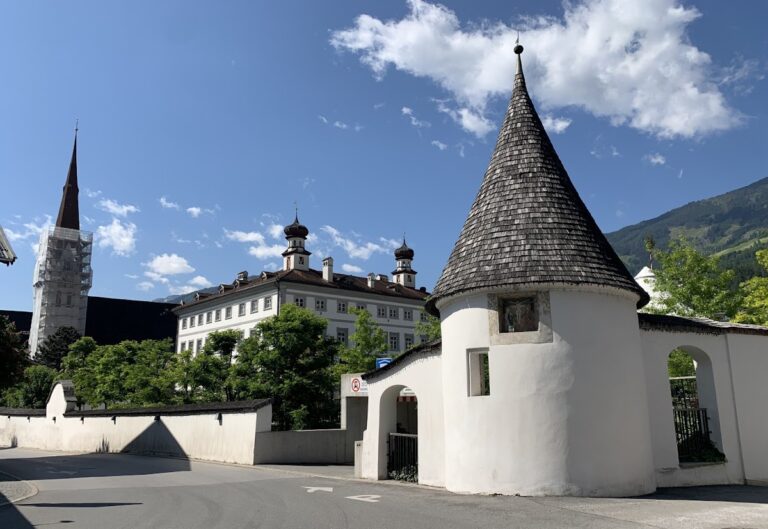
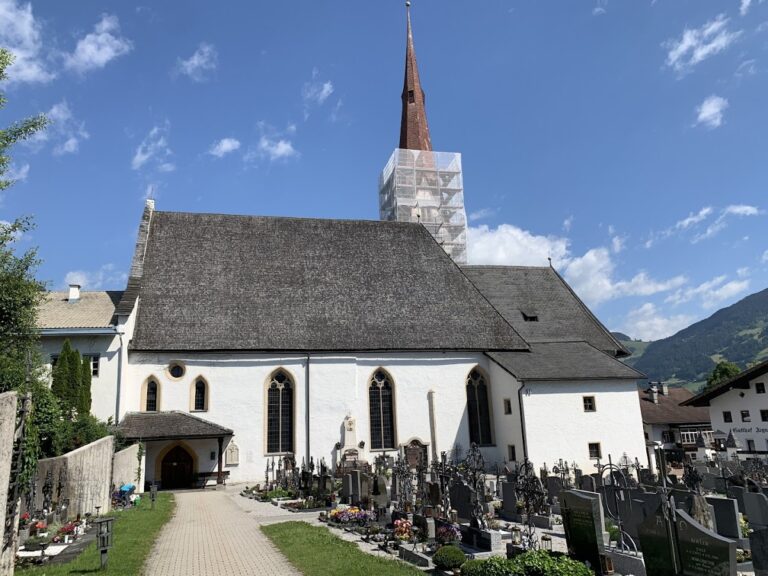
The church stands within its cemetery in the centre of Wiesing village. It is a Baroque hall church, a form in which the nave and adjoining spaces are broadly similar in height, attached to a Gothic tower. Rendered pilasters articulate the exterior. The west front has a curved gable, a red-marble portal, and a carved door dated 1780. An eighteenth-century statue of Saint Nicholas occupies a niche in the wall.
Inside, the four-bay nave leads to a narrower two-bay choir that ends in a semicircular apse. Lath vaults create transversely oval, flat domes, while the wall pillars carry Rocaille capitals. Rocaille is an eighteenth-century ornamental style based on asymmetrical shell-like and rock-like forms.
Painted decoration and furnishings
Frescoes and wall paintings
The choir frescoes show the Assumption of Mary and the Glory of Saint John Nepomuk. Nepomuk was a fourteenth-century Bohemian priest and martyr traditionally associated with protecting the seal of confession. In the nave, the frescoes depict the Fall of the Angels, two episodes from the legends of Saint Martin, and Saint John of Matha, the medieval founder of the Trinitarian order for the redemption of captives.
Grisaille paintings, made in a monochrome technique that imitates relief sculpture, represent the Four Church Fathers and Saints Isidore, Notburga, Peter, and Paul. A Crucifixion occupies the south wall of the nave.
Altars and saints’ shrines
The high altar is a Baroque column altar, an altar structure framed by columns. Its 1779 altarpiece by Franz Anton Zeiller depicts Saints Martin, Mary, Francis, and Nicholas. Sculptures of Saints Cassian and Ingenuin stand on the altar, while a devotional image of Saint John Nepomuk from around 1750 is placed above the tabernacle.
The left side altar carries an around-1800 painting of the Holy Family by Josef Leopold Strickner, with statues of Saints Leonard and Notburga. The right side altar has an around-1800 painting of Saint Joseph by Anna Maria Moser and statues of Saints Aloysius and Francis. Shrines on the side altars contain the eighteenth-century bodies of Saints Clement and Laurentia, brought from Reischach Monastery in Upper Bavaria.
Other interior furnishings
An eighteenth-century crucifix is preserved in the church. The pulpit bears the symbols of the Evangelists and has a sounding board with angels of Judgment dating from the late eighteenth century. Statues of Saints John and Paul, made around 1700, stand beneath the double gallery. The pews date from around 1780, and the marble offertory box bears the date 1783.
The organ
The present organ is installed in a partly late-eighteenth-century Baroque case. It has two manuals, a pedalboard, approximately 1,200 pipes, and 22 registers, each register controlling a distinct set of pipes. Its action is entirely pneumatic. The decorative gallery positive has no musical function. The pipes in the side towers of the main case are painted wooden dummy pipes, and the upper division suggested by the case is probably also nonfunctional.
The instrument has the normal couplers II/I, I/P, and II/P, together with super-octave couplers I/I and II/I and a sub-octave coupler II/I. Its listed controls include Piano, Mezzo Forte, Forte, Pleno, Tutti, cancellation, reed-off, and automatic pedal changeover.