Malsky Monastery: An Orthodox Monastic Settlement in Russia


Site at a Glance
- Rating
- 4.8
- Popularity
- Very Low
- Country
- Russia
- Primary era
- Early Modern
- Eras represented
- Early Modern, Modern
- Civilizations
- Russian
- Site type
- Religious
- Remains
- Monastery
On this page6 sections
History
Malsky Monastery is a male Orthodox monastery in Russia, located near the village of Maly in Pskov Oblast. It originated as a place of monastic habitation in the fifteenth century, with its foundation dated to 1471.
Origins and Early Community
The local wilderness became associated with the hermit Onufry, who died there on June 12/25, 1492. By the middle of the sixteenth century, Malsky Monastery had two churches and housed twelve monks. Its parish community included Russians and Seto, a Finno-Ugric people traditionally associated with the borderlands of southeastern Estonia and the Pskov region.
Wartime Destruction
The monastery stood near the Livonian frontier, a historical region corresponding broadly to parts of present-day Estonia and Latvia. In 1581, Hungarian troops serving Stephen Bathory, king of Poland and grand duke of Lithuania, approached Malsky Monastery after his failed assault on the Pskov-Caves Monastery, an Orthodox monastery in the Pskov region. The attackers destroyed the wooden monastery, and all its Orthodox monks were killed.
The monastery’s frontier location again exposed it to military violence. Swedish forces destroyed it in 1710. More peaceful conditions followed the Treaty of Nystad in 1721, which ended the Great Northern War between Sweden and Russia and confirmed major Russian territorial gains around the Baltic Sea. The Russian Empire’s frontier subsequently moved to the Baltic shores.
Revival and Changing Borders
Empress Anna Ioannovna, who ruled Russia from 1730 to 1740, ordered the monastery’s activities to resume in 1730. Bishop Rafael Zborovsky of Pskov was placed in charge of the restoration of monastic life.
A major rebuilding and strengthening campaign took place in 1902, adding a bell tower to the ensemble. From 1919 to 1940, the monastery lay within independent Estonia in Petserimaa County. Estonian authorities pursued policies intended to detach Seto parishioners from Orthodoxy, restrict the use of Russian, and align Orthodox holidays with Lutheran ones. The territory became part of the Soviet Union in January 1945.
In 2000, Malsky Monastery received the status of the Spaso-Onufriev Skete of the Pskov-Caves Monastery. A skete is a small monastic settlement that usually depends on a larger monastery rather than operating as a fully independent institution. The monastery ensemble is a federally significant cultural-heritage site of the Russian Federation and remains under state protection.
Remains
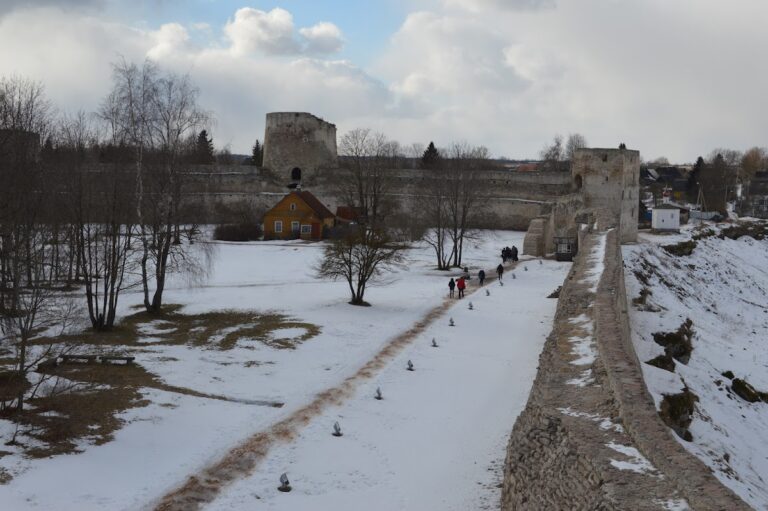
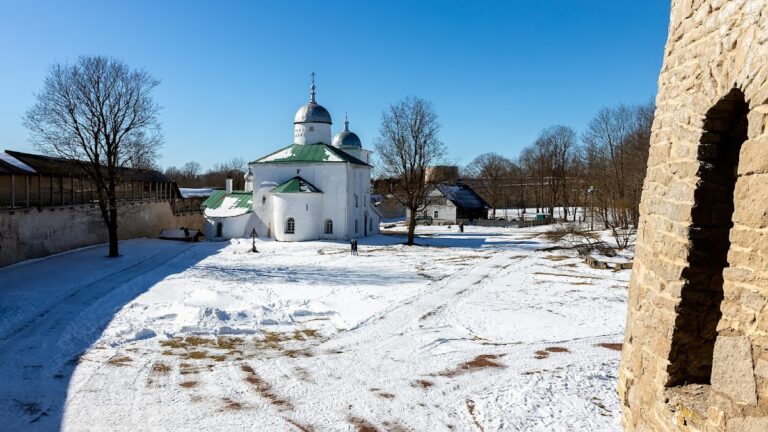
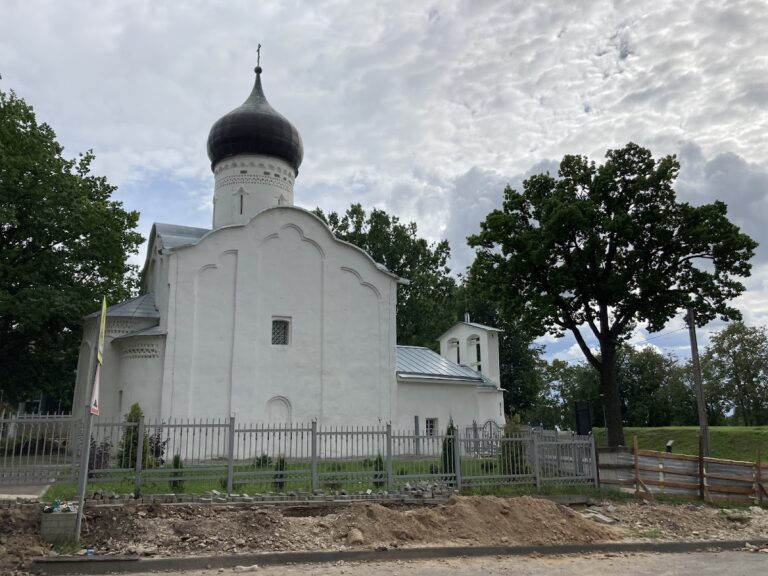
Malsky Monastery stands on the shore of Lake Malskoye near Maly, between Pechory and Izborsk, approximately 18 kilometres southeast of the Pskov-Caves Monastery. Its architectural ensemble developed from an early wooden monastic complex into a rebuilt and strengthened group of buildings. The monastery is in satisfactory condition.
Monastery Ensemble
By the middle of the sixteenth century, the complex contained two churches. The earlier monastery buildings were made of wood and were destroyed during the attack of 1581. The rebuilding and strengthening carried out in 1902 altered the surviving ensemble and added a bell tower, which forms part of its present architectural character.