Pskovo-Pechersky Dormition Monastery: A Historic Orthodox Fortress Monastery in Russia


Site at a Glance
- Rating
- 4.9
- Popularity
- Medium
- Country
- Russia
- Primary era
- Medieval
- External website
- Open
- Eras represented
- Medieval, Early Modern, Modern
- Civilizations
- Russian
- Site type
- Religious
- Remains
- Fortified Monastery
On this page26 sections
History
Pskovo-Pechersky Dormition Monastery is an active Russian Orthodox male monastery in Pechory, Russia, near the Estonian border. Traditionally founded in 1473, it became a spiritual center for the Seto, a Finno-Ugric people of the borderlands, and is one of the few Russian monasteries that has never been closed.
Origins and foundation
The beginnings of monastic life at the site remain uncertain. Local tradition places the discovery of the caves in 1392 and connects them with hermits who fled south from raids by Crimean Tatars. The earliest named hermit is Mark, regarded as the monastery’s first monk. Earlier accounts treated Mark as legendary, while later tradition accepted him as a historical figure.
In 1470, the priest John, who had been associated with the Church of Saint George in Yuryev-Livonian, present-day Tartu, settled at the site. With help from his wife Maria, later the nun Vassa, he excavated the Dormition cave church. After Vassa’s death, John became the monk Jonah. The church was consecrated in 1473, the date traditionally accepted as the monastery’s foundation, and Ivan Dementyev transferred the surrounding land to the monks.
Expansion and frontier defense
The early community was repeatedly plundered by Livonian forces. Its revival began in 1519, when the Moscow government recognized the strategic value of a monastery situated about 20 kilometers from the Livonian fortress of Neuhausen. In 1523, under Abbot Dorotheus, the community was enlarged through the efforts of the state clerk Misyur Munekhin. The cave church was extended, and a church dedicated to Saints Anthony and Theodosius of the Kyiv Caves Lavra was built on Holy Mountain. Abbot Gerasim introduced a communal rule modeled on the traditions of that major Orthodox monastic center in Kyiv.
Under Abbot Cornelius, the monastery entered a major period of growth. A refectory church dedicated to the Annunciation was built in 1541, the Dormition Church was enlarged, and the cave system was extended. Stone defensive walls were constructed between 1558 and 1565, and the Saint Nicholas Gate Church followed in 1564 or 1565.
Cornelius died in 1570. According to tradition, Tsar Ivan IV killed him at the monastery gate after suspecting him of treason. A manuscript preserved at the Trinity-Sergius Lavra places the event at the gate. After repenting, Ivan carried Cornelius’s body to the Dormition Church. The route between the Saint Nicholas Church and the Dormition Church has since been known as the Bloody Path.
For more than 150 years, the monastery served as a western border fortress. It resisted a two-month siege by the forces of Stephen Batory in 1581. Polish, Lithuanian, and Swedish forces approached or attacked it repeatedly between 1611 and 1614, and the army of King Charles XII of Sweden besieged it in 1703. Its military role ended after the Treaty of Nystad in 1721 moved the Russian frontier westward.
Imperial additions
The monastic complex continued to develop during the imperial period. The Intercession Church was built in 1758 and 1759, the Church of Saint Lazarus between 1792 and 1800, the Michael Archangel Cathedral between 1815 and 1827, and the Sretensky Church in 1870. The Michael Archangel Cathedral commemorated the liberation of Pskov from the danger posed by Napoleon’s forces in 1812.
Estonian and wartime history
Under the Treaty of Tartu, Pechory and the surrounding district became part of Estonia in 1920. The area remained outside Soviet territory until Estonia was incorporated into the Soviet Union in 1940. This position helped the monastery remain open during the early period of mass religious closures in the Soviet Union. A theological seminary operated at Pechory from 1933 to 1940.
During the German occupation in the Second World War, the monastery was subject to the dual ecclesiastical authority of the Metropolitan of Tallinn and the Exarch of the Baltic region. From August 1941 to February 1944, its monks and Abbot Pavel took part in the Pskov Orthodox Mission, a wartime church initiative intended to revive religious life in territories occupied by Germany. Bishop Macarius took refuge at the monastery in spring 1942.
The monastery hosted meetings of senior Baltic Exarchate clergy, including an archpastoral conference held in the Sretensky Church on 28 August 1943. Members of the clergy and monastic community also supported the Russian Liberation Army, an anti-Soviet armed formation organized under German control, and issued appeals for enlistment. At the same time, the monastery sheltered resistance members and people sought by German authorities. These connections with the occupying administration and wartime political forces remain a contested part of the monastery’s history.
The treasury was looted during the occupation. A 1944 investigation attributed the removal to German authorities and recorded losses exceeding five million gold rubles. A later interpretation held that the valuables had been removed for safekeeping with the permission of church and occupation officials. Artillery damaged the churches, refectory, and monastic residence. Bishop Macarius was killed by a bomb fragment during a Soviet air raid on the night of 31 March to 1 April 1944.
Abbot Pavel was arrested in late 1944 and sentenced to fifteen years for alleged collaboration and anti-Soviet activity. He died in 1950, was denied rehabilitation in 1990, and was posthumously rehabilitated in 1997. On 16 January 1945, the Pechory district returned to the Pskov region of the Russian Soviet Federative Socialist Republic.
Survival and renewal
For approximately forty years after the war, Pskovo-Pechersky Monastery and the Trinity-Sergius Lavra were the only active monasteries in the Russian Soviet Federative Socialist Republic. Patriarch Alexy I visited in 1946, and seven elders from Valaam moved there in 1957. Archimandrite Pimen Izvekov, later Patriarch of Moscow and All Rus, served as superior from 1949 to 1954.
Abbot Alipy Voronov, appointed in 1959, prevented closure during Khrushchev’s anti-religious campaign and directed restoration and preservation work until 1975. The looted treasury was returned in 1973 with assistance from the government of the Federal Republic of Germany. Of 566 removed objects, 504 were recovered and 62 remained missing. The fortifications were repaired, and major restoration of the interiors took place in the 1980s.
A church dedicated to the Hieromartyr Cornelius, a member of the clergy recognized as having died a martyr’s death, was consecrated in the Nikolskaya Tower in 1986. A wooden church dedicated to the Pskovo-Pechersky saints was built on Holy Mountain in 1995. A branch of the Sretensky Theological Seminary later opened at the monastery, and the Holy Synod established the Pskovo-Pechersky Theological Seminary in 2021.
The monastery’s recent history has also included controversy. Archimandrite Roman Zherebtsov resigned in 1995 after permitting the burial in the monastery caves of Nikolai Gavrilenkov, a murdered leader of the Velikiye Luki organized-crime group. Archimandrite Tikhon Sekretaryov served as superior from 1995 to 2018. Metropolitan Tikhon Shevkunov became ecclesiastical superior in 2018, followed by Arseny Perevalov from October 2023 to April 2024 and Archbishop Matthew Kopylov from April 2024.
Twelve mineya icons, Orthodox liturgical icons associated with the feasts and saints of particular months, were returned to the monastery in February 2021 after having been stolen by German occupiers. The monastery marked its 550th anniversary in 2023 with repair and restoration work, commemorative monuments, and a sculpture of the Archangel Michael. It is a federally significant cultural-heritage site of the Russian Federation.
Remains
The monastery occupies Holy Mountain, a sandstone hill containing the Dormition cave church and the God-Built Caves. These underground spaces lie in sandstone deposits beside the Kamianets stream. Natural erosion and suffosion, the washing of fine particles through porous ground by moving water, may have formed some of the cavities, while later passages were excavated or enlarged for monastic use. The wider ensemble includes churches, bell towers, residential and treasury buildings, holy springs, and a circuit of fortified walls and towers.
Underground churches and burial galleries
Near Caves
The Near Caves form a U-shaped complex about 15 meters long. They contain tombs and relics associated with Mark, Jonah, Lazarus, and Vassa. Lazarus’s chains hang above his tomb, giving the underground complex a particularly direct connection with the ascetic traditions preserved by the monastery.
Far Caves
The Far Caves consist of seven underground galleries, or streets, extending for about 200 meters. The Resurrection Church stands at the end of the sixth gallery, while a candle stand marks the end of the central gallery. The galleries maintain a stable temperature of approximately 10 degrees Celsius.
Burials and funerary plaques
The caves were first used for monastic burials and later became a burial place for laypeople, including statesmen, princes, nobles, benefactors, pilgrims, and defenders of the monastery. The first lay burial was that of the state clerk Misyur Munekhin in 1528. The galleries contain the remains of monks, bishops, and elders, as well as members of notable families connected with Alexander Pushkin, Mikhail Kutuzov, Modest Mussorgsky, Alexey Pleshcheyev, and Vasily Tatishchev. The total number of burials is estimated at about 10,000.
Lay burials no longer take place in the caves. Monks are buried in the fifth and sixth galleries, in coffins placed within the cave walls without being covered with earth. About 350 ceramic and stone funerary plaques from the sixteenth to the early eighteenth century survive in the galleries. The oldest ceramic plaque dates from 1530, and the oldest stone inscription from 1591.
Cave and monastic churches
Dormition Cave Church
The Dormition Cave Church is the oldest and principal church of the monastery. John, later the monk Jonah, excavated it in the sandstone hill, and it was consecrated in 1473. Its front facade is outside the hill, while the rear portion extends underground. The church was enlarged and renovated in 1523, when a side chapel dedicated to Saints Anthony and Theodosius of the Kyiv Caves Lavra was added.
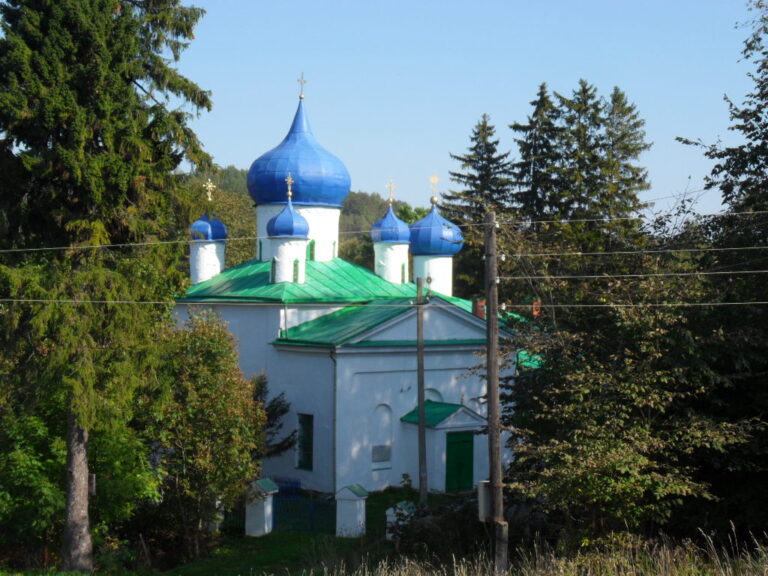
The Intercession Church was built above the cave church in 1758 and 1759, giving the two churches a shared facade. Multicolored Ukrainian-Baroque domes were added above the combined structure in the nineteenth century. Inside the Dormition Church are the reputedly wonder-working Pskovo-Pechersky icon of the Dormition, attributed to the Pskov painter Alexey Maly and donated in 1521, as well as two revered copies of the Tenderness icon from the sixteenth and nineteenth centuries. The church also contains the relics of Cornelius and a sixteenth-century icon of Saint Nicholas with scenes from his life.
Saint Nicholas Gate Church
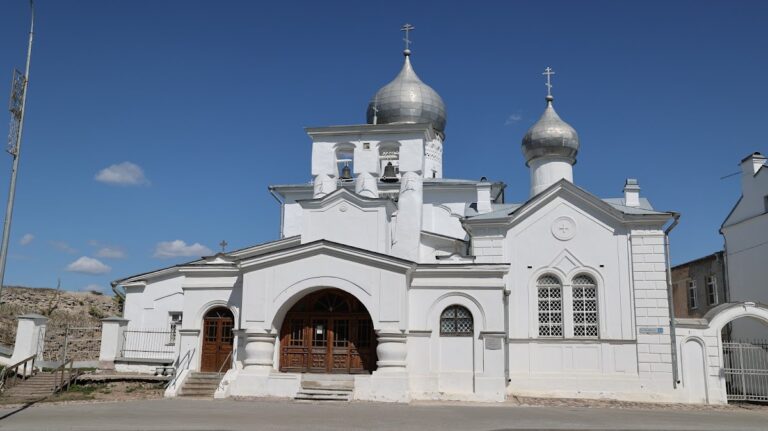
The stone Saint Nicholas Gate Church was built by Pavel Zabolotny in 1564 or 1565, probably as part of the fortress construction. It may originally have been the principal entrance, or Holy Gate, of the monastery. The church shares a roof with the adjacent Nikolskaya Tower, and a wooden sculptural image of Saint Nicholas holding a sword is kept inside. A small bell structure with five bells was associated with the gate complex.
Annunciation and Sretensky Churches
The Annunciation Church was built as a refectory church in 1541. The Sretensky Church was rebuilt in 1870 in the Russian style from the earlier refectory adjoining the Annunciation Church. Its original supporting walls are thought to survive beneath the later decoration. The basement once held a bakery, flour room, treasury, and cabbage cellar; it now includes a reading room and vegetable-storage rooms. The church contains copies of the Three-Handed and Recovery of the Perishing icons, together with a reliquary, a container for sacred relics, holding the relics of Simeon Zhelnin since 2003.
Lazarus Church
The Lazarus Church was built between 1792 and 1800 north of the Dormition Church. It formerly served the monastery hospital. In 1848, after the original superior’s residence burned, the building was converted into the superior’s residence.
Michael Archangel Cathedral
The Michael Archangel Cathedral is the largest building in the monastery. Constructed between 1815 and 1827 in the Classical style, it was designed by the Italian architect Luigi Rusca. Gold-plated metal plaques inside list the commanders and troop strength of the corps led by Field Marshal Count Peter Wittgenstein. The cathedral contains the right hand of Saint Tatiana, transferred there in 1977, and the Pskovo-Pechersky Tenderness icon stands near the right choir.
Later churches
The church dedicated to the Hieromartyr Cornelius occupies the Nikolskaya Tower and was consecrated in 1986. A wooden church dedicated to the Pskovo-Pechersky saints was built on Holy Mountain in 1995. Together with the earlier churches, these buildings express the continuing use of the hill as a religious complex rather than as a monument preserved only in ruins.
Bell tower, treasury, and springs
Great Bell Tower
The Great Bell Tower stands east of the Dormition Church. It is a stone structure made of several pillars aligned from west to east. Construction began in 1523 on the site of an earlier wooden bell tower. Six principal arched openings form its original arrangement, while a seventh opening was added later to create a second level. The monastery’s collection contains more than thirty bells, including the Festive bell, cast in 1690 by the Pskov founder Fyodor Klementyev. Traditional attributions of three large bells to Boris Godunov, Ivan IV, and Peter I are not historically correct.
Great Treasury
The separate Great Treasury is a three-story brick building opposite the Great Bell Tower and adjoining the Sretensky Church. It most probably dates from 1688, after a fire in 1687 and before the beginning of the Great Northern War. A small blue cupola with gold stars crowns the building. Its floors contain storage space, the treasury, and a library. The collection includes gold and silver crosses, jeweled covers and vestments, shrouds, liturgical vessels, and gifts from Russian rulers and emperors.
Holy springs
Two holy springs form part of the monastic complex. The Spring of Saint Cornelius lies opposite the Dormition Church near the treasury. An artesian spring dedicated to the Life-Giving Spring icon lies opposite the Annunciation Church, with a small hexagonal chapel built above it in 1911.
Fortifications
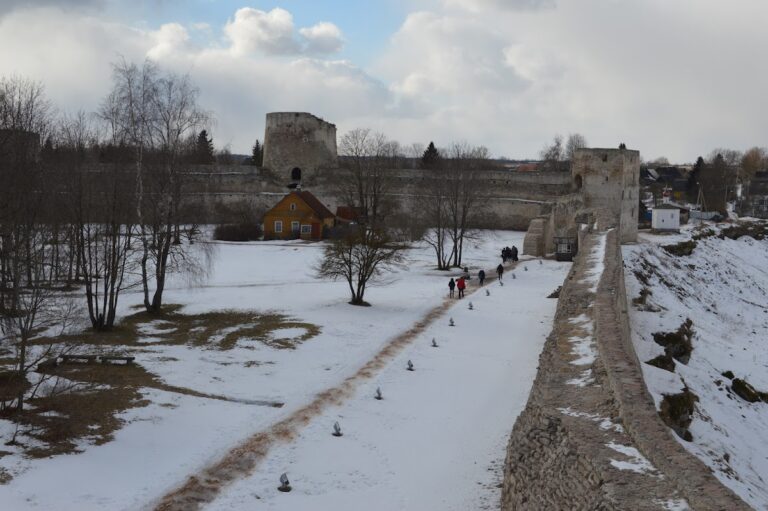
The stone fortress walls were constructed between 1558 and 1565. The original circuit had six towers and three gates, and four additional towers were added later. The present circuit is about 810 meters long and includes nine towers: Petrovsky, Nikolsky, Annunciation, Izborsky, Tylovskaya, Prison, Tararginov, Upper Grilles, and Lower Grilles. The site of the Brusovaya Tower, destroyed in 1581, was later occupied by the Michael Archangel Cathedral.
Entrances and reconstructed walls
The present entrance is at the foot of the seventeenth-century Petrovsky Tower. The original entrance lay beneath the Saint Nicholas Gate Church and passed through a fortified passage known as a zahab, an enclosed approach designed to expose attackers to defensive fire and prevent a direct assault on the gate. After the fire of 1688, the towers and walls remained without roofs until large-scale reconstruction in 1960. Copper roofing was added over the towers and walls during the 1990s.
Upper and Lower Grilles Towers
The Upper Grilles Tower stands in the ravine containing the Kamianets stream. A small stone arch at its base allowed the stream to enter the fortress and could be closed with an iron grille. The tower rises about 25 meters and contains six fighting levels with loopholes and gun chambers, together with a watch platform above.
The Lower Grilles Tower lies farther downstream and closes the northeastern arc of the fortifications. It has four fighting levels with loopholes controlling the approaches and the lower gate. The two towers show how the watercourse and ravine were incorporated into the monastery’s defensive system.
Commemorative monuments
A monument to Cornelius by the sculptor I. V. Golubev was consecrated in 2012. During the anniversary works of 2023, it was replaced by a monument to the Pskovo-Pechersky elders. Additional commemorative monuments and a sculpture of the Archangel Michael were installed near the monastery at the same time.
Nearby sites