Mirozhsky Monastery: A Russian Orthodox Monastic Complex in Pskov
Site at a Glance
- Country
- Russia
- Primary era
- Medieval
- Eras represented
- Medieval, Early Modern, Modern
- Civilizations
- Novgorod Republic, Russian
- Site type
- Religious
- Remains
- Monastery
On this page11 sections
History
Mirozhsky Monastery is a Russian Orthodox monastery in Pskov, Russia, traditionally founded in the mid-12th century and first recorded in 1156. Its exact foundation date is unknown, but tradition associates its establishment with Nifont, bishop of Novgorod. The monastery belonged to the Pskov Diocese, an Orthodox church district under a bishop.
Medieval foundation and cultural life
The monastery grew into a center of learning and artistic work in Pskov. It maintained a library and workshops for copying manuscripts and painting icons. Its copyists helped preserve the Pskov Chronicle, a medieval record of the city’s history, and reproduced The Tale of Igor’s Campaign.
In 1299, Livonian knights, members of Catholic military orders active in the eastern Baltic, burned Mirozhsky and Snetogorsky monasteries during an assault on Pskov’s outer settlement. The attackers killed Mirozhsky’s abbot Basil and Snetogorsky’s abbot Joasaph. Both were later honored as saints in local tradition. Another tradition places Basil’s relics, together with those of the monastery’s first abbot, Abraham, beneath the altar of the Transfiguration Cathedral.
Early modern period
In the early 16th century, Cornelius of Pskov studied at Mirozhsky before becoming a monk at Pskov Caves Monastery. The Mirozh icon of the Mother of God was renowned for miracles by 1567, and tradition dates its miraculous appearance to 1198.
In 1581, Polish king Stephen Báthory positioned cannons on the monastery’s bell tower and fired on Pskov. The monastery also held extensive property, including land in the Mirozha River floodplain, mills, forges, and agricultural holdings along the Velikaya River. Its estate contracted after Catherine the Great’s government secularized church lands in the 18th century, leaving it close to its present extent.
Dispersal and revival
After the 1917 Revolution ended imperial rule in Russia, the monastic community dispersed and a Pskov excursion station occupied the site. The monastery was formally abolished in 1922. Flooding affected the complex in 1886, 1900, 1928, 1960, and 2011. On 9 April 2011, water from the Mirozha and Velikaya rivers rose to a metre inside Saint Stephen’s Church and began entering the Transfiguration Cathedral; emergency crews pumped water from the buildings.
Monastic life began to return in 1994, when Saint Stephen’s Church, the brethren’s building, and the abbot’s house were leased to the Pskov Diocese. An international icon-painting school was established under Archimandrite Zinon, a senior Orthodox monk. After he permitted Catholics to worship at the monastery and received communion with them, church authorities disciplined him, including barring him from priestly service. Metropolitan Eusebius consecrated the school in 1997. In 2010, the monastery buildings and grounds, apart from the Transfiguration Cathedral and small cells, passed to the Russian Orthodox Church for use. A children’s icon-painting school opened the following year.
The ensemble received state protection as a monument of republican significance in 1960. In 2019, the Transfiguration Cathedral joined UNESCO’s World Heritage listing for the Churches of the Pskov School of Architecture. The cathedral now serves as a museum, with worship on certain feast days, while regular services take place in Saint Stephen’s Church.
Remains
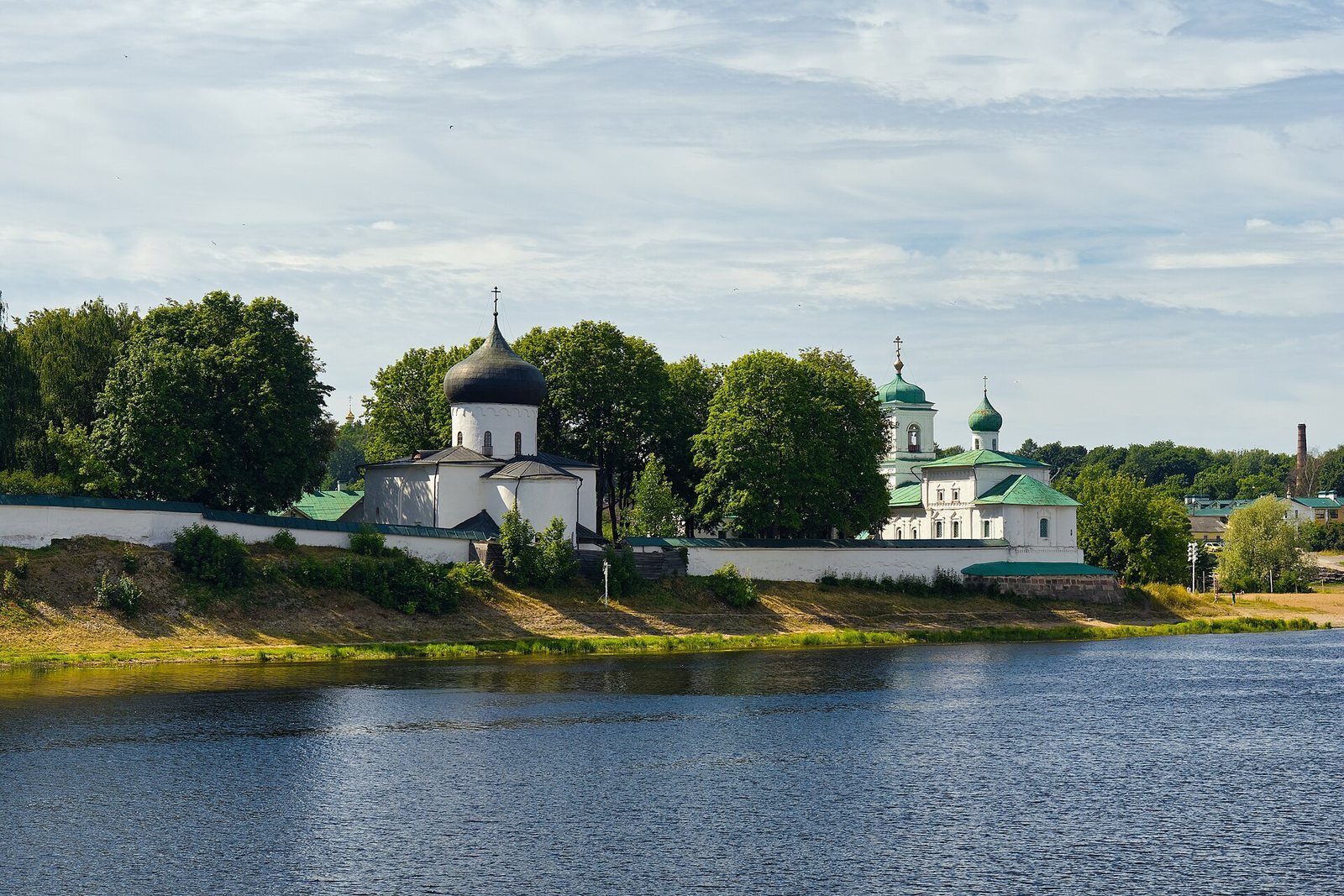
The monastery stands where the Mirozha meets the Velikaya River. Its surviving buildings include the Transfiguration Cathedral, the abbot’s house, Saint Stephen’s Church, the brethren’s building and cells, a bathhouse, and an enclosure wall measuring 400 metres. The abbot’s house dates from the 16th to 19th centuries; Saint Stephen’s Church from the 17th century; the brethren’s building from the late 18th to 19th centuries; and the cells from the 17th to 19th centuries. The wall was built between 1799 and 1805, and the bathhouse dates to the early 19th century.
Transfiguration Cathedral
Plan and construction
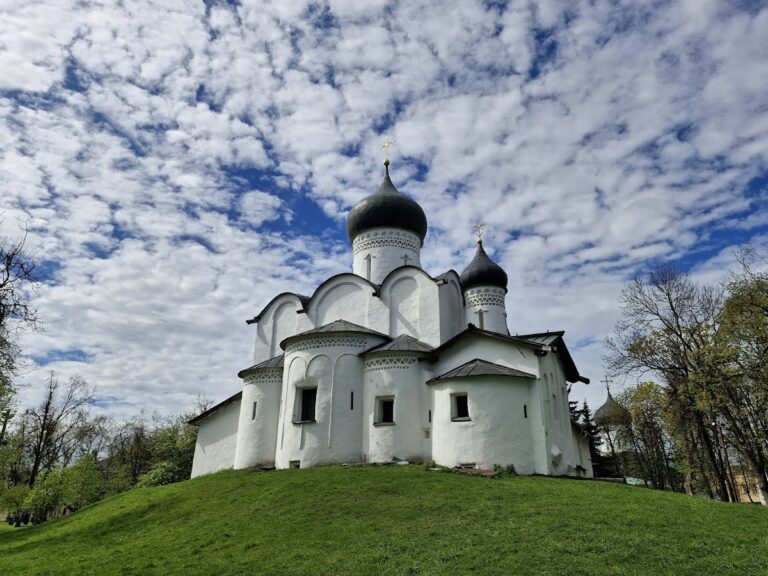
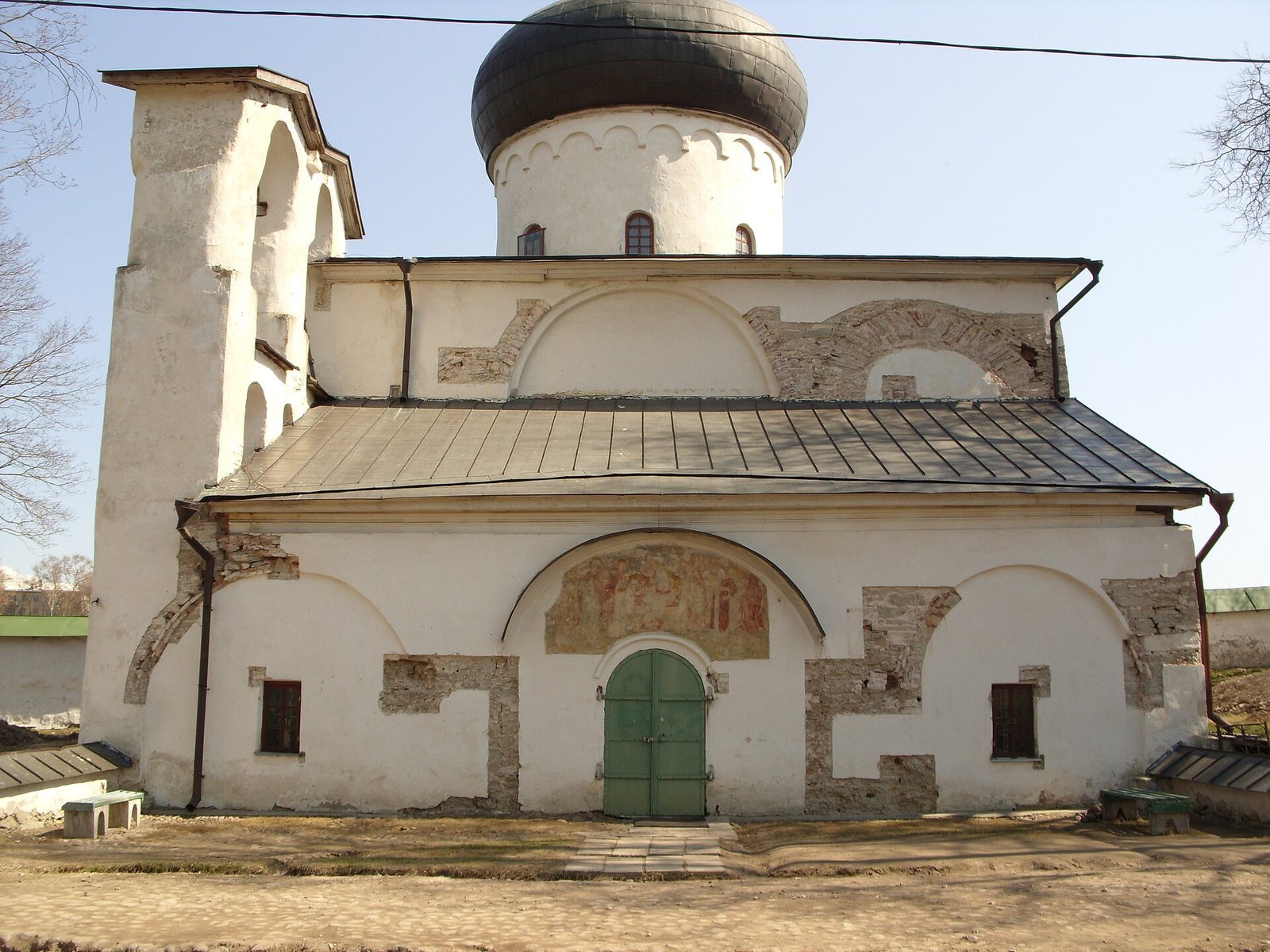
Built of thin, flat plinth brick and stone before 1156, the cathedral is a cross-domed church, with a central space arranged around a cross-shaped plan and covered by a dome. Its original central volume formed an equal-armed cross. At the east, a rounded apse enclosed the altar; two low rectangular spaces adjoined the western corners, while smaller apses projected from the eastern corners. Additions above the western corners were part of the initial construction, and later rebuilding altered the original design. The building remains one of Pskov’s two surviving pre-Mongol structures, from the period before the Mongol invasions of Rus’ in the 13th century, and exemplifies a distinctive type of early Russian architecture.
Frescoes and conservation
The cathedral’s frescoes, or paintings made on plaster, were executed from the upper parts of the building downward in the 1130s and 1140s by artists from Greece whose names are unknown. Their unified design and exceptional preservation distinguish the cycle, whose style has been compared with 12th-century Byzantine mosaics in Sicilian churches. The painted ensemble also contains work from later periods, extending into the early 20th century.
Whitewashing in the 17th century helped protect the medieval paintings. Vladimir Suslov and his pupils uncovered them beneath plaster in the late 19th century. In 1900–1901, a team led by Nikolai Sofonov cleaned the medieval work and added glue-based paint in an archaizing style, retaining its original imagery. Further uncovering began in the 1920s. During restoration in the 1970s, conservators consolidated damaged areas with concentrated egg-yolk emulsion, toned surfaces, and removed some of Sofonov’s repainting.
Saint Stephen’s Church
Church structure and lower level
Saint Stephen’s is a gate church built above a basement level, on the site of an earlier church dating to 1406. Columns with ring-shaped bands and pediments frame its windows and doors. The lower level houses an exhibition of contemporary icons, and the church’s icon-bearing screen, or iconostasis, consists of fresco paintings by Archimandrite Zinon.
Icons and relics
A 1998 copy of the Mirozh icon of the Mother of God is kept in the church. It shows the Virgin standing with raised hands in prayer, flanked by the Pskov prince Dovmont and his wife, Maria Dmitrievna. The original is held by the Pskov Museum, while an earlier copy dating to 1583 belongs to the Pskov State Museum-Reserve. Other venerated objects include a 19th-century icon of Saint Panteleimon brought from Mount Athos, icons of the Mother of God of Tikhvin and Nicholas the Wonderworker, and fragments of relics associated with many saints.