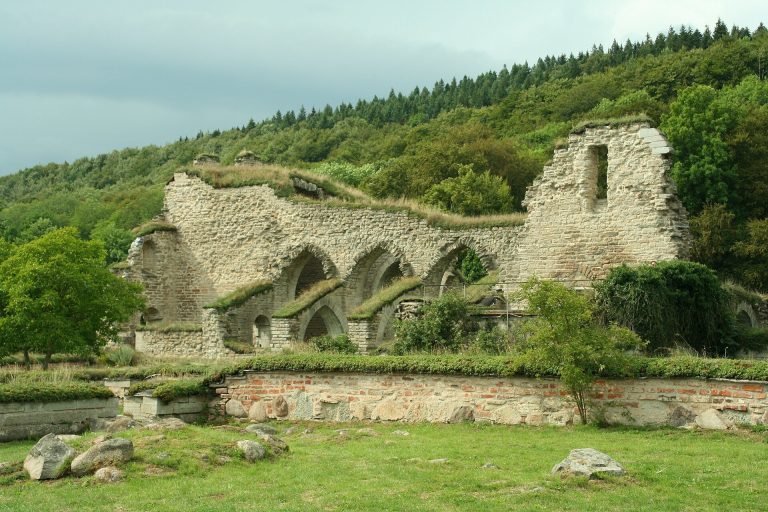
Gudhem Abbey: A Medieval Nunnery in Sweden


Site at a Glance
- Rating
- 4.4
- Popularity
- Low
- Country
- Sweden
- Primary era
- Medieval
- External website
- Open
- Eras represented
- Medieval
- Civilizations
- Swedish
- Site type
- Religious
- Remains
- Monastery
On this page6 sections
History
Gudhem Abbey is the ruin of a medieval nunnery in Sweden, outside Falköping, established in 1152 and built before 1175. It began as a Benedictine community, following the Rule of Saint Benedict, and later became Cistercian under the supervision of nearby Varnhem Abbey. Gudhem is regarded as one of Sweden’s oldest convents, after Vreta Abbey, founded around 1100, and Alvastra Abbey, founded in 1143.
Before and during the foundation
The name Gudhem means “Home of the Gods,” and tradition held that the place had been sacred before Christianity. One saga says that one hundred images of the thunder god Thor were placed there. Another popular legend attributes the abbey’s foundation to 1052 and to Gunnhildr Sveinsdóttir, the queen dowager of Sweden and Denmark. According to the story, she retired to Gudhem after her marriage to King Svein II of Denmark was annulled. The historically supported foundation date is 1152, a century later.
During the reign of Charles VII of Sweden, from 1161 to 1167, the royal estate of Gudhem Manor was donated to the newly established nunnery. The community became particularly prestigious during the 13th century and was responsible for offering hospitality to pilgrims travelling to Nidaros, the medieval pilgrimage centre at present-day Trondheim in Norway associated with the shrine of Saint Olav.
Royal patronage and expansion
Catherine of Ymseborg, queen consort of Sweden from 1244 to 1250 as the wife of King Eric XI, later entered the community and became abbess of Gudhem Abbey. She donated her extensive estates to the abbey. After her arrival, the monastery complex was expanded, while the monastic church was remodeled, enlarged, and given elaborate stonework.
Reformation and abandonment
During the Swedish Reformation, the abbey was confiscated by the Crown in 1527 under the reduction of Gustav I of Sweden. It was soon granted as a fief to the nobleman Nils Olofsson. The former nuns received allowances from the abbey’s former properties and were allowed to remain in the buildings for life.
The abbey burned in 1529. The last abbess requested that it be reconstructed, but the request was refused, and the nuns were housed by surrounding peasants. Former nuns were still receiving allowances in the area in 1540. The abbey was never rebuilt, and its ruins were later used as a quarry, including for the expansion of a nearby royal estate.
Excavation and conservation of the monastic ruins took place between 1928 and 1969, preserving the surviving remains and clarifying the character of the former nunnery.
Remains
The site consists of the excavated ruins of the former nunnery immediately beside Gudhem Church near Gudhem, in the Falbygden area of Västergötland. The monastery buildings were enlarged during the medieval period, and the monastic church was remodeled, extended, and decorated with selected stonework. The ruins were conserved during the archaeological work carried out from 1928 to 1969.
Gudhem Church
Gudhem Church stands beside the former abbey and was originally built between 1160 and 1200, after the abbey’s foundation. It remained substantially in its original condition until the 1560s, when it was looted and burned. In 1703, its tower chamber was converted into a sacristy, and the church was extended eastward between 1811 and 1815.
The present tower dates from extensive restoration in 1900. The church was restored again in 1897–1900, and its interior was restored in 1951–1952. In 1979, it was remodeled with a new sacristy. During the restoration of 1999–2000, the barrel vault was removed, the altar was lowered, and the interior was repainted in warm colours. Some decorative painting was reproduced from its original patterns and colours.